


For much of evolutionary history, the dominant reproductive strategy across the animal kingdom was straightforward and detached: organisms produced offspring and immediately left them to fend for themselves, relying purely on the laws of probability for species survival. Over millions of years, however, a profound behavioral shift occurred. Complex forms of parental care emerged, ranging from birds nesting and protecting fragile eggs to mammals nourishing their young with milk, and social insects tending meticulously to developing larvae. How these sophisticated nurturing behaviors evolved from ancestors that offered little or no parental investment has long remained one of evolutionary biology’s most compelling mysteries.
A landmark study published in the journal Nature sheds new light on this evolutionary transition, offering concrete evidence that nature did not invent entirely new neural systems from scratch to facilitate parenting. Instead, researchers discovered that evolution repurposed ancient, pre-existing brain pathways that originally governed hunger and feeding, adapting them to drive social care. By examining the brain chemistry of clonal raider ants, scientists have mapped a chemical bridge between the primal drive to feed oneself and the selfless drive to nurture offspring.
The Research Model: Why Clonal Raider Ants Hold the Key
Investigating the neurological roots of parenting has historically presented a major methodological hurdle for neuroscientists. Model organisms traditionally favored in laboratory settings—such as fruit flies (Drosophila melanogaster) and roundworms (Caenorhabditis elegans)—exhibit virtually no parental care, making them ill-suited for studying the evolution of nurturing behavior. Conversely, mammals like mice provide extensive and complex parental care, and scientists have successfully identified several neuropeptides involved in these interactions. However, the mammalian brain is immensely complex, boasting roughly 100 million cells in a mouse, which obscures the precise mapping of underlying neural circuits.
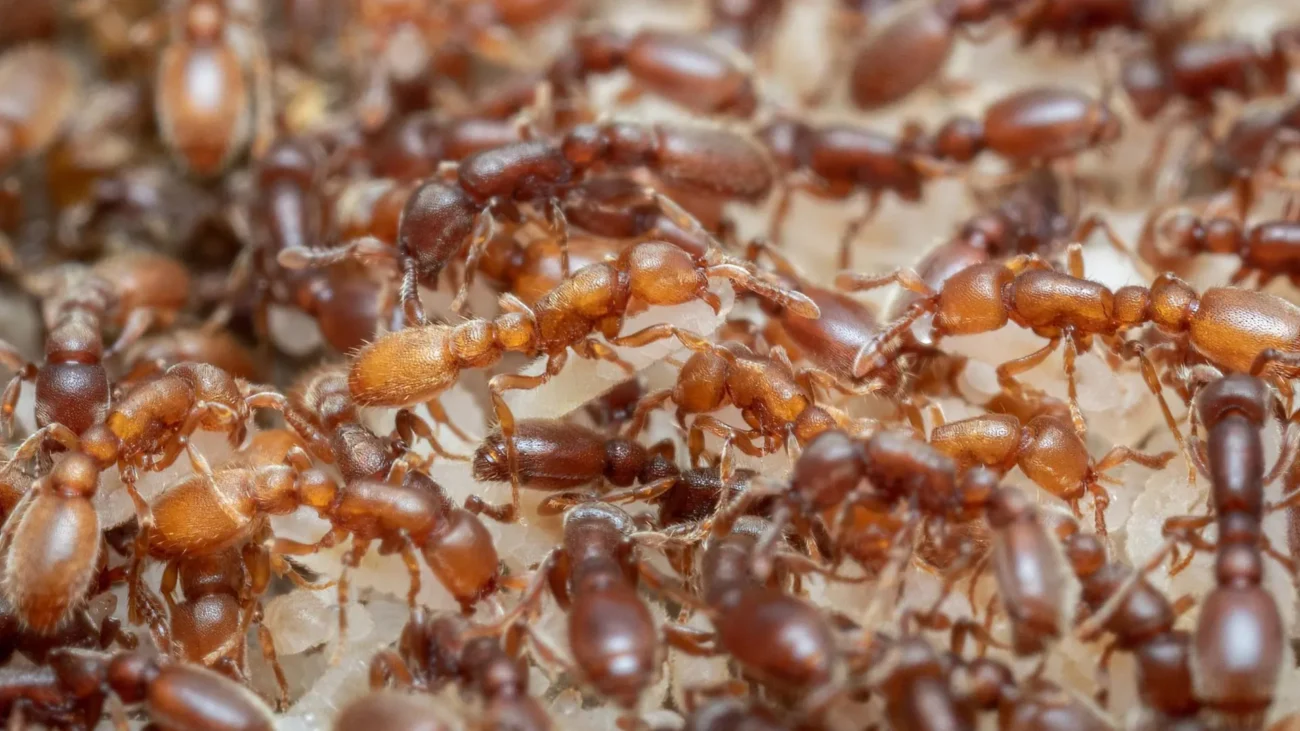
Enter the clonal raider ant (Oerapheidole or similar clonal lineages, studied extensively in laboratory environments). The ant brain contains a manageable total of approximately 60,000 cells. This compact neurological architecture allows researchers to examine underlying neural circuits in granular detail and at an accelerated pace compared to mammalian models. Furthermore, ants share related brain signaling systems with mammals that regulate caregiving, and they undergo a predictable behavioral transition as they age. Younger ants remain inside the nest to care for vulnerable larvae, while older ants transition to foraging outside the nest for food. This natural division of labor based on age makes clonal raider ants an ideal living laboratory for studying both the evolution of parenting and the mechanisms of healthy brain aging.
Mapping the Ant Neuropeptidome: A Chronology of Discovery
The path to these recent findings required years of meticulous biochemical mapping and behavioral tracking. The research team, spearheaded by scientists at The Rockefeller University, constructed an automated behavioral monitoring system capable of housing individual ants with individual larvae. This high-throughput technological setup enabled the team to simultaneously record and analyze hundreds of individual caregiving interactions under controlled laboratory conditions.
Following the setup of the automated behavioral tracking, the researchers undertook the arduous task of identifying and synthesizing the complete set of chemical messengers present in the ant brain—a catalog known as the neuropeptidome. Through intensive biochemical analysis, the team successfully annotated 70 distinct neuropeptides. With this comprehensive chemical library in hand, the scientists systematically tested each molecule to observe whether and how it altered the caregiving behaviors of the insects.
To test the hypothesis that these caregiving pathways remained tethered to ancient feeding circuitry, the researchers compared the neurological profiles of well-fed ants with those of food-deprived ants. They tracked where the most promising signaling molecules were produced, measured how their concentrations fluctuated across an ant’s lifespan, and experimentally manipulated the activity levels of these molecules to observe direct behavioral changes.
Two Master Molecules: Neuropeptide F and Allatostatin A
The biochemical experiments revealed that ant caregiving is governed closely by ancient brain systems originally evolved to regulate hunger. Specifically, two distinct signaling molecules were identified as playing opposing, decisive roles in driving ant behavior: Neuropeptide F (NPF) and Allatostatin A (AstA).
Depending on the ant’s age and internal metabolic state, these two molecules act as a biological toggle switch. Neuropeptide F was found to actively encourage ants to tend to and care for larvae. In sharp contrast, Allatostatin A suppressed nurturing behavior, prompting ants to abandon the larvae and venture outside the nest to forage.
The concentrations of these molecules aligned perfectly with the natural division of labor observed in ant colonies. Young ants naturally exhibited significantly higher levels of NPF and lower levels of AstA in critical regions of the brain. As the ants aged, their neurochemical profile inverted: NPF levels declined while AstA levels rose, mirroring the insects’ behavioral transition from indoor nurses to outdoor foragers. When researchers artificially manipulated the activity of either molecule, the ants immediately altered their behavior, proving that these neuropeptides were not mere biomarkers of age, but active causal drivers of nurturing versus foraging actions.
The Hunger Connection: Bridging Nourishment and Parenting
Perhaps the most revealing aspect of the study was the discovery that these exact same neuropeptides respond directly to metabolic hunger, linking parental care directly back to nutritional homeostasis.
When researchers subjected ants to food deprivation, the starving insects experienced a marked increase in NPF and a decrease in AstA. Consequently, these hungry ants began to behave more like devoted caregivers, focusing their attention on the brood. Once the ants were fed, their internal chemical balance reversed; the drive to nurture subsided, and their inclination to forage for sustenance returned.
"We learned that parental behaviors build on the neural circuitry for feeding, and that makes some sense," notes Daniel Kronauer, head of the Laboratory of Social Evolution and Behavior at Rockefeller University. "Parental behavior is a lot about feeding—not just yourself, but your offspring."
This discovery provides empirical weight to the theory that parental care evolved by co-opting ancient biological networks designed to locate, evaluate, and consume food. Instead of engineering an entirely novel neurological framework for family dynamics, evolution expanded the scope of feeding behavior, transforming a mechanism meant strictly for self-preservation into an impulse to nourish dependent offspring.
Implications for Mammalian Biology and Human Evolution
While the immediate experiments were conducted on insects with microscopic brains, the broader implications of the research extend deep into mammalian biology, including human health and behavior. Mammals utilize analogous neuropeptide signaling systems when caring for their young. The discovery that distinct animal lineages separated by hundreds of millions of years of divergent evolution rely on similar chemical blueprints suggests that evolutionary pathways are far more constrained than previously assumed.
"It amazes me that similar parenting behaviors have evolved so many times in so many distinct animal lineages," observes Kay, a key contributor to the research effort. "Our paper suggests that the evolutionary routes to these sorts of behaviors are far more constrained than we may have naively imagined. That’s very exciting, because it may eventually lead to a blueprint of how these complex social behaviors evolve."
By mapping the specific neural circuits influenced by NPF and AstA in ants, scientists hope to establish a comparative framework. This cross-species mapping could eventually reveal whether similar neurochemical adaptations underlie parental bonding and social attachment in mammals, offering a unified model for the evolution of social care.
Unlocking the Mysteries of Healthy Brain Aging
Beyond the insights into parenting, the clonal raider ant model offers a powerful new lens through which to study neurobiology across the lifespan. Modern biomedical research is heavily weighted toward investigating late-stage neurodegenerative disorders, such as Alzheimer’s disease and other forms of dementia. As a result, neuroscientists possess a wealth of data on pathological brain decline, yet understand remarkably little about the subtle, gradual neurochemical shifts that occur within a healthy brain across a normal lifespan.
Because age-related behavioral transitions are structurally vital to the survival of an ant colony, colonies provide a naturally occurring system for observing how brain chemistry continuously reshapes social roles and cognitive proclivities over time. The researchers suspect that the neuromodulatory mechanisms driving age-dependent behavioral changes in ants operate similarly across the animal kingdom.
"There’s a lot of research and funding invested in studying late-stage neurodegenerative diseases, but we actually know very little about how the brain changes throughout the normal healthspan of an individual," Kronauer remarks, emphasizing the broader applicability of the work. "In ant colonies, these dynamics are central to the organization of the society. Our discovery provides a striking demonstration that neuromodulators can produce age-dependent changes in behavioral proclivities in ants, and I suspect that that’s the case in other animals as well, including in humans."
As scientists continue to untangle the complex web of neuropeptides governing social insects, this research marks a vital step forward. By demonstrating how nature recycles its oldest chemical tools to build its most complex social bonds, the study bridges the gap between basic entomology and the fundamental questions of mammalian evolution, behavior, and healthy aging.

