


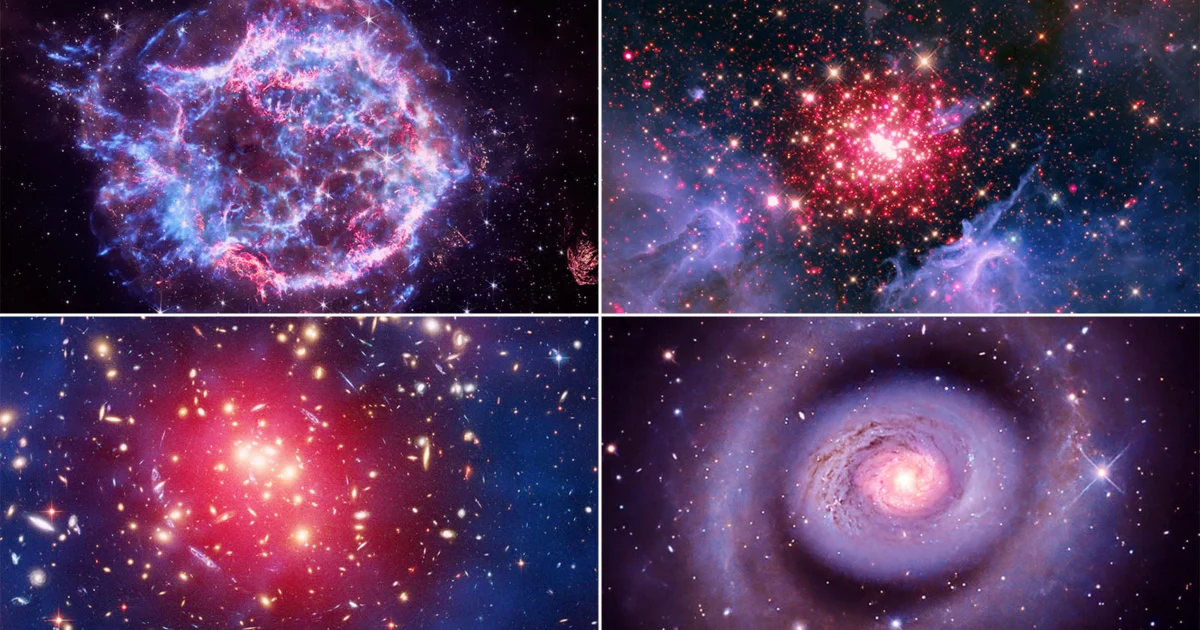
In a grand celestial tribute to the United States of America’s upcoming 250th anniversary, the National Aeronautics and Space Administration (NASA) has released a stunning quartet of images captured by the Chandra X-ray Observatory. These composite images, meticulously rendered in patriotic hues of red, white, and blue, showcase the structural complexity and violent beauty of the cosmos. By blending high-energy X-ray data with infrared and optical observations from other premier telescopes, NASA has provided a unique perspective on four "wonders of the Universe," highlighting the nation’s enduring commitment to space exploration and scientific discovery.
The release serves as a milestone for the Chandra X-ray Observatory, which has been a cornerstone of NASA’s "Great Observatories" program for over two decades. The images—featuring a supernova remnant, a massive star-forming region, a spiral galaxy, and a distant galaxy cluster—demonstrate the synergy between different wavelengths of light and the critical role that X-ray astronomy plays in understanding the most energetic processes in space.
A Synthesis of Cosmic Wavelengths: The Four Wonders
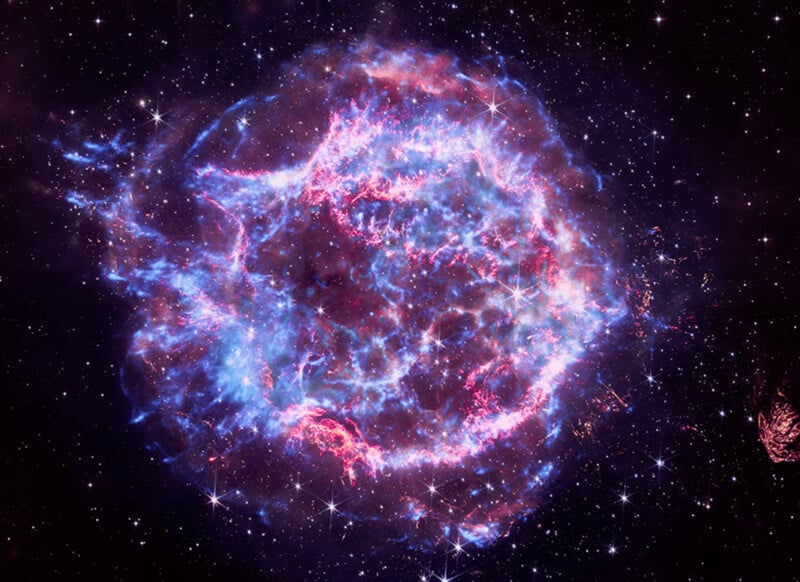
The first of the four featured celestial objects is Cassiopeia A (Cas A), one of the most well-studied supernova remnants in our galaxy. Located approximately 11,000 light-years away, Cas A is the debris field of a massive star that exploded. In this new commemorative rendering, NASA has combined Chandra’s X-ray data, shown in deep blues and purples, with infrared data from the James Webb Space Telescope (JWST), displayed in reds and whites.
Chandra’s contribution to the Cas A image is vital for visualizing the invisible. Its "X-ray vision" captures the intense blast wave produced by the explosion, which continues to tear through the surrounding interstellar medium at millions of miles per hour. Furthermore, the X-ray data identifies specific chemical elements forged in the heart of the dying star, such as iron, calcium, and oxygen. Meanwhile, the JWST data provides a look at the cooler dust and gas, revealing the intricate, expanding shell of material that remains as a testament to the star’s violent end.
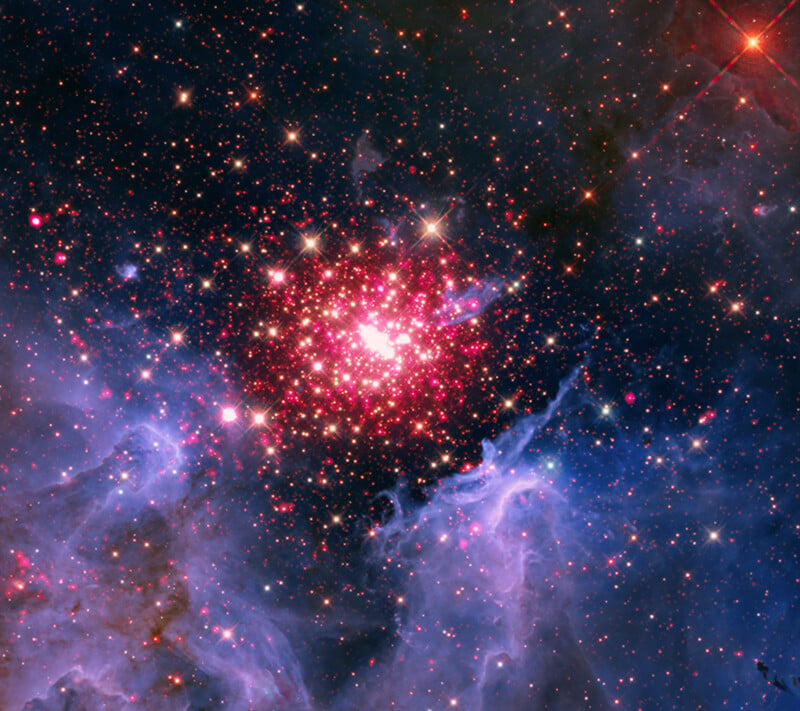
The second image depicts NGC 3603, a region located in the Carina spiral arm of the Milky Way. Described by astronomers as a "colossal and brilliant star factory," NGC 3603 is one of the most massive young star clusters in our galaxy. To create this portrait, scientists merged X-ray data from Chandra with optical data from the Hubble Space Telescope. Hubble’s sensors captured the majestic, towering pillars of gas and dust—cradles for future stars—while Chandra’s X-ray instruments pierced through the obscures to reveal a "sparkling swarm" of young, massive stars. These stars emit high-energy X-rays as they interact with their environment, providing scientists with a map of the cluster’s most active stellar inhabitants.
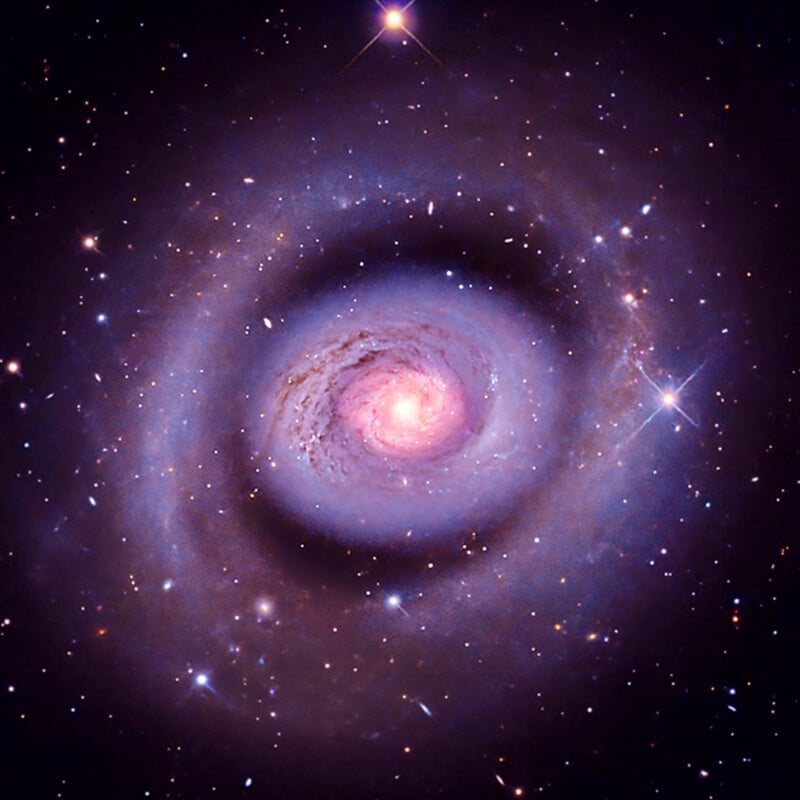
The third feature is Messier 94 (NGC 4736), a spiral galaxy located roughly 16 million light-years from Earth. This image is particularly noteworthy for its inclusion of data from citizen scientists. While Chandra provided the X-ray wavelengths (mapped to red, orange, and blue), the visible light data was captured by amateur astronomers using ground-based telescopes. Messier 94 is characterized by a distinctive "starburst ring"—a bright inner circle where star formation occurs at an accelerated rate. The combination of ground-based and space-based data highlights the collaborative nature of modern astronomy, where professional and amateur observations converge to create a complete picture of galactic evolution.
Rounding out the collection is ZwCL 0024+1652, a massive and distant galaxy cluster. This image represents the largest scale of the quartet, showcasing a region of space where hundreds or even thousands of galaxies are bound together by gravity. Astronomers have used this cluster to find significant evidence of dark matter, the mysterious substance that makes up the majority of the Universe’s mass but does not emit light. The composite image uses Chandra data (in red) to show a reservoir of superheated gas that fills the space between galaxies, while Hubble data (in blue, yellow, and white) maps the galaxies themselves and the effects of gravitational lensing used to detect dark matter.
The Legacy of the Chandra X-ray Observatory
The release of these images comes at a pivotal time for the Chandra X-ray Observatory. Launched on July 23, 1999, aboard the Space Shuttle Columbia (STS-93), Chandra was designed to detect X-ray emissions from extremely hot regions of the Universe. Unlike visible light, which can be blocked by cosmic dust, X-rays can pass through dense clouds, allowing astronomers to observe the immediate surroundings of black holes, the remnants of exploded stars, and the vast clouds of hot gas in galaxy clusters.
Over its 25-year tenure, Chandra has revolutionized our understanding of high-energy astrophysics. It has provided the first definitive evidence of a supermassive black hole at the center of the Milky Way (Sagittarius A*) and has tracked the distribution of dark matter in colliding galaxy clusters. The observatory is named after Subrahmanyan Chandrasekhar, the Nobel Prize-winning Indian-American astrophysicist whose work on the maximum mass of white dwarf stars laid the foundation for our understanding of stellar evolution and black holes.
Technical Innovation: Data Sonification
In addition to the visual feast, NASA has released "sonifications" for three of the four images. Sonification is a process that translates digital data into sound, allowing the public—including the blind and visually impaired community—to experience the wonders of the Universe through audio.
In these sonifications, the brightness and position of the data points dictate the pitch and volume of the sounds. For example, in the sonification of a spiral galaxy, the "playhead" might move in a circle starting from the center, with the sounds changing as it passes through the starburst ring and the outer spiral arms. This technique is more than just an artistic interpretation; it is a novel way for researchers to identify patterns in complex datasets that might be missed by the human eye. By converting the "red, white, and blue" data into an auditory landscape, NASA continues to push the boundaries of how scientific information is communicated and consumed.
Chronology of the Project and National Context
The development of this commemorative set follows a long tradition of NASA celebrating national milestones through astronomical imagery.
- 1999: Chandra is launched, beginning its mission to map the X-ray sky.
- 2021-2022: The James Webb Space Telescope begins its mission, providing the infrared data necessary for the Cas A composite.
- 2023-2024: NASA’s Universe of Learning program begins coordinating with citizen scientists to incorporate ground-based data for Messier 94.
- July 2024: NASA officially unveils the "250th Anniversary" collection, aligning with the lead-up to the United States’ Semiquincentennial in 2026.
This initiative is part of a broader effort to highlight the "Great Observatories" and their collective power. By combining the strengths of Chandra (X-ray), Hubble (Visible/UV), and Webb (Infrared), NASA demonstrates a "multi-wavelength" approach to science. This synergy is essential because each telescope sees a different "slice" of reality; only by layering these slices can scientists understand the full physical story of a celestial object.
Broader Implications and Scientific Analysis
The scientific implications of these images extend beyond their aesthetic appeal. The data represented in the Cas A image, for instance, helps researchers model the "nucleosynthesis" that occurs during a supernova—the process that creates the heavy elements necessary for life, such as the iron in our blood and the calcium in our bones.
Furthermore, the study of galaxy clusters like ZwCL 0024+1652 is fundamental to cosmology. By measuring the temperature and distribution of the X-ray-emitting gas, scientists can calculate the total mass of the cluster. When this is compared to the visible mass of the galaxies, the discrepancy points directly to the presence of dark matter. These observations are critical for refining the "Standard Model" of cosmology, which describes the origin and evolution of the Universe.
However, the release also serves a strategic purpose. In recent years, the astrophysics community has expressed concern over potential budget cuts to long-running missions like Chandra. By showcasing the observatory’s continued relevance and its ability to work in tandem with newer flagship missions like the James Webb Space Telescope, NASA makes a public case for the continued operation of its aging but highly capable fleet. These images remind the public and policymakers alike that the "old guard" of space telescopes still has much to teach us.
Conclusion
NASA’s release of these four cosmic wonders in red, white, and blue is a testament to the intersection of national pride and scientific achievement. As the United States approaches its 250th year, the Chandra X-ray Observatory remains a vital tool in humanity’s quest to map the unknown. Through the synthesis of X-ray, infrared, and optical data, and the innovative use of sonification, NASA continues to make the mysteries of the deep Universe accessible to all. These images are not merely photographs; they are maps of the fundamental forces that shape our existence, captured by a mission that continues to redefine the boundaries of human knowledge.

