


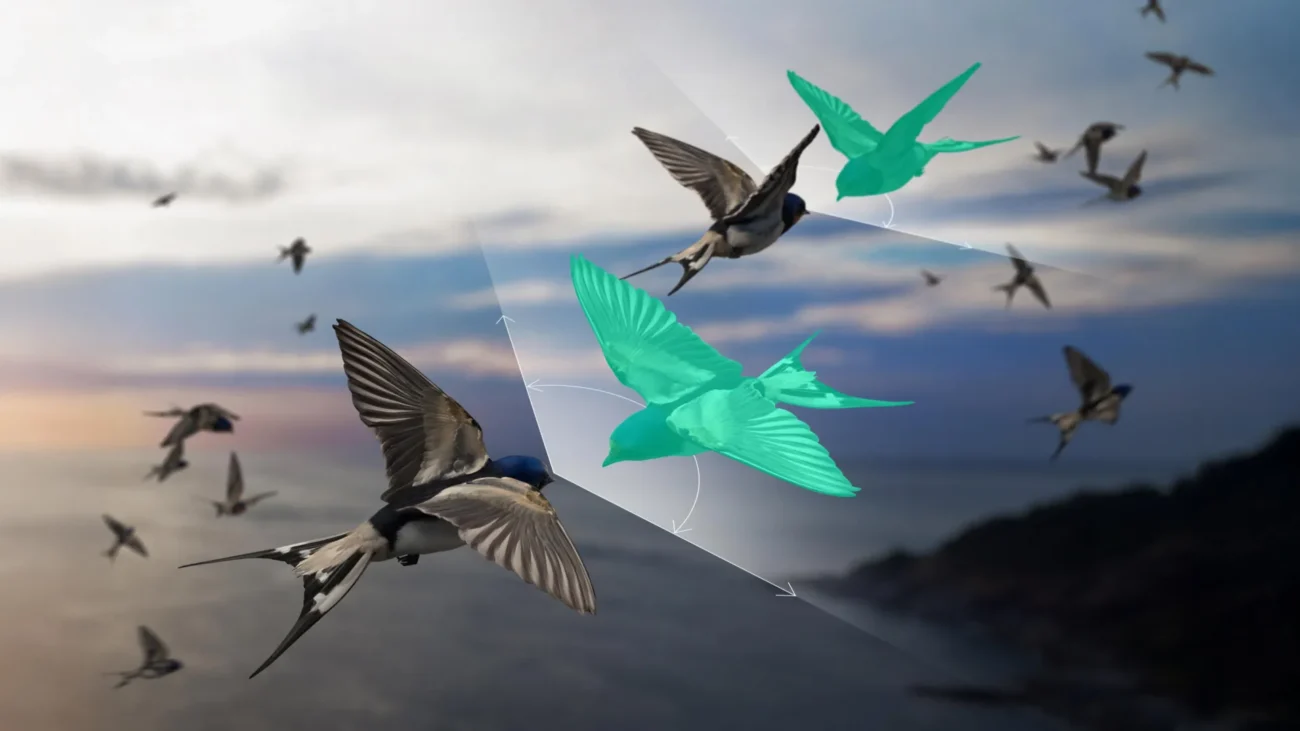
A groundbreaking theoretical advancement is poised to revolutionize our understanding of collective behavior in both the natural and physical worlds. Researchers have successfully developed a novel mathematical framework that allows for the precise simulation and analysis of systems where traditional laws of physics, specifically Newton’s third law of motion, appear to break down. This breakthrough, detailed in a recent publication in the prestigious journal Nature Physics, offers a powerful new lens through which to study phenomena ranging from the intricate movements of bird flocks to the complex dynamics of quantum matter.
For over three centuries, Newton’s third law, the principle of action and reaction, has been a cornerstone of classical physics. This law states that for every action, there is an equal and opposite reaction. It elegantly explains how objects move, from a runner pushing off the ground to a rocket expelling fuel. However, observations in various natural systems have long presented a puzzle: groups of individuals, whether biological or inanimate, often exhibit collective behaviors that do not adhere to this fundamental reciprocity.
The Paradox of Non-Reciprocity
The conundrum arises when individual components within a system react to only a portion of their environment, rather than the entirety of it. A prime example, as highlighted by the research, is the flight of bird flocks. While individual birds possess a wide field of vision, their flocking behavior suggests a focused attention primarily on their immediate neighbors – those to the sides and ahead. Birds in the rear of the flock do not appear to exert a direct, equal, and opposite force that influences the birds in front, a departure from the expected action-reaction balance.
This apparent deviation from Newton’s third law is not confined to avian aerial acrobatics. Similar patterns of non-reciprocal interaction are observed in bacterial swarms, where individual bacteria respond to local chemical gradients rather than a global force, and in human crowds, where individuals react to those around them rather than being influenced by a uniform, opposing force. Even at the cellular level, groups of cells within living tissues can exhibit emergent properties that defy simple reciprocal interaction models.
Historically, physicists have grappled with these "non-reciprocal interactions" because traditional theoretical models were meticulously designed for reciprocal systems. The inability to accurately simulate these systems has posed significant challenges in fields as diverse as biology, where understanding cellular migration and disease spread is crucial, and engineering, where designing efficient collective robotic systems is a growing area of interest. The lack of precise predictive tools has hampered progress in understanding the fundamental mechanics driving these complex collective phenomena.
A Breakthrough in Theoretical Modeling
The team of physicists, led by Roderich Moessner at the Max Planck Institute for the Physics of Complex Systems in Dresden and affiliated with the Würzburg-Dresden Cluster of Excellence ctd.qmat, has now provided a robust solution. Their work, building upon years of research into complex systems, introduces a novel theoretical framework that effectively bridges the gap between traditional physics and the perplexing realm of non-reciprocity.
"Whatever we normally teach our students in theoretical mechanics, it ultimately rests on the action-reaction principle," explains Marin Bukov, a leader within the research group. "Our new theory makes much of what we teach our students applicable to non-reciprocal systems as well. These systems, where Newton’s third law does not apply, can now finally be described exactly and simulated precisely – even using established methods. This is exactly the kind of tool that has been missing in recent years."
The core of their innovation lies in extending the established action-reaction framework by introducing "artificial variables." These variables are not direct representations of physical properties like position or velocity, which are typically used to describe natural systems. Instead, they serve as mathematical constructs that enable the transformation of inherently non-reciprocal interactions into a form that can be analyzed using the well-established mathematical tools designed for reciprocal systems.
The Ingenious Addition of "Imaginary" Partners
To illustrate their approach, the researchers often use the metaphor of an "imaginary bird." When simulating the movement of a flock, instead of directly modeling the complex, one-way influences between real birds, their theory posits the existence of a fictitious partner for each real bird. This imaginary partner is placed in an "aligned in exactly the opposite direction," effectively creating a reciprocal interaction within the mathematical model.
Ricard Alert, a biophysicist and colleague of Bukov, elaborates on this ingenious strategy: "The trick behind the new theory is that it constructs a partner for each component of the system – a fictitious partner that doesn’t exist in nature. The original non-reciprocal interactions are replaced by reciprocal interactions with these auxiliary degrees of freedom."
These imaginary partners are not meant to represent physical entities. They are purely mathematical devices that allow the complex, imbalanced forces observed in non-reciprocal systems to be re-framed as balanced, reciprocal forces within the simulation. This re-framing is critical because it allows researchers to leverage the vast array of existing, sophisticated algorithms and mathematical techniques developed over decades for analyzing reciprocal systems.
A New Era for Complex Systems Research
The implications of this breakthrough are far-reaching. By enabling precise simulations, the new framework promises to unlock deeper insights into a multitude of phenomena:
- Biological Systems: Understanding how cells migrate during development and wound healing, how pathogens spread within populations, and how animal groups coordinate their movements for foraging or predator evasion. For example, in studying disease transmission, the ability to accurately model how individuals in a crowd react to those immediately around them, rather than a generalized threat, could lead to more effective public health strategies.
- Crowd Dynamics: Predicting crowd behavior during emergencies, optimizing pedestrian flow in urban environments, and understanding the emergent patterns of social movements. The ability to simulate non-reciprocal crowd behavior could inform urban planning and disaster response protocols, potentially saving lives by anticipating panic or bottlenecks.
- Materials Science and Quantum Physics: Exploring novel quantum phenomena where particles exhibit non-reciprocal interactions, leading to new forms of collective quantum behavior. This is a particularly exciting frontier, as highlighted by Moessner.
"In Würzburg and Dresden, we study quantum matter whose particles interact under certain conditions in ways that give rise to new phenomena such as magnetism or lossless current transport," says Moessner. "The exciting question now is whether these exceptions to Newton’s law lead to entirely new forms of collective quantum behavior. We still know very little about this – and that is precisely what makes this so fascinating."
The application of auxiliary degrees of freedom is not entirely new in physics. However, their successful adaptation to accurately model and simulate systems with inherently non-reciprocal interactions marks a significant paradigm shift. This approach allows scientists to harness the robust theoretical foundations of many-body physics while simultaneously achieving a level of simulation accuracy previously unattainable for these complex systems.
A Timeline of Discovery and Future Prospects
The research leading to this publication likely spans several years, involving iterative theoretical development, rigorous mathematical proofs, and extensive computational testing. While specific dates for the initiation of this particular research thrust are not publicly detailed, the involvement of institutions like the Max Planck Institute and a Cluster of Excellence suggests a sustained, high-level research effort. The publication in Nature Physics in late 2023 or early 2024 signifies the culmination of this intensive period of scientific inquiry and validation.
The implications extend beyond immediate applications. A deeper understanding of non-reciprocal interactions could fundamentally alter our conceptualization of causality and force in complex systems. It challenges the intuitive, albeit often incomplete, application of classical laws to emergent phenomena.
While official reactions from the broader scientific community are still emerging as the findings are disseminated and digested, the publication in Nature Physics itself serves as a strong endorsement from peer reviewers. Experts in theoretical physics, complex systems, and biophysics are expected to engage with this work, potentially leading to further collaborations and the exploration of its application in their respective fields.
The development of this new theoretical framework represents a significant leap forward in our ability to model and comprehend the intricate workings of the universe, from the smallest quantum particles to the largest biological ensembles. As researchers continue to explore the capabilities of this innovative approach, the scientific community anticipates a cascade of new discoveries and a deeper appreciation for the diverse and often surprising ways in which systems organize and behave. The era of precisely simulating the non-reciprocal has officially begun, promising to rewrite textbooks and redefine our understanding of fundamental physical laws in complex, emergent phenomena.

