


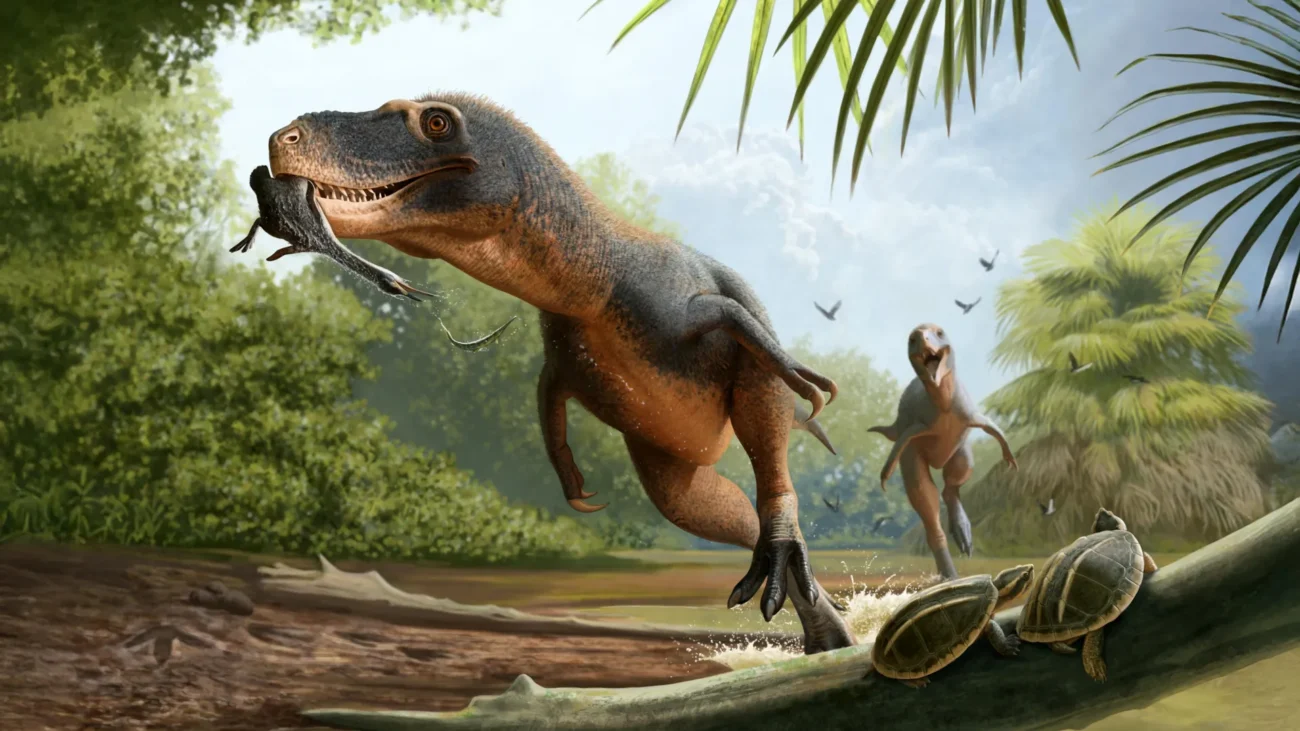
Sixty-six million years ago, a massive apex predator—potentially a Tyrannosaurus rex or a closely related Nanotyrannus—consumed a small diving bird in what is now the American West, leaving behind an exceptional biological time capsule that has only now come to light. Discovered inside a fossilized piece of dinosaur dung, or coprolite, an extraordinarily well-preserved feather specimen has provided paleontologists with unprecedented insights into the Cretaceous Period. Published in the peer-reviewed journal Current Biology, the finding not only illuminates ancient predator-prey dynamics at the twilight of the dinosaur era but may also help solve a long-standing evolutionary mystery: why modern birds managed to survive the cataclysmic mass extinction that wiped out all other non-avian dinosaurs.
The research team, spearheaded by scientists from the Field Museum in Chicago, the University of Washington, and the Carter County Museum, utilized advanced micro-CT scanning technology to peer inside a golf-ball-sized, reddish-brown coprolite recovered from the Hell Creek Formation in Montana. The resulting three-dimensional digital reconstructions revealed an intricate matrix of biological material, including delicate bird bones, microscopic scales from a gar fish, and multiple intact feathers. According to researchers, the preservation quality rivals or exceeds that of specimens trapped in amber, opening an entirely unexpected avenue for paleontological research.
Chronology of a Montana Discovery
The journey of this remarkable fossil began during the summer field season of 2016 in northeastern Montana. David DeMar, Jr., a research scientist and collections manager for the Hell Creek Project at the University of Washington Burke Museum, was conducting routine fieldwork along a rocky outcrop, collecting micro-vertebrate fossils such as ancient fish teeth and scales.
Scanning the terrain, DeMar noticed an unassuming dark, reddish-brown nodule measuring roughly half the size of a golf ball. Upon picking up the specimen and examining its surface with a hand lens, he spotted a tiny, distinct structure that defied standard geological expectations: a fossilized feather.
The find was immediately recognized as anomalous. Despite more than a century and a half of intensive geological prospecting and fossil excavation within the Hell Creek Formation—a premier geologic treasure trove spanning parts of Montana, North Dakota, South Dakota, and Wyoming—feather fossils had never before been documented in these strata. Recognizing the fragility and significance of the object, the team transported the nodule to a laboratory setting for non-destructive analytical evaluation.
Using high-resolution micro-CT scanning facilities at the University of Southern California’s medical campus, paleontology researchers virtually unwrapped the contents of the rock. Nate Carroll, a co-author of the study and paleontologist at the Carter County Museum, noted that every subsequent hour of data processing yielded astonishing details. The scans unveiled a complex assemblage of a hesperornithiform bird—an extinct group of flightless, aquatic diving birds ecologically analogous to modern loons. The association of the leg bones, fish scales, and feathers within a single coprolite strongly indicated that the apex predator had ingested the bird whole or in large chunks, with the indigestible plumage and bone fragments passing through the digestive tract and becoming fossilized.
Contextualizing the End-Cretaceous Mass Extinction
The timing of this final meal is of profound scientific interest. Approximately 66 million years ago, at the boundary between the Cretaceous and Paleogene periods (the K-Pg boundary), a celestial impactor roughly 6 miles wide—commonly referred to as the Chicxulub asteroid—struck the Yucatán Peninsula in modern-day Mexico. The impact unleashed energy equivalent to billions of atomic bombs, triggering global firestorms, earthquakes, tsunamis, and an extended period of atmospheric darkness known as "impact winter."
During this global crisis, the Earth’s biosphere collapsed. Approximately 75 percent of all plant and animal species on Earth perished, including all non-avian dinosaurs, marine reptiles like mosasaurs and plesiosaurs, and pterosaurs. Within the avian lineage, the vast majority of bird groups also went extinct, including the dominant enantiornithines and the specialized hesperornithiforms.
However, a single branch of the avian family tree—known scientifically as Neornithes—managed to endure. This lineage ultimately diversified into the roughly 10,000 species of modern birds inhabiting the planet today. For decades, evolutionary biologists and paleontologists have debated the specific physiological and ecological mechanisms that allowed Neornithes to survive while their contemporaneous avian and non-avian relatives vanished.
Morphology of the Hesperornithiform Feather
The newly analyzed feathers inside the Montana coprolite belong to a hesperornithiform, an aquatic diving bird that populated the shallow inland seaways of North America during the late Cretaceous. While hesperornithiforms shared a common ancestry with the surviving Neornithes lineage, they occupied a distinct evolutionary branch that ultimately met its demise at the K-Pg boundary.
Detailed morphological analysis of the fossil feathers revealed a transitional structural architecture. While the plumage exhibited advanced, modern-looking characteristics suitable for aquatic environments—such as waterproofing adaptations—it also retained primitive, fuzzy body elements more commonly associated with non-avian theropod dinosaurs and enantiornithines.
Lead author Jingmai O’Connor, associate curator of fossil reptiles at the Field Museum, emphasizes that this intermediate feather morphology may hold the key to the selective survival of birds during the impact winter. Modern birds rely heavily on highly efficient, specialized plumaceous feathers for thermal insulation. If primitive bird lineages like hesperornithiforms and enantiornithines possessed less sophisticated insulating plumage, they would have been significantly more vulnerable to the sudden, severe temperature drops that followed the asteroid impact.
Implications for Habitat and Physiology
A prominent prior hypothesis suggested that Neornithes survived the mass extinction simply because many of them inhabited freshwater or marine environments, where aquatic food webs may have been buffered from the immediate terrestrial devastation.
However, the discovery of a specialized aquatic bird—the hesperornithiform—that nevertheless went extinct complicates this environmental narrative. Because hesperornithiforms lived in and around water yet still succumbed to the extinction event, habitat alone cannot fully account for the survival differential.
Instead, researchers point toward internal physiological differences, specifically concerning feather structure, metabolic rates, and molting strategies. The way birds replace their feathers—whether sequentially to maintain continuous insulation or all at once—could have severely impacted their ability to withstand the freezing temperatures of the impact winter. If Neornithes possessed superior thermal insulation and more adaptable molting cycles, they would have held a decisive evolutionary advantage over their archaic cousins.
Methodological Shifts in Paleontology
Beyond the evolutionary implications for avian survival, the study marks a significant methodological milestone for paleontology. Historically, researchers studying fossilized feathers have relied almost exclusively on exceptional Lagerstätten deposits—rare geological sites with extraordinary preservation conditions, such as the fine-grained shales of Liaoning, China, or amber deposits found in Myanmar.
The successful extraction of pristine 3D feather data from an ordinary coprolite demonstrates that fossilized feces can act as accidental preservation matrices. Because digestive acids and anoxic environments within a predator’s gut can sometimes shield ingested soft tissues from microbial decay before mineralization occurs, coprolites may hold a vast, untapped archive of prehistoric biodiversity.
Co-author Greg Wilson Mantilla, professor at the University of Washington and curator of vertebrate paleontology at the Burke Museum, underscored the rarity of finding such delicate structures. Finding bird fossils is inherently uncommon due to their fragile, hollow bones; finding intact feathers is rarer still. Capturing both within a predator’s coprolite provides an exceptionally clear snapshot of Late Cretaceous trophic webs just moments before the absolute termination of the dinosaur lineage.
Broader Impact and Future Research Directions
As the scientific community digests the implications of the Montana coprolite, researchers are advocating for a systematic reevaluation of existing fossil collections housed in museums worldwide. Thousands of coprolites sit in archives, often categorized merely as geological oddities or dismissed as uninformative waste.
The research team hopes that by applying non-destructive micro-CT scanning technology to these museum specimens, paleontologists can uncover hidden microfossils, soft tissues, and rare integumentary structures that were previously invisible to surface-level inspection. Such efforts could yield further clues regarding the dietary habits of apex predators like T. rex and provide additional data points for mapping the complex evolutionary history of feathers.
Ultimately, this microscopic examination of a 66-million-year-old meal demonstrates how seemingly insignificant fragments can rewrite established paradigms. By peering inside the digested remains of an ancient aquatic bird, scientists have gained a clearer window into the fragile balance of life on Earth on the eve of its greatest modern crisis.

