


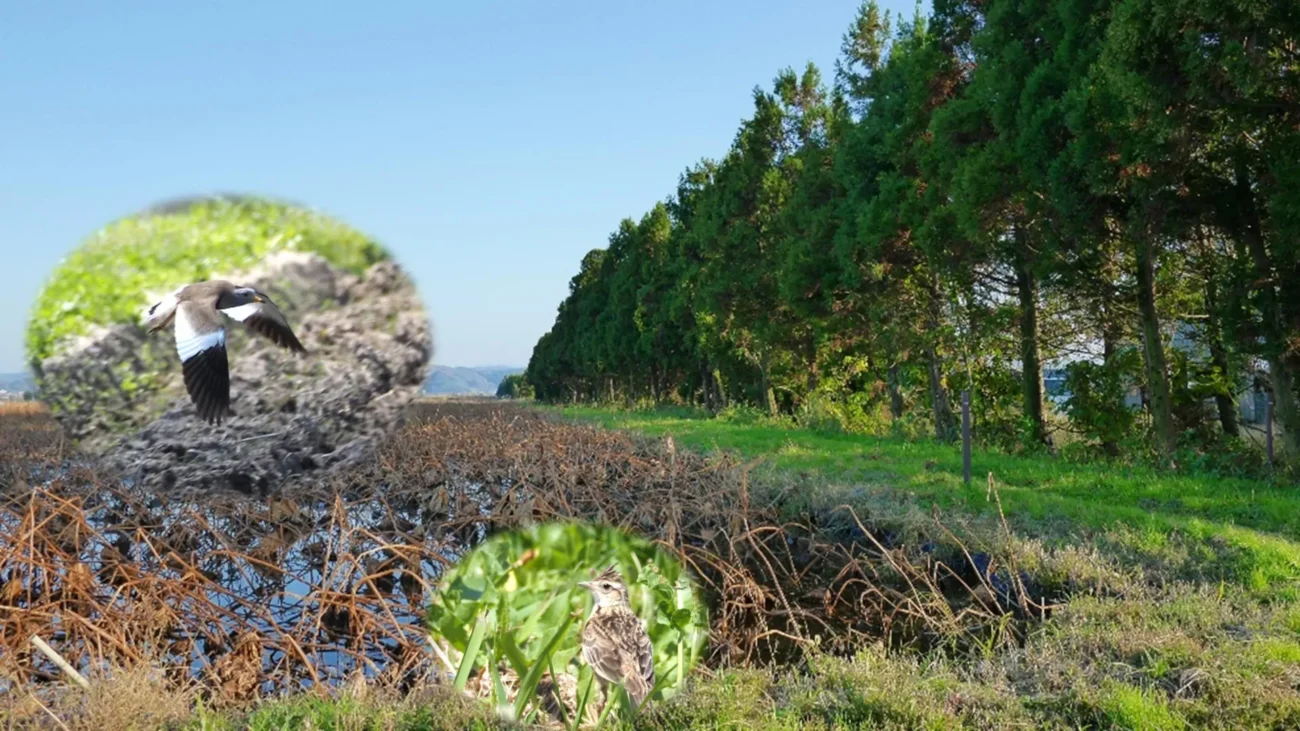
The conventional wisdom surrounding agricultural conservation has long favored a simple equation: more trees equal more biodiversity. Across North America and Europe, agri-environmental schemes routinely incentivize farmers to plant hedgerows, shelterbelts, and woody linear features to combat soil erosion, buffer chemical runoff, and provide refuge for local wildlife. However, a comprehensive new study published in the Journal of Environmental Management suggests that this arboreal panacea may come with unforeseen ecological costs, particularly in agricultural wetland landscapes where an array of native and migratory bird species depend on expansive, unobstructed vistas.
Conducted by an interdisciplinary team of researchers from institutions including Hiroshima University, The University of Tokyo, and Kyoto University, the study examined the localized impacts of windbreak shelterbelts on bird populations surrounding Lake Kahokugata in central Japan. The findings challenge the universal application of tree-planting initiatives, revealing a sharp ecological trade-off: while shelterbelts successfully foster edge-dwelling and shrub-adapted species, they simultaneously trigger steep declines in the abundance and diversity of open-habitat specialists that rely on vast, treeless expanses of rice paddies and wetlands.
The Implications of Wet-Farming Landscapes
To understand the weight of these findings, researchers emphasize the unique ecological role played by agricultural wetlands. Far beyond their primary function as food-production systems, managed wetlands such as rice paddies act as vital substitute habitats for a diverse array of fauna. This is especially true for migratory birds navigating major international flyways, including the heavily utilized East Asian-Australasian Flyway. As natural wetlands continue to experience severe degradation and disappearance worldwide due to urban expansion and intensive development, these agricultural interfaces have become critical lifelines for avian conservation.
Yet, despite their global importance, the majority of empirical research informing modern agri-environmental policy has historically derived from dryland croplands and upland grasslands in Western nations. Consequently, land-use planners have often extrapolated these Western-centric findings to radically different ecosystems, such as the wet-farmed agricultural matrices that dominate much of Asia.
"The central question of our study is, ‘Do shelterbelts and other woody linear features benefit all farmland birds equally in agricultural wetland landscapes, or do they create trade-offs by disadvantaging species that depend on open habitats?’" explained corresponding author Masumi Hisano, an assistant professor at Hiroshima University’s Graduate School of Advanced Science and Engineering.
By questioning the blanket efficacy of tree planting in these specialized zones, the research team aims to prompt a fundamental reassessment of how conservation policies are drafted and implemented in human-modified landscapes.
Chronology and Field Methodology at Lake Kahokugata
The empirical foundation of the study is rooted in rigorous field surveys conducted around Lake Kahokugata, a geographically and ecologically significant basin in central Japan. Characterized by expansive tracts of low-lying rice paddies, lotus fields, and intensive cultivation zones, the Kahokugata region is historically subjected to severe seasonal weather patterns. Fierce winter winds and driving storms sweep across the flat terrain, prompting generations of local farmers to establish dense networks of shelterbelts—primarily linear rows of trees designed to safeguard vulnerable crops and prevent wind-induced structural damage.
Simultaneously, Lake Kahokugata functions as a major avian crossroads. Situated directly along the East Asian-Australasian Flyway, the lake and its surrounding agricultural matrix host nearly 300 recorded bird species throughout the year. The region supports two distinct ecological cohorts: wintering migratory species that travel from northern latitudes to endure the colder months, and summer breeding populations that utilize the wet agricultural fields to nest and rear their young.
To capture the shifts in bird communities across these seasonal transitions, the research team deployed a standardized point-count methodology across multiple sites. Field data collection was executed in two distinct phases: an initial winter survey window in February and March 2021, followed by a breeding-season survey window in June 2023. By sampling bird abundance and diversity at sites immediately adjacent to shelterbelts as well as at control locations positioned roughly one kilometer away in open areas, the researchers were able to quantify the exact spatial influence of the tree lines.
Quantitative Findings: Winners, Losers, and Ecological Walls
The results of the multisite surveys painted a stark portrait of habitat fragmentation within a micro-scale agricultural setting. The data revealed a profound ecological polarization among avian guilds, effectively dividing the local bird community into beneficiaries and casualties of the established windbreaks.
Shelterbelts successfully fulfilled their conservation promise for specific guilds, providing structural foraging resources, nesting sites, and protective cover for bird species naturally adapted to forest edges, scrublands, and transitional ecotones. However, these same arboreal networks exerted a profoundly detrimental effect on open-landscape specialists.
Most notably, the abundance of grassland-dependent birds was recorded at levels more than 70 percent lower at monitoring sites immediately adjacent to shelterbelts compared to the open control sites situated a kilometer distant. Furthermore, the overall diversity of wetland-reliant species experienced a marked contraction near the tree lines.
To articulate the physical and behavioral barrier these structures impose on wildlife, Dr. Hisano invoked a vivid conceptual metaphor. "A useful way to think about this is that shelterbelts act like ecological walls," Hisano noted.
Beyond physically fragmenting the landscape, these linear forests can fundamentally alter the behavioral ecology of open-habitat birds. The presence of elevated perches and vertical structures introduces a high-risk environment for ground-nesting and open-foraging species by expanding covert hunting grounds for avian and mammalian predators. Consequently, birds that have evolved behavioral strategies to detect predators across wide, unobstructed horizons find themselves severely disadvantaged and increasingly exposed to predation pressure when forced near shelterbelts.
Broader Impacts and Policy Implications
The publication of these findings in the Journal of Environmental Management arrives at a critical juncture for global environmental policy. As international bodies and national governments ramp up funding for nature-based solutions—frequently translating into aggressive, uncalibrated tree-planting campaigns—the research underscores the urgent need for nuance in conservation management.
Historically, environmental campaigns have suffered from a psychological bias that equates trees with an unmitigated good. While afforestation and reforestation are indispensable tools for carbon sequestration and watershed protection in deforested uplands, applying the same logic to naturally open, wet-farmed ecosystems can yield counterproductive results. If poorly planned tree-planting initiatives inadvertently squeeze out specialized open-habitat and wetland bird populations, well-intentioned conservation dollars may accelerate the local decline of vulnerable species.
The research team is careful to clarify that their findings should not be interpreted as an indictment of shelterbelts entirely. Windbreaks remain functionally essential for agricultural productivity in storm-prone regions like Kahokugata, preventing soil degradation and protecting crop yields. Instead, the study advocates for a paradigm shift from simplistic, one-size-fits-all prescriptions toward sophisticated, landscape-level spatial planning.
"Biodiversity-friendly farmland management must balance structural complexity with the ecological needs of open-habitat species, especially in landscapes where wetlands have already been heavily modified by humans," Hisano emphasized.
Future Research Directions and the Path Forward
Building upon their baseline data from Lake Kahokugata, the research consortium is calling for an expanded research agenda to refine agricultural management guidelines. Future studies must investigate how specific structural attributes of shelterbelts—including their width, canopy height, inter-tree spacing, spatial configuration, and botanical composition—interact with wildlife across diverse geographic regions and climatic seasons.
Additionally, scientists hope to unpack the complex web of indirect ecological cascades triggered by linear forests. This includes examining how shelterbelts influence local microclimates, alter the spatial dynamics of predator-prey interactions, and affect ecological connectivity for non-avian taxa such as amphibians and insects that also utilize agricultural wetlands.
Ultimately, the research team envisions a framework where agricultural science moves beyond binary debates of tree promotion versus elimination. By integrating empirical data into regional land-use planning, policymakers can design evidence-based agri-environmental policies that maintain the economic viability of wet-farming regions while simultaneously preserving the complex, open-landscape habitats upon which millions of migratory and resident birds depend. Through careful spatial orchestration, agricultural wetlands can successfully sustain human livelihoods and biological diversity alike in an era of rapid environmental change.
The international research team responsible for this study includes Masumi Hisano (Hiroshima University, The University of Tokyo, and Kyoto University); Shota Deguchi (Fukui City Museum of Natural History); Wenhuan Xu (University of British Columbia and Simon Fraser University); Xike Xiao (Hiroshima University); Keinosuke Sannoh (Nihonkai Eco Engineering Technologies); Xinli Chen (Zhenjiang A&F University); and Ken Motomura (Nakano City Hall).
Financial support for the investigation was provided by the Kahokugata Lake Institute and the Japan Society for the Promotion of Science (JSPS) KAKENHI grants.

