


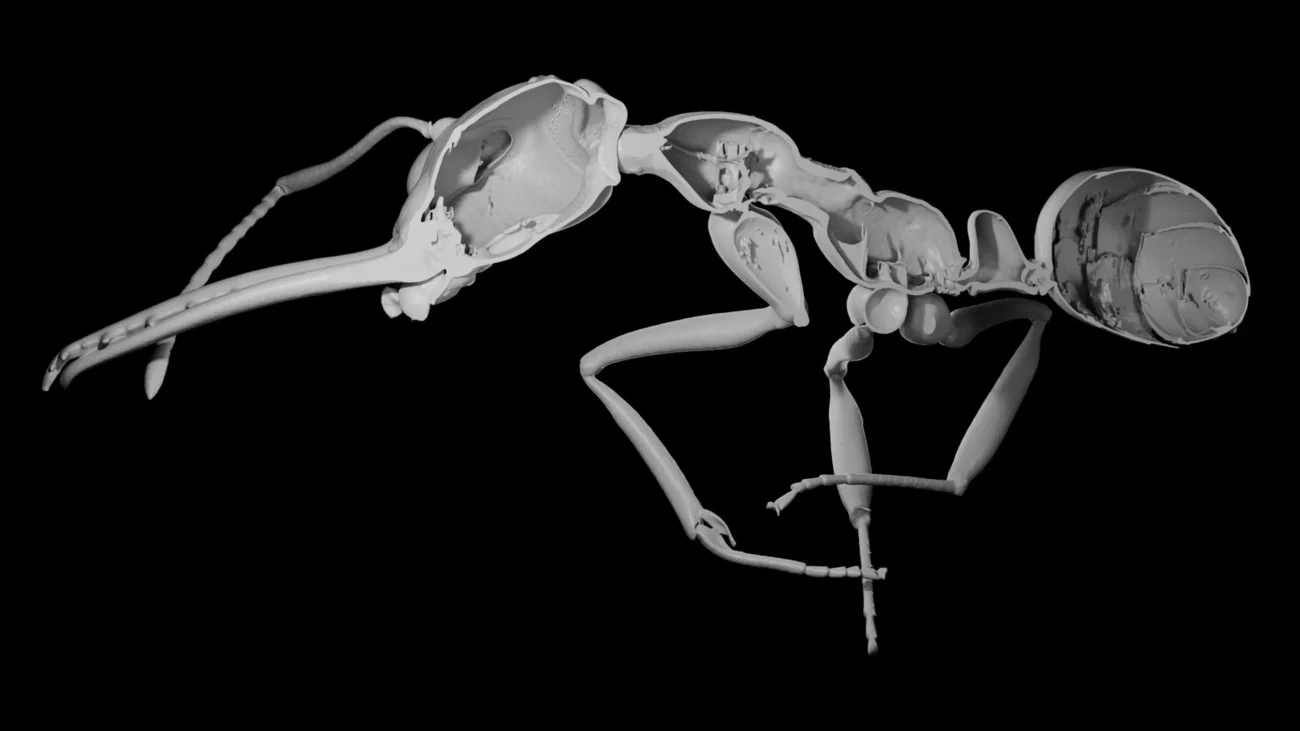
A groundbreaking study published in the journal Science Advances on December 19, 2025, offers a compelling new perspective on the evolutionary trajectory of social insects, particularly ants. Researchers from the University of Maryland and the University of Cambridge have unveiled evidence suggesting that a fundamental evolutionary tradeoff – prioritizing quantity over individual quality – has been a pivotal driver in the development of complex ant societies and their remarkable diversification. This research challenges long-held assumptions about evolutionary success, proposing that by investing less in the robust physical defenses of individual workers, ant colonies have been able to grow exponentially, fostering greater complexity and leading to the proliferation of new species.
The study, spearheaded by senior author Evan Economo, chair of the Department of Entomology at the University of Maryland, and lead author Arthur Matte, a Ph.D. student in zoology at the University of Cambridge, delves into the intricate relationship between resource allocation and societal evolution. At its core, the research explores a seemingly paradoxical strategy: ants that opt for producing a larger number of less physically formidable individuals over a smaller contingent of highly armored ones have ultimately achieved greater evolutionary success. This approach, the scientists argue, liberates crucial nutrients and metabolic resources that can then be channeled into increasing the sheer number of workers, thereby bolstering the colony’s collective strength and capacity.
The Tradeoff: Quantity Over Individual Robustness in Ant Evolution
The central hypothesis investigated by the research team revolves around the ant’s cuticle, the tough, chitinous exoskeleton that provides vital protection against predators, desiccation, and pathogens, while also serving as an anchor for muscular systems. The creation of a robust cuticle is metabolically expensive, demanding significant inputs of limited nutrients such as nitrogen and various minerals. The study posits that species capable of reducing their investment in this costly "body armor" can redirect these resources towards producing a greater workforce. This economic principle, the researchers contend, has been a cornerstone of ant evolution, enabling the formation of massive, highly organized societies that dominate ecosystems worldwide.
"There’s this question in biology of what happens to individuals as societies they are in get more complex," explained Dr. Economo, who also holds the James B. Gahan and Margaret H. Gahan Professorship at UMD. "For example, the individuals may themselves become simpler because tasks that a solitary organism would need to complete can be handled by a collective." This concept, often described by scientists as individuals becoming "cheaper" – requiring fewer resources to build and thus producible in larger numbers, even if less physically robust – has been a theoretical cornerstone in evolutionary biology. However, its explicit empirical testing across a broad range of social insects had remained elusive until this comprehensive study.
Ants as a Model for Social Evolution
Ants, with their vast range in colony sizes – from a few dozen individuals to millions – and their ubiquitous presence across nearly every terrestrial habitat, provide an unparalleled natural laboratory for studying the mechanisms of social evolution. "Ants are everywhere," stated Matte. "Yet the fundamental biological strategies which enabled their massive colonies and extraordinary diversification remain unclear." This research proposes that the extent to which ants invest in their cuticle is a key factor linking colony size and evolutionary success.
To rigorously test their hypothesis, the research team embarked on an extensive data collection and analysis effort. They compiled a substantial database comprising 3D X-ray scans from over 500 distinct ant species. This sophisticated imaging technique allowed them to meticulously measure both the total body volume and the cuticle volume for each species. Their findings revealed a significant degree of variation in cuticle investment, with some species allocating as little as 6% of their body mass to this protective layer, while others dedicated as much as 35%.
Evolutionary Models Reveal a Clear Trend
These detailed anatomical measurements were then integrated into sophisticated evolutionary models. The results presented a striking and consistent pattern: ant species that allocated a smaller proportion of their body mass to cuticle development were overwhelmingly those that tended to form larger and more complex colonies. This correlation provides strong empirical support for the theory that a strategic reduction in individual defense investment can be a catalyst for the formation of larger social structures.
The implications of this finding extend beyond mere colony size. The study also uncovered a significant link between reduced cuticle investment and higher rates of diversification. Diversification, a key metric of evolutionary success, reflects the rate at which new species emerge from ancestral lineages. The researchers found that species with less investment in their cuticle exhibited a greater tendency to speciate. This suggests that the "cheaper worker" strategy not only facilitates the growth of large societies but also fuels their evolutionary innovation and adaptation into new ecological niches.
The Collective Advantage: Beyond Individual Armor
While a thinner cuticle might intuitively suggest greater vulnerability for individual ants, the authors propose that this perceived weakness is, in fact, a strategic advantage for the collective. Reduced individual armor may be intrinsically linked to, and even encourage, the development of other crucial social traits that become more pronounced as colonies grow. These include enhanced cooperative foraging strategies, sophisticated shared nest defense mechanisms, and a more pronounced division of labor among colony members. In essence, the collective strength and efficiency of the larger society compensate for the diminished individual resilience.
"Ants reduce per-worker investment in one of the most nutritionally expensive tissues for the good of the collective," Matte explained. "They’re shifting from self-investment toward a distributed workforce, resulting in more complex societies. It’s a pattern that echoes the evolution of multicellularity, where cooperative units can be individually simpler than a solitary cell, yet collectively capable of far greater complexity." This analogy to the evolution of multicellularity underscores the profound nature of the evolutionary shift being described.
Mechanisms Driving Speciation and Diversification
The precise mechanisms by which reduced cuticle investment promotes speciation remain an active area of investigation, but the researchers have put forth compelling hypotheses. One leading idea is that ants with lower nutritional demands due to less investment in their cuticle are better equipped to colonize and thrive in environments where resources are scarce.
"Requiring less nitrogen could make them more versatile and able to conquer new environments," said Matte, reflecting on the origins of this research which began during his master’s program while interning in Economo’s lab at the Okinawa Institute of Science and Technology in Japan. This increased adaptability allows these less-armored lineages to explore and exploit a wider range of ecological niches, a key driver of diversification.
Furthermore, as ant societies evolved greater complexity, the reliance on collective defenses like communal nest protection and sophisticated disease control mechanisms likely reduced the selective pressure for heavy individual armor. This could have created a self-reinforcing evolutionary cycle: lower cuticle investment allows colonies to grow larger, and larger, more complex colonies, in turn, further diminish the need for each individual ant to possess robust physical defenses. Dr. Economo humorously characterized this phenomenon as "the evolution of squishability," noting that the physical resilience of insects is not uniform, a fact many childhood encounters with ants have revealed.
Broader Implications for Social Organisms and Beyond
The findings from this ant-centric study hold significant implications that extend far beyond the realm of entomology. The evolutionary principle of trading individual quality for collective quantity is a recurring theme in the natural world and even in human history. The researchers draw parallels to human military history, citing the gradual replacement of heavily armored, individually strong knights with larger numbers of specialized, less individually robust soldiers such as archers and crossbowmen.
Dr. Economo also referenced Lanchester’s Laws, a set of mathematical models developed during World War I to analyze combat dynamics. These laws demonstrate how, under certain conditions, a numerically superior force, even if composed of weaker individuals, can overwhelm a smaller, stronger force. This mathematical framework aligns remarkably well with the evolutionary strategy observed in ants.
"The tradeoff between quantity and quality is all around. It’s in the food you eat, the books you read, the offspring you want to raise," Matte observed. "It was fascinating to retrace how ants handled it through their long evolution. We could see lineages taking different directions, being shaped by different constraints and environments, and ultimately giving rise to the extraordinary diversity we observe today." This highlights the universal nature of such evolutionary pressures and strategies.
The research was supported by grants from the Okinawa Institute of Science and Technology, the Japan Society for the Promotion of Science KAKENHI (24K01785), the University of Cambridge, and the General Research Fund 2022/2023 (17121922) from the Research Grant Council of Hong Kong. While this article reflects the findings of the study, it does not necessarily represent the official views of these funding organizations. The study’s findings are expected to spur further research into other social organisms, such as termites, to determine if similar evolutionary pathways have been followed, and to deepen our understanding of the fundamental principles governing the evolution of complexity and diversity across life.

