


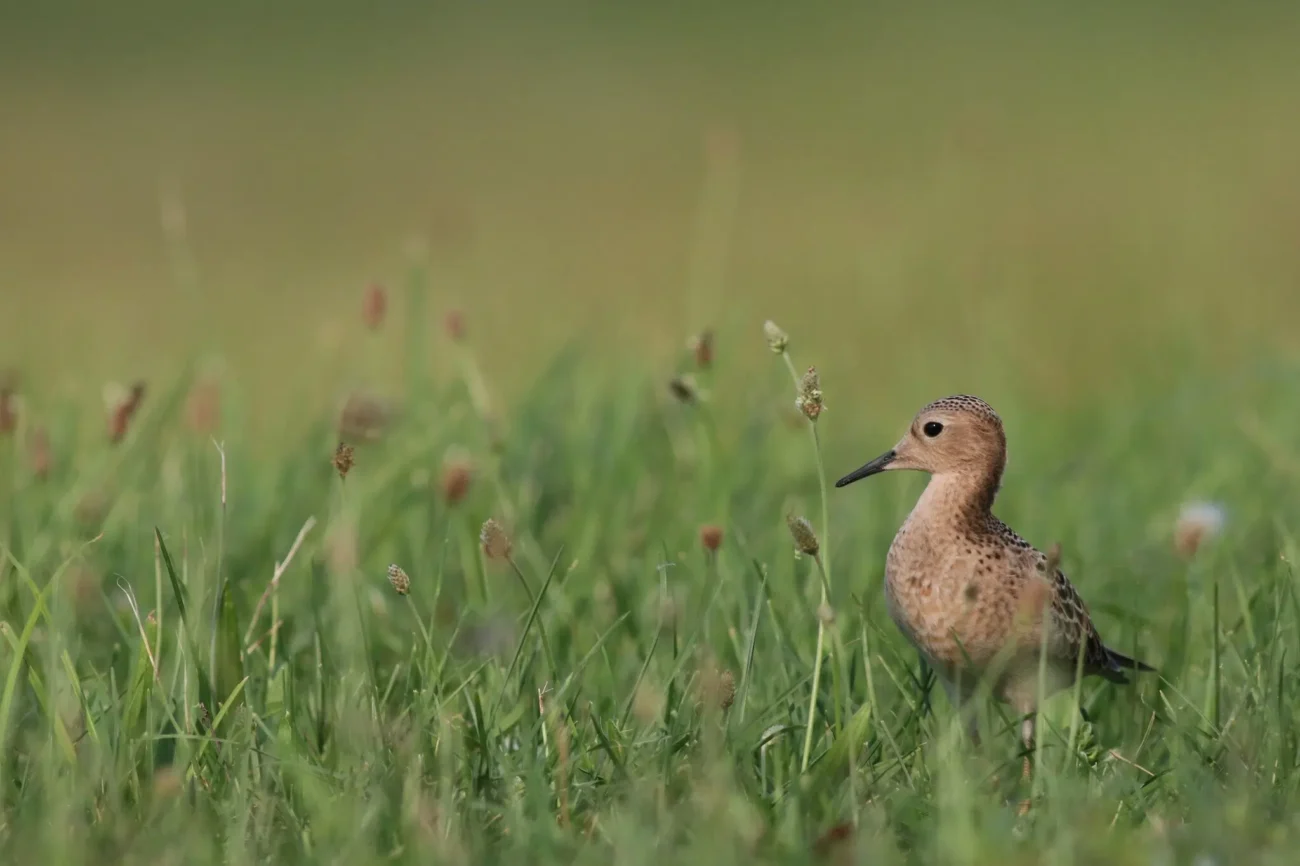
Birds navigate the globe utilizing intricate aerial pathways known as flyways, akin to superhighways in the sky, facilitating their arduous journeys between breeding grounds, essential feeding areas, and vital seasonal refuges. Among these feathered travelers, the Buff-breasted Sandpiper (Calidris subruficollis) stands out as a remarkable long-distance migrant. This species undertakes an impressive migratory route along the Americas Flyway, traversing the expansive North American grasslands before ultimately finding winter refuge in the temperate embrace of the South American pampas. With an estimated global population hovering around 550,000 individuals, the Buff-breasted Sandpiper thrives in a variety of open, grassy ecosystems, including dry grasslands, prairies, and agricultural fields. However, this species is not without its challenges; it is currently listed as Vulnerable on the IUCN Red List of Threatened Species, facing a persistent array of threats, most notably habitat conversion and the lingering effects of historical hunting practices.
The annual odyssey of the Buff-breasted Sandpiper commences in the vast and often harsh environment of the Arctic tundra. Here, these birds engage in sporadic breeding activities, with documented nesting sites ranging from central Alaska across to Devon Island in Canada. Their mating system is particularly noteworthy within the shorebird order, as they employ a lek mating system. In this fascinating display, males congregate in designated areas, performing elaborate courtship rituals to attract potential mates, a strategy that sets them apart from many of their congeners. Following the conclusion of the breeding season, the sandpipers embark on a distinctly circular migration pattern. They typically journey through the North American Great Plains, a crucial refueling corridor, before reaching their primary wintering grounds in the expansive South American pampas, which encompass regions of Argentina, Uruguay, and Brazil. Their return journey, northbound, involves a strategic crossing of the Llanos de la Orinoquia, a seasonally arid savanna region straddling Colombia and Venezuela, which offers critical feeding opportunities during this demanding phase of their migration.
Vital Stopover Sites and Wintering Grounds: Pillars of Survival
Throughout their extensive southbound migration, a network of Key Biodiversity Areas (KBAs) plays an indispensable role in the survival of the Buff-breasted Sandpiper. These globally recognized sites, designated for their exceptional importance to biodiversity, function as critical “fuelling stations” and safe havens for this intrepid long-distance traveler. The identification and protection of these KBAs are paramount to understanding and safeguarding the migratory routes of this vulnerable species.
West Mamoré River (Bolivia): A Crucial Bottleneck
Within Bolivia, the West Mamoré River region emerges as the most significant KBA for the Buff-breasted Sandpiper. Astonishingly, over 40% of the global population of this species utilizes this site and the adjacent Beni savanna grasslands during their southbound migration. The sandpipers exhibit a strong foraging preference for the short grasses found along river edges, maintained by the grazing activities of livestock, and for the sandy banks of the Mamoré and Madre de Dios rivers. They tend to avoid the taller, denser savannas and the interspersed forest islands. The Buff-breasted Sandpiper’s reliance on the Beni Savanna ecosystem during its southbound journey is absolute; during this period, the grasslands are typically dry and provide suitable foraging conditions. Conversely, during the northbound migration, the Beni grasslands are often inundated, rendering them largely unsuitable for foraging. This seasonal dependency highlights the critical importance of maintaining the specific habitat conditions offered by the West Mamoré River KBA during the southbound passage.
Estuário da Laguna dos Patos (Brazil): A Gathering Point Under Threat
Situated at the southernmost extent of the Patos Lagoon in Brazil, the Estuário da Laguna dos Patos is another KBA of considerable importance. Specifically, Torotama Island within this estuary consistently hosts the largest aggregations of Buff-breasted Sandpipers observed in Brazil. Despite its ecological significance, this vital site faces mounting pressures from urban expansion and the increasing threat of flooding, underscoring the need for robust conservation strategies to mitigate these encroaching dangers and preserve this critical habitat.
Laguna de Rocha (Uruguay): A Protected Wintering Haven

The Laguna de Rocha in Uruguay has been officially recognized as a KBA of global priority. This brackish lagoon is an integral part of a larger coastal lagoon system that stretches across southeastern Brazil and eastern Uruguay. It serves as a vital wintering ground for the Buff-breasted Sandpiper, being one of the qualifying species that led to its designation as a KBA. Furthermore, the Laguna de Rocha holds the esteemed status of a Western Hemisphere Shorebird Reserve Network (WHSRN) site and is recognized under the Ramsar Convention, signifying its international importance for wetland conservation and migratory bird protection.
Bahía de Samborombón y Punta Rasa (Argentina): A Hub for Migratory Shorebirds
In Argentina, the Bahía de Samborombón y Punta Rasa KBA represents a major stopover and wintering site where substantial numbers of migratory shorebirds converge during the austral summer. This area is crucial for preserving some of the last remaining tracts of original Pampas grassland. Its qualification as a KBA is directly linked to the presence of the Buff-breasted Sandpiper, among other significant bird species. Similar to Laguna de Rocha, this site also benefits from its designation as a WHSRN and Ramsar site, reflecting its broad international conservation significance.
The Northbound Journey: Critical Staging Grounds in the Llanos
As the Buff-breasted Sandpiper commences its arduous journey back north, typically between February and April, several key sites within the Llanos de la Orinoquia region of Colombia and Venezuela serve as the final, high-stakes staging grounds before the crossing of the Caribbean Sea. These areas are critical for the birds to build up reserves for the final leg of their migratory flight.
Reservas de la Vereda Altagracia (Colombia): Essential High Ground
The Reservas de la Vereda Altagracia in Colombia is identified as a KBA that supports more than 1% of the global population of the Buff-breasted Sandpiper during its spring migration. The species’ survival here is intrinsically linked to the availability of “benches” – elevated areas of land that remain dry as the region transitions into the rainy season. These dry, open areas provide essential foraging opportunities during this critical pre-migration period.
Puerto Rico y La Polonia Natural Reserve (Colombia): Sustainable Grazing Practices
This privately protected reserve in Colombia is dedicated to the conservation of natural savannas and wetlands. Its approach to land management, which includes traditional livestock practices, is remarkably aligned with conservation objectives. The system of grazed grasslands maintained by the reserve provides the specific habitat structure that the Buff-breasted Sandpiper requires for successful staging and refueling before its final push north.
Conservation in Action: Safeguarding Grasslands Across the Americas
The conservation strategy for the Americas Flyways places a significant emphasis on the protection of grassland ecosystems. These vast landscapes span the entire hemisphere, encompassing iconic regions such as the Pampas of the Southern Cone, the Beni Savanna in Bolivia, the Llanos of Colombia and Venezuela, the Chihuahuan Desert in Mexico and the United States, and the Great Plains of the USA and Canada. Collectively, these regions provide indispensable breeding, migration, and wintering habitats for a multitude of migratory bird species, with the Buff-breasted Sandpiper being a prime example.

Alianza del Pastizal: A Grasslands Alliance for the Southern Cone
To ensure the long-term health and vitality of these critical grasslands in the Southern Cone, a collaborative regional initiative known as the Alianza del Pastizal (Grasslands Alliance) was established in 2006. This initiative, spearheaded by BirdLife International, is actively implemented by its esteemed partners: Aves Argentinas, SAVE Brasil, Guyra Paraguay, and Aves Uruguay. These organizations work in concert to conserve these extensive and ecologically significant landscapes. The Alianza del Pastizal brings together a diverse coalition of stakeholders, including producers, conservationists, researchers, and government representatives. It champions grassland-based livestock systems as a potent conservation tool, aiming to restore degraded habitats for grassland birds and other key biodiversity. To date, this nature-friendly livestock management system has been implemented across more than 1 million hectares, engaging hundreds of landowners across Argentina, Brazil, Paraguay, and Uruguay. This collaborative approach demonstrates the tangible benefits of integrating sustainable land use with biodiversity conservation.
Beni Eco-Friendly Ranching Alliance: Sustainable Practices in Bolivia
In the Beni Savanna of Bolivia, a focused conservation effort is underway through the Beni Eco-Friendly Ranching Alliance. This alliance was co-founded by Asociación Armonía, BirdLife International’s partner in Bolivia, in collaboration with the Beni Cattle Ranchers’ Federation. The alliance unites ranchers who are committed to producing beef through environmentally responsible and sustainable grazing practices. Armonía works closely with its members, guiding them through a transition from conventional cattle ranching to shorebird-friendly management. This shift not only helps maintain high-quality grassland habitat essential for species like the Buff-breasted Sandpiper but also enhances the overall sustainability and productivity of ranching operations, creating a win-win scenario for both livelihoods and biodiversity.
Barba Azul Nature Reserve: A Model of Habitat Management
Further demonstrating its commitment to grassland conservation, Asociación Armonía established the Barba Azul Nature Reserve in 2008. Spanning 12,200 hectares, this reserve is now recognized as Bolivia’s sole Western Hemisphere Shorebird Reserve Network Site of Regional Importance. This designation is a direct acknowledgment of the significant numbers of Buff-breasted Sandpipers that migrate through the area annually. To ensure the reserve’s long-term financial viability, Armonía actively manages a herd of approximately 1,200 cattle. Livestock grazing, when meticulously managed, serves as a crucial habitat management tool. By maintaining optimal grass heights, typically between 4 and 6 cm, at river-edge shortgrass sites, the reserve actively cultivates the ideal foraging habitat for the Buff-breasted Sandpiper, illustrating a practical application of conservation science.
A Continental Connection: The Broader Implications
The extraordinary migratory journey of the Buff-breasted Sandpiper serves as a powerful narrative of interconnectedness, highlighting how a cross-continental voyage can forge links between diverse natural landscapes and distinct human cultures. The ongoing efforts to protect the network of Key Biodiversity Areas that stitch the continent together are not merely about safeguarding individual species; they are fundamental to ensuring the persistence of migratory bird populations and the preservation of the rich grassland biomes that define the Americas. These efforts also extend to supporting the human communities and cultures that have thrived within these dynamic landscapes for generations. The success of initiatives like the Alianza del Pastizal and the Beni Eco-Friendly Ranching Alliance demonstrates that by fostering collaboration between conservationists, land managers, and local communities, it is possible to achieve both ecological integrity and sustainable livelihoods, ensuring that these vital grassland ecosystems can continue to support life for generations to come.

