


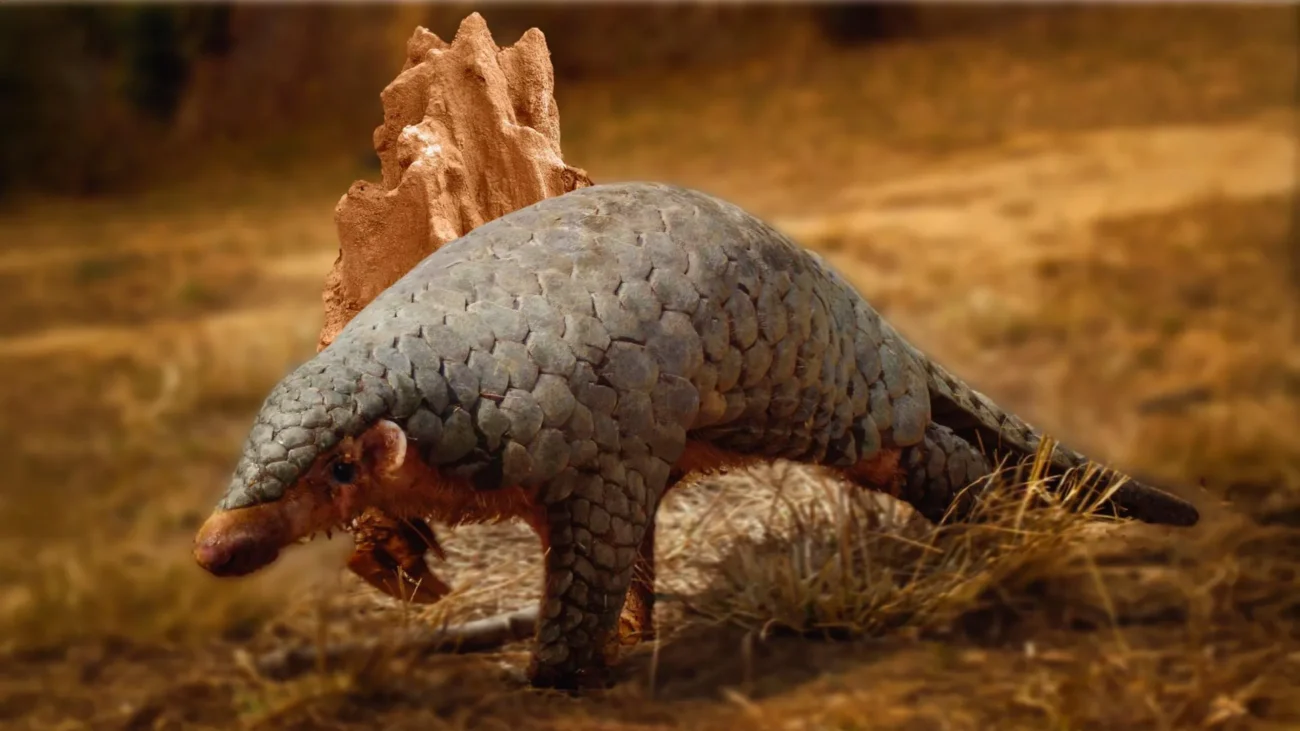
Pinecone-like scales, elongated snouts, and a prehistoric appearance characterize the pangolin, an elusive mammal that has recently stepped into the center of a major conservation breakthrough. Found exclusively across the tropical and subtropical regions of Africa and Asia, these solitary creatures have long captured the imaginations of biologists. However, their defining feature—overlapping keratinous scales—has also made them the target of relentless international wildlife trafficking. Widely considered the most heavily poached and trafficked mammals on Earth, all eight known species face severe risks of extinction.
Now, an international team of researchers has formally confirmed the existence of a distinct, previously unrecognized Asian pangolin species: Manis aurita. Ranging across the rugged terrain of Nepal and Northern India, this newly validated species brings critical clarity to the complex pangolin family tree. Published in the journal Communications Biology, the findings illuminate the evolutionary lineages, geographical distribution, and physical characteristics of these animals. More importantly, conservationists believe this taxonomic breakthrough will hand law enforcement agencies and wildlife forensic scientists a powerful new toolkit to trace illegal supply chains, pinpoint poaching hot spots, and shield vulnerable populations from total collapse.
Untangling the Taxonomic Riddle
The formal recognition of Manis aurita is the culmination of years of meticulous genetic detective work and international collaboration, resolving a tangled history of misclassification that spans nearly two centuries. The modern chapter of this discovery began in Nepal, where field researchers documented anatomical and behavioral evidence suggesting that the Himalayan pangolins did not neatly fit the profile of the classic Chinese pangolin (Manis pentadactyla).
Chronologically, the scientific re-evaluation accelerated significantly. In early 2025, a separate research collective determined that animals previously grouped broadly under the banner of the Chinese pangolin actually represented two distinct evolutionary lineages. While one lineage inhabited China proper, the other occupied the Himalayan foothills traversing Nepal, India, Bhutan, and Myanmar. That mountain-dwelling group was initially dubbed Manis indoburmanica, commonly referred to as the Indo-Burmese pangolin.
However, the rigid protocols of biological nomenclature dictate the rule of priority: when multiple scientific names are given to the same biological entity, the oldest valid name takes precedence. As an international consortium—including scientists from the Field Museum, Guangzhou University, the Nepal Engineering College at Pokhara University, and the Guangdong Academy of Forestry—conducted a decade-long overarching investigation into pangolin evolution, they encountered archival records of Manis aurita, a species originally described in 1836. Over subsequent decades, M. aurita had been systematically demoted and reclassified as a mere subspecies of the Chinese pangolin.
This historical oversight sparked a core taxonomic riddle for contemporary researchers: What was the exact biological relationship between the newly proposed indoburmanica and the archival aurita? Were they genetically identical, or did they represent separate lineages?
The Ultimate Proof: DNA from 1836
Answering this evolutionary puzzle required reaching deep into the vaults of natural history museums. The breakthrough arrived courtesy of the Natural History Museum in London, which houses the original type specimen of the Nepalese subspecies (aurita) collected in 1836. Utilizing advanced paleogenomic techniques, researchers successfully extracted and sequenced ancient DNA directly from this nearly 190-year-old museum specimen.
When geneticists compared the ancient DNA sequences against modern Himalayan pangolin samples, the results were unequivocal. The modern Himalayan pangolin samples matched the genetic profile of aurita. Consequently, the animals temporarily designated in 2025 as Manis indoburmanica were, in fact, members of the species first documented and named by naturalists nearly two centuries prior. Under the rules of taxonomy, Manis aurita was re-established as the correct and valid scientific name.
Physical and Geographical Distinctions
With the species officially validated, scientists have detailed the clear morphological and ecological boundaries that separate Manis aurita from its closest relatives. Morphologically, the Himalayan pangolin diverges from the Chinese pangolin in several distinct ways.
According to researchers, Manis aurita boasts a larger overall body size, a significantly longer tail, and noticeably smaller external ears. Ironically, the specific epithet aurita—derived from Latin roots relating to ears—serves as a nod to these unique anatomical proportions. Furthermore, geographical mapping confirms that the ranges of the Chinese pangolin and the Himalayan pangolin do not naturally overlap. Maintaining these clear geographic and taxonomic boundaries is paramount, especially for critically endangered taxa where localized management decisions dictate survival.
Combating the Global Illegal Wildlife Trade
The illegal trade in pangolins is driven largely by demand in traditional medicine, where their keratin scales are erroneously believed to possess curative properties and aphrodisiac qualities. Despite international trade bans under the Convention on International Trade in Endangered Species of Wild Fauna and Flora (CITES), poachers continue to slaughter tens of thousands of pangolins annually.
For law enforcement agencies, combating this clandestine trade presents unique logistical hurdles. Anti-poaching inspectors rarely encounter live, intact animals in illegal markets. Instead, authorities typically intercept sacks of loose, dried scales stripped from their biological context, rendering visual identification nearly impossible.
The validation of Manis aurita and the integration of robust genetic baselines directly address this vulnerability. Conservation scientists can now apply forensic DNA testing to confiscated scales, accurately matching the genetic material to specific species and, by extension, distinct geographic regions. By working backward from intercepted contraband, enforcement agencies can identify active poaching networks, disrupt supply routes, and deploy targeted protective measures to high-risk zones.
Implications for Conservation and Reintroduction
Beyond forensic tracking, the clarification of pangolin taxonomy directly impacts captive breeding and reintroduction initiatives. Historically, conservationists attempting to restore depleted wild populations faced the risk of genetic mismatching—releasing animals far outside their native habitats or introducing incorrect species into sensitive ecosystems, such as releasing Chinese pangolins into historical Himalayan ranges.
By mapping the precise geographic limits and genetic signatures of Manis aurita, conservation planners can execute targeted rewilding projects with surgical precision. Ensuring that the right species is returned to the right ecosystem safeguards local genetic integrity and maximizes the likelihood of population recovery.
The Indispensable Role of Natural History Museums
The successful resurrection of Manis aurita underscores a broader narrative regarding the vital importance of natural history museums in modern biodiversity conservation. In an era where field sampling is increasingly constrained by the rarity of wild populations, historic museum collections serve as irreplaceable biological libraries.
Preserving specimens collected over a century ago allows contemporary scientists to peer backward in time, accessing genetic profiles of populations that may now be critically depleted or entirely extirpated from the wild. Without the nearly two-century-old London specimen, the true identity of the Himalayan pangolin might have remained obscured, illustrating how historical archives continue to drive cutting-edge conservation biology.
The multi-institutional study reflects a sweeping global effort, drawing contributions from researchers representing Guangzhou University, Nepal Engineering College, Pokhara University, the Chinese Academy of Sciences, the University of Washington, the Smithsonian National Museum of Natural History, the University of Sevilla, the Guangdong Academy of Forestry, Tribhuvan University, Aspect Ecology Oxfordshire, the Chinese Wildlife Forensic Science Service, the Chengdu University of Traditional Chinese Medicine, and the Field Museum.
As conservationists race against time to protect the world’s most heavily trafficked mammal, the formal recognition of Manis aurita transforms a historical footnote into a modern shield, offering a renewed scientific foundation for species preservation in an increasingly hostile world.

