


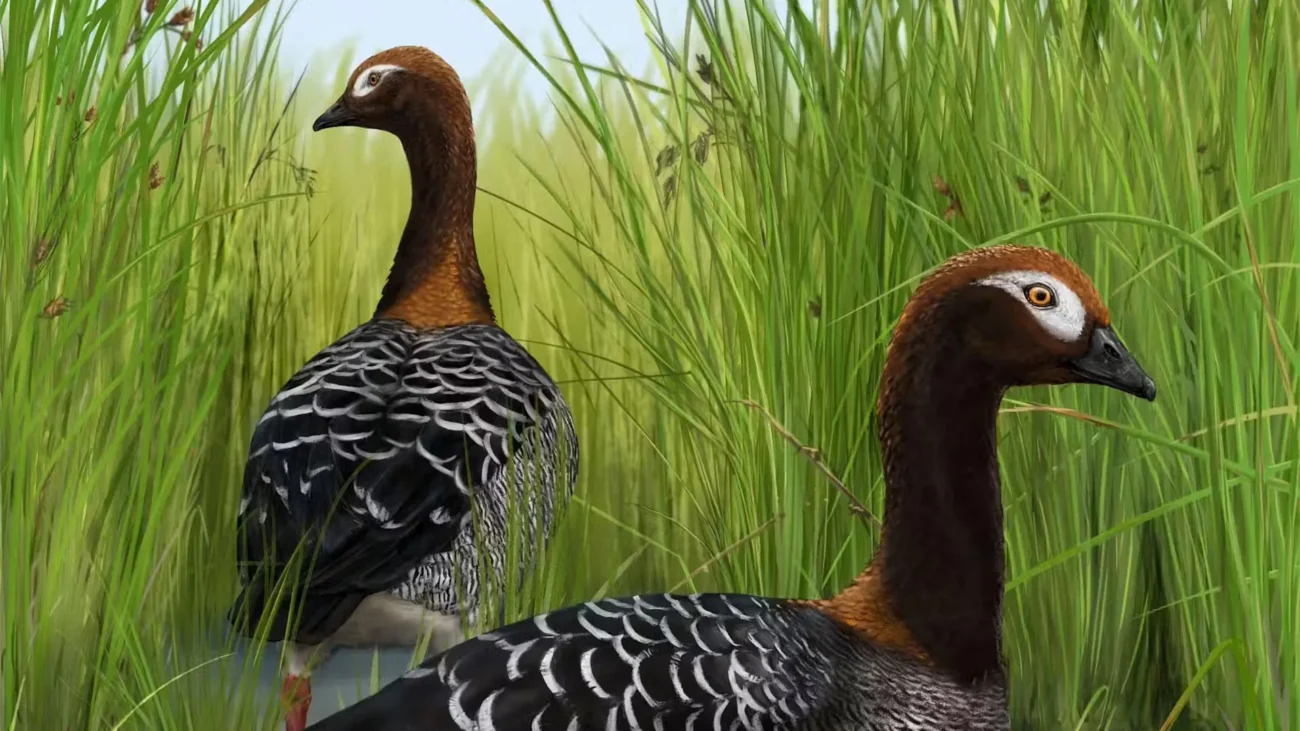
The discovery of a previously unknown species of fossil goose within the ancient lake remnants of Central Otago is fundamentally transforming paleontological understanding of how New Zealand’s extraordinary and isolated bird life evolved. Unearthed from the internationally renowned St Bathans fossil deposits, this small-goose specimen has been officially designated as Meterchen luti. According to researchers from the University of Otago, operating alongside the Museum of New Zealand Te Papa Tongarewa and the University of Cambridge, the finding provides robust new evidence that the foundational origins of Aotearoa’s avifauna were far more dynamic, wave-driven, and complex than long-standing academic dogmas previously suggested.
Published in the peer-reviewed journal Historical Biology, the international study re-examines the intricate lineages of ancient waterfowl that inhabited the submerged landscapes of prehistoric Zealandia. By combining cutting-edge paleogenetics with exhaustive morphological comparisons, the research team has dismantled traditional assumptions regarding how and when iconic bird lineages established themselves in the South Pacific. The implications of this discovery ripple far beyond the taxonomy of ancient waterfowl, offering a modernized framework for evaluating island biogeography, rapid evolutionary adaptation, and the relentless geological transformations that have shaped the biodiversity of New Zealand over tens of millions of years.
The St Bathans Fossil Deposits: A Window into Miocene Zealandia
To understand the profound significance of Meterchen luti, scientists must look back roughly 16 to 19 million years to the early Miocene epoch. During this period, the landmass of Zealandia—the largely submerged continent upon which New Zealand sits—presented an environmental landscape vastly different from the rugged, alpine terrain seen today. The region known today as Central Otago was characterized by extensive, warm, shallow subtropical and temperate freshwater lakes, surrounded by lush vegetation and dynamic volcanic activity.
Over millions of years, the sediment accumulating at the bottom of these ancient water bodies acted as an extraordinary trap for organic remains. The St Bathans Fossil Deposit has emerged as one of the most important paleontological sites in the Southern Hemisphere, preserving a unique snapshot of a Miocene ecosystem that thrived before the dramatic tectonic uplift of the Southern Alps. While the site has previously yielded a breathtaking array of fossilized bones—including early bats, terrestrial mammals, crocodiles, turtles, and a diverse assortment of primitive birds—waterfowl remains have proven exceptionally telling. Although general duck and swan-like fossils appear regularly in the fossil beds, definitive goose material has remained notably scarce, prompting researchers to take a closer, more critical look at the archives.
Unmasking Meterchen luti: Methodology and Nomenclature
The collaborative research initiative was spearheaded by an international consortium of paleontologists and geneticists. Associate Professor Nic Rawlence, Director of the Otago Palaeogenetics Laboratory and co-author of the study, noted that while waterfowl fragments were abundant, a systematic re-examination of every single fossil bone previously cataloged as goose-like was long overdue. The team undertook meticulous comparative analyses, cross-referencing the St Bathans fragments against a vast reference library comprising both modern and extinct bird skeletons from around the globe.
The diagnostic work revealed that a distinct subset of these bones belonged to an entirely undescribed species roughly the size of a modern small goose. To honor both the ecological context of the find and a touch of cultural whimsy, the team named the new taxon Meterchen luti. The generic epithet Meterchen is derived from ancient Greek, translating directly to "mother goose" and serving as an homage to the classic nursery rhyme character, while the specific epithet luti is Latin for "of the mud," signifying the muddy sediments of the ancient lake from which the bones were recovered.
Crucially, morphometric and genetic evaluations confirmed that Meterchen luti possesses no close evolutionary kinship to the recently extinct, giant flightless geese of the genus Cnemiornis that once walked New Zealand, nor is it closely related to the Australian Cape Barren goose (Cereopsis novaehollandiae). Instead, Meterchen luti represents an ancient, distinct lineage that colonized Zealandia deep in the geological past, only to vanish entirely without leaving living descendants.
Chronology of Discovery and the Competing Evolutionary Theories
The debate surrounding the lineage of New Zealand’s geese highlights a broader historical tension within Australasian biogeography: the conflict between the "ancient vicariance/long residency" hypothesis and the "wave-dispersal/recent arrival" model.
For decades, many paleontologists favored a hypothesis suggesting that the St Bathans goose fossils represented the direct, uninterrupted ancestors of the giant flightless Cnemiornis geese. Under this traditional paradigm, it was argued that this specific lineage had maintained a continuous residency on the Zealandia landmass for at least 14 million years, surviving major climatic shifts and geographic isolation.
However, this long-residency model sat in direct opposition to accumulating genetic datasets. Modern mitochondrial and nuclear DNA analyses consistently indicate that the ancestors of Cnemiornis did not evolve in isolation for tens of millions of years. Rather, genetic evidence strongly points to a much more recent trans-Tasman colonization event from Australia roughly seven million years ago. Proponents of the older theory had historically sidelined these genetic incongruities, viewing ancient fossils as the definitive baseline for lineage longevity.
The comprehensive reassessment published by Tennyson, Rawlence, and their colleagues effectively resolves this long-standing academic friction. By demonstrating that the St Bathans goose (Meterchen luti) belongs to an entirely separate, older lineage that ultimately went extinct, the study confirms that the ancestors of the giant Cnemiornis geese indeed arrived via oversea dispersal millions of years later. This reinforces a growing scientific consensus that New Zealand’s bird populations were not simply relics of the ancient Gondwanan supercontinent break-up, but were instead shaped by successive waves of colonization over geological time.
Official Responses and Expert Insights
Lead author Alan Tennyson of the Museum of New Zealand Te Papa Tongarewa emphasized that the evolutionary history of New Zealand’s avifauna is characterized by continuous turnover rather than static isolation.
"While many bird groups have managed to reach New Zealand over the course of millions of years, the genetic and fossil data increasingly demonstrate that the ancestors of several of our most iconic large endemic birds arrived surprisingly recently," Tennyson explained. He pointed to other major species whose lineages established themselves relatively late in Zealandia’s history—such as the takahē, Forbes’ harrier, and the legendary, apex-predatory Haast’s eagle—all of which trace their origins back a mere four to five million years.
Associate Professor Nic Rawlence underscored the power of modern interdisciplinary science in unraveling these complex evolutionary narratives. "By utilizing all the tools available in the modern scientific toolkit—integrating ancient DNA extraction with rigorous morphological paleontology—we can reconstruct how the dynamic geological, climatic, and eventually human-driven history of Zealandia has shaped the evolution of Aotearoa’s fauna with unprecedented precision," Rawlence stated.
Furthermore, Rawlence highlighted the extreme evolutionary malleability demonstrated by island ecosystems. The rapid evolution of the giant flightless Cnemiornis geese serves as a textbook case study in island gigantism and morphological acceleration. Standing roughly one meter tall and tipping the scales at up to 18 kilograms, Cnemiornis evolved into the largest geese to have ever existed anywhere on Earth. Achieving such massive bodily dimensions within a compressed evolutionary window underscores how island environments can radically accelerate physical divergence in the absence of mammalian terrestrial predators.
Broader Impact and Implications for Conservation and Paleontology
The formal description and placement of Meterchen luti carry profound implications for modern conservation biology and global paleontology. Understanding the historical baseline of biodiversity in New Zealand is not merely an academic exercise; it provides essential context for modern ecological restoration and species management.
For over a century, conservation frameworks in New Zealand have operated under the conceptual umbrella of protecting pristine, primordial ecosystems that supposedly remained unchanged since the separation of Gondwana 80 million years ago. However, discoveries like Meterchen luti and the revision of the Cnemiornis lineage paint a picture of an ecological landscape defined by constant flux. Species arrive, diversify, adapt rapidly to island conditions, and—even prior to human intervention—frequently go extinct due to natural climate oscillations, volcanic catastrophes, and interspecific competition.
This dynamic perspective helps conservationists re-evaluate what constitutes a "natural" ecosystem state in Aotearoa. As climate change accelerates contemporary pressures on endemic species, understanding how prehistoric bird populations responded to past environmental volatility offers vital predictive models for modern wildlife management.
In the sphere of global paleontology, the St Bathans deposits continue to punch well above their weight. The identification of Meterchen luti solidifies the site’s status as a world-class Lagerstätte—a sedimentary deposit exhibiting extraordinary fossil richness and preservation. As international research teams continue to comb through the ancient lake muds of Central Otago, applying advanced microscopic imaging, isotopic analysis, and paleogenomic screening, it is virtually certain that further hidden chapters of prehistoric life will emerge from the dark.
The story of Meterchen luti serves as a powerful reminder that the natural history of New Zealand is infinitely more intricate, surprising, and globally significant than previously imagined. Through the collaborative efforts of institutions spanning the globe, the fossilized fragments of a long-vanished ecosystem are once again speaking, offering modern science a clearer, more nuanced window into the evolutionary forces that shaped the unique wildlife of Aotearoa.

