


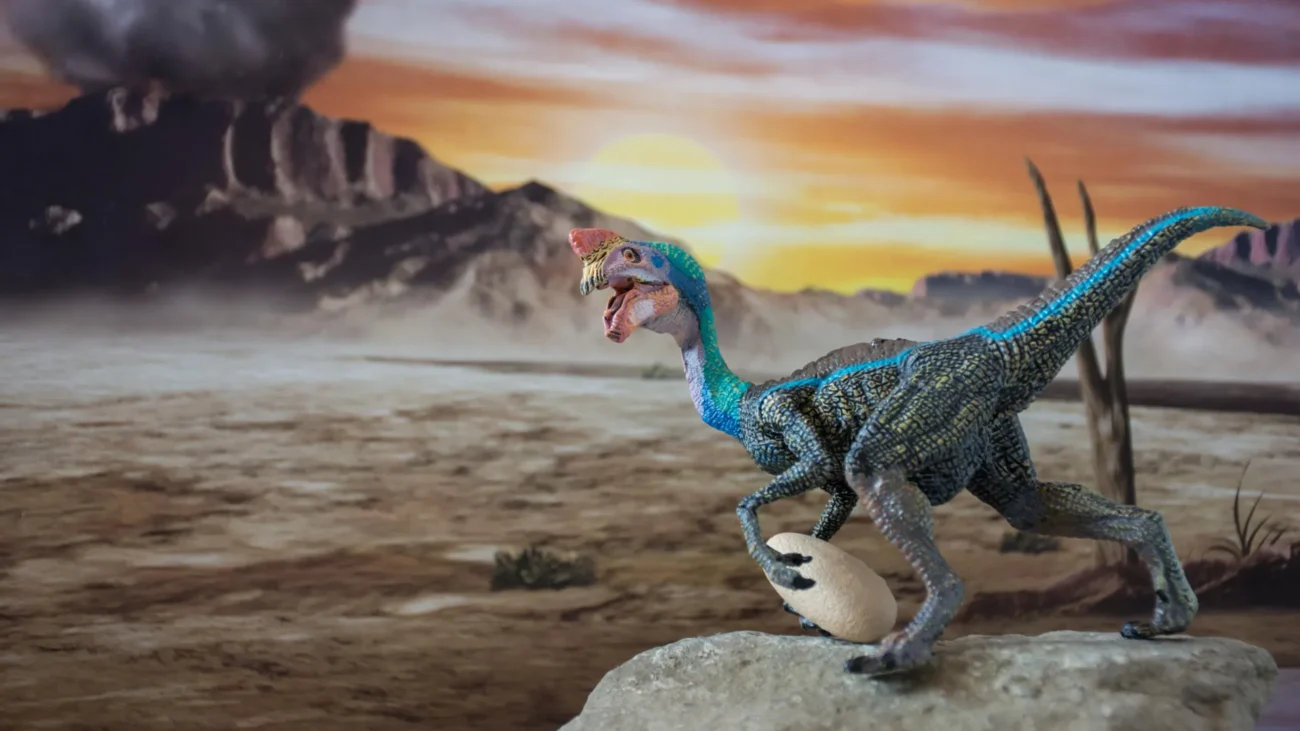
For decades, paleontologists have debated how non-avian theropod dinosaurs brought their young into the world, caught in a scientific tug-of-war between the direct, high-efficiency brooding behaviors of modern birds and the passive, environmental incubation strategies of modern reptiles like crocodiles and turtles. A groundbreaking study published in the journal Frontiers in Ecology and Evolution has now shed fresh light on this evolutionary puzzle. By pairing meticulous physical experimentation with sophisticated computer simulations, an innovative research team in Taiwan has reconstructed the ancient nesting environment of Heyuannia huangi, an oviraptorid dinosaur that roamed the earth roughly 70 to 66 million years ago. Their findings challenge long-held assumptions about prehistoric parental care, revealing that these feathered, bird-like dinosaurs relied on a fascinating cooperative system of co-incubation, sharing the warming duties with the equatorial sun itself.
The Genesis of the Study: Merging Paleontology with Modern Engineering
The inquiry into oviraptor reproduction centers on a foundational evolutionary transition: the bridge between non-avian dinosaurs and modern avian species. Oviraptors—whose name translates ironically to "egg thief," a misnomer originating from the first discovered fossil found near a clutch it was actually brooding rather than plundering—were relatively small-to-medium-sized theropods. Sporting toothless, beak-like jaws, long necks, and often dramatic cranial crests, these creatures lived during the Late Cretaceous Period across what is now arid and semi-arid Central and East Asia, particularly modern-day Mongolia and China.
Fossil discoveries from these regions have yielded astonishingly preserved skeletons of adult oviraptors found directly atop their nests in brooding postures, sparking intense scientific interest. While these specimens confirmed that oviraptors practiced a form of parental care, the mechanics of how they transferred heat to their clutches remained deeply contested. Unlike modern birds, which sit tightly upon their eggs to maximize heat transfer through direct bodily contact, oviraptors possessed anatomical traits and nest architectures that rendered traditional avian incubation nearly impossible.
To resolve this physiological mystery, senior author Dr. Tzu-Ruei Yang, an associate curator of vertebrate paleontology at Taiwan’s National Museum of Natural Science, spearheaded a collaborative project alongside Chun-Yu Su, who was a high school student at Washington High School in Taichung when the research was executed. Recognizing the limitations of studying static fossil records alone, the team decided to recreate an entire prehistoric nesting ecosystem from the ground up.
Building a Prehistoric Nursery: Methodology and Material Science
Recreating the physical reality of a 70-million-year-old nest required extraordinary ingenuity, particularly given the unique morphology of Heyuannia huangi. This specific oviraptor species measured approximately 1.5 meters in total length, weighed an estimated 20 kilograms, and constructed semi-open nests featuring distinctive double or multiple rings of eggs.
To simulate the brooding adult, the researchers constructed a life-sized anatomical model. The structural core was built using a supportive wooden framework coupled with lightweight polystyrene foam to mimic the dinosaur’s body volume. To account for the thermal insulation properties of living tissue, the team layered cotton, cloth, and bubble paper over the artificial torso, carefully matching the expected weight distribution and dimensions of a living Heyuannia huangi.
The eggs presented an even greater challenge. Because oviraptor eggs are morphologically distinct from those of any extant species, standard avian or reptilian eggs could not be used as proxies. The team cast custom artificial eggs out of resin, designing them to approximate the size, shape, and thermal conductivity of genuine fossilized oviraptor eggs. These resin replicas were then arranged in meticulous double rings, replicating the exact spatial geometry observed in well-preserved fossil nests unearthed in China.
Environmental Dynamics: The Sun as a Co-Incubator
Once the physical model and artificial nest were fully assembled, the researchers subjected the setup to rigorous thermal testing under varying environmental conditions to observe how heat transferred through the clutch. The results revealed a complex thermodynamic interplay dictated heavily by ambient weather and the exact positioning of the brooding adult.
Under cooler environmental conditions, temperature gradients across the nest were striking. Eggs situated in the outer ring of the clutch—farther from the direct weight and warmth of the brooding adult—exhibited temperature discrepancies of up to 6 degrees Celsius compared to the centrally located eggs. In a biological context, such a significant thermal variation would likely have triggered asynchronous hatching, a developmental phenomenon where certain eggs within the same clutch mature and hatch significantly earlier than others.
However, when the ambient temperature was elevated to simulate a warmer prehistoric climate, the thermal gap between the inner and outer rings dropped precipitously to a mere 0.6 degrees Celsius. This dramatic stabilization demonstrated that sunlight played a vital, active role in the incubation process. Rather than acting as the sole thermal generator, the adult oviraptor and the ambient heat of the sun functioned as co-incubators.
"It’s unlikely that large dinosaurs sat atop their clutches," Dr. Yang explained, noting the broader reptile-like tendencies of megafaunal incubation. "Supposedly, they used the heat of the sun or soil to hatch their eggs, like turtles. Since oviraptor clutches are open to the air, heat from the sun likely mattered much more than heat from the soil."
Oviraptors Versus Modern Birds: Redefining Thermal Efficiency
The study’s quantitative analysis also provided a clear metric for oviraptor incubation efficiency, comparing it directly with that of modern avian species. Most living birds rely on what evolutionary biologists term thermoregulatory contact incubation, or TCI. This strategy requires three strict physiological and behavioral conditions: the incubating parent must maintain direct physical contact with every individual egg, the parent’s body must serve as the primary and nearly exclusive heat source, and the eggs must be kept within a tightly regulated, narrow temperature range to ensure uniform embryonic development.
The physical experiments demonstrated that oviraptors could not fulfill these stringent criteria. Due to the semi-open design of their nests and the geometric layout of their multi-ringed clutches, an adult Heyuannia huangi was physically incapable of making simultaneous direct contact with every egg in the nest.
"Moreover, we obtained an estimate of the incubation efficiency of oviraptors, which is much lower than that of modern birds," noted first author Chun-Yu Su.
This lower efficiency, however, should not be misinterpreted as an evolutionary deficiency. The combination of parental brooding and direct solar radiation represents an intermediate adaptive strategy—an evolutionary halfway point between the buried, purely environmental nests of ancestral archosaurs and the highly specialized, metabolically intensive contact brooding seen in modern birds.
Broad Implications and the Evolution of Avian Parenting
The implications of this research extend far beyond the thermal dynamics of a single dinosaur species. By demonstrating that oviraptors utilized a dual-heat incubation strategy, the study offers deeper insights into the evolutionary timeline of parental care behaviors. Traits such as nest attendance, brooding postures, and passive environmental resource utilization evolved long before the emergence of true, modern birds during the Mesozoic Era.
Furthermore, the researchers caution against viewing evolutionary history through a teleological lens of progress or superiority. Dr. Yang emphasizes that the comparison between dinosaur reproduction and avian reproduction is not a competitive hierarchy.
"Modern birds aren’t ‘better’ at hatching eggs," Yang asserted. "Instead, birds living today and oviraptors have a very different way of incubation or, more specifically, brooding. Nothing is better or worse. It just depends on the environment."
As global climates during the Late Cretaceous Period varied significantly from modern Earth conditions, these dinosaurs were finely tuned to their specific ecological niches. The longer incubation periods hypothesized for oviraptors, combined with their reliance on ambient solar energy, formed a robust reproductive strategy that successfully sustained their populations for millions of years prior to the Cretaceous-Paleogene extinction event.
A Triumph for Regional and Interdisciplinary Science
Beyond its contributions to vertebrate paleontology, the study stands as a remarkable testament to the power of interdisciplinary collaboration and accessible scientific inquiry. By successfully merging hands-on physical reconstruction with advanced thermal fluid dynamics and computer modeling, the research team has blazed a new methodological trail for studying dinosaur reproduction without relying exclusively on incomplete fossil remains.
Additionally, the project highlights the borderless nature of modern scientific discovery. Reflecting on the journey from a high school laboratory to an internationally recognized publication in Frontiers in Ecology and Evolution, Dr. Yang underscored the inspirational value of the work for young researchers in regions traditionally removed from major fossil-bearing localities.
"It also truly is an encouragement for all students, especially in Taiwan," Yang concluded. "There are no dinosaur fossils in Taiwan, but that does not mean that we cannot do dinosaur studies."
As scientists continue to unpack the complex evolutionary tapestry connecting non-avian dinosaurs to the feathered fauna inhabiting our modern world, studies like this one prove that imagination, rigorous engineering, and paleontology can successfully resurrect the ancient behaviors of a lost world.

