


For generations, the prevailing consensus within the global paleontological community was absolute and uncompromising: the process of fossilization acts as a biological eraser. Scientists long assumed that over millions of years, heat, pressure, microbial activity, and chemical groundwater percolation would utterly obliterate any original organic molecules once present in living tissues. Bones, teeth, and shells were viewed strictly as mineralized templates—inorganic casts where calcium phosphate and silica had meticulously replaced every trace of ancient proteins, DNA, and soft tissue. Under this classical framework, fragile biological macromolecules such as collagen were deemed chemically incapable of surviving across tens of millions of years of deep geological time.
However, a groundbreaking multidisciplinary study led by researchers at the University of Liverpool has shattered this long-held dogma. Providing some of the most robust and incontrovertible evidence to date, the new research demonstrates that exceptional Mesozoic fossils—including the bones and teeth of dinosaurs—can indeed retain authentic remnants of their original organic building blocks. Utilizing state-of-the-art analytical chemistry techniques, a team of scientists successfully detected and verified molecular traces of collagen embedded deep within the hip bone of an Edmontosaurus, a massive duck-billed herbivorous dinosaur that roamed North America during the Late Cretaceous epoch.
This monumental discovery injects definitive empirical data into a fierce, three-decade-long scientific debate regarding the true limits of molecular preservation. By bridging the fields of paleontology, materials science, and advanced mass spectrometry, the study not only validates the existence of ancient proteins but also establishes a roadmap for how researchers might extract hidden biological histories from museum archives worldwide.
An Exceptional Specimen from the Hell Creek Formation
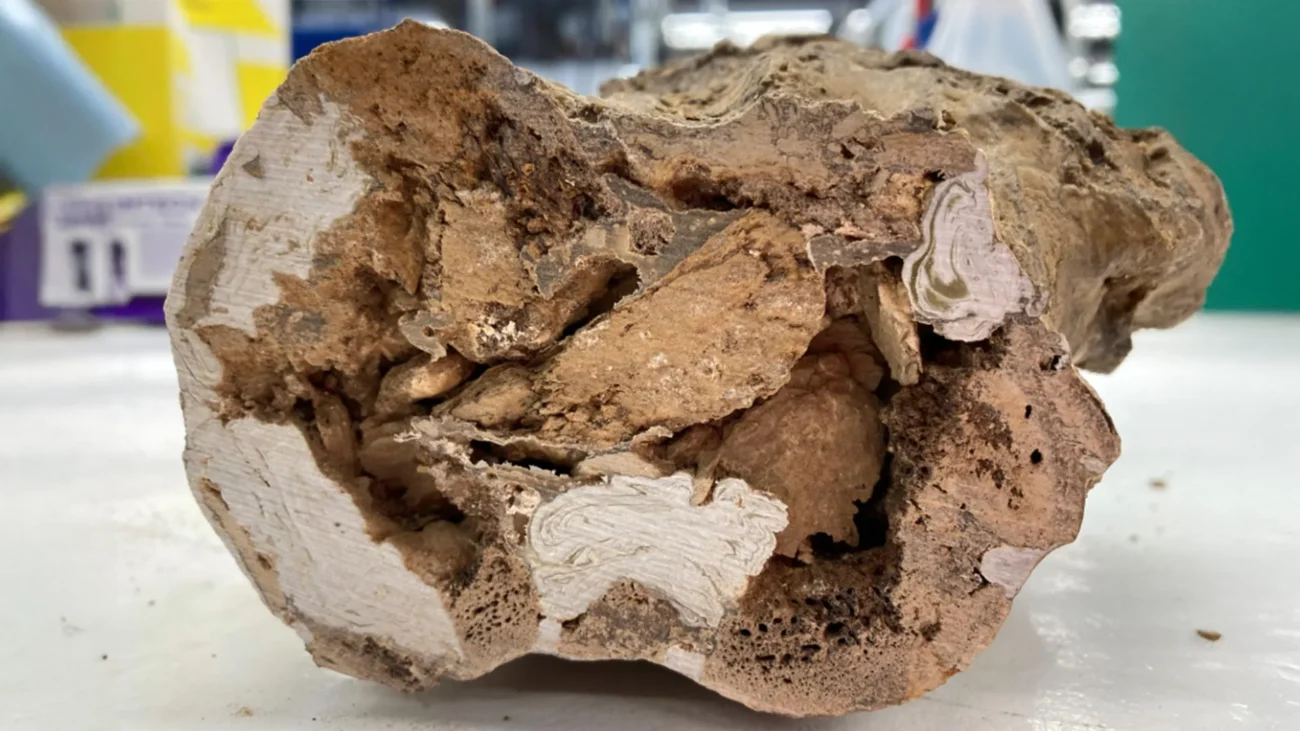
At the heart of this scientific breakthrough is an unusually well-preserved 22-kilogram sacrum—a fused group of vertebrae connected to the pelvis that forms a critical part of the lower spine—belonging to an Edmontosaurus. The fossil was originally excavated from the richly fossiliferous Upper Cretaceous rock layers of the Hell Creek Formation in South Dakota. Renowned globally among paleontologists, the Hell Creek geological strata preserve a diverse ecosystem that existed immediately before the catastrophic Cretaceous-Paleogene extinction event, which wiped out the non-avian dinosaurs approximately 66 million years ago.
Following its excavation, the specimen found a home within the scientific collections of the University of Liverpool. Because the bone exhibited an extraordinarily rare degree of structural preservation—largely shielded from destructive groundwater currents and extreme diagenetic alteration—it presented an ideal candidate for cutting-edge molecular interrogation. Recognizing the unique opportunity, an interdisciplinary team spearheaded by Professor Steve Taylor decided to subject the ancient bone to advanced analytical methods historically reserved for modern biochemistry and proteomics rather than ancient paleontology.
The research team deployed a battery of sophisticated technologies, most notably protein sequencing and high-resolution mass spectrometry. Mass spectrometry operates by ionizing chemical compounds and measuring the mass-to-charge ratios of their constituent ions, enabling scientists to precisely identify molecules based on their unique chemical properties. In this investigation, the technology was specifically calibrated to hunt for molecular signatures and peptide sequences characteristic of collagen, which serves as the primary structural protein providing tensile strength and elasticity to vertebrate bone.
Resolving the Contamination Controversy
The question of authenticity has long plagued the field of molecular paleontology. Ever since pioneering researchers first proposed the survival of soft tissues and proteins in dinosaur fossils during the late 20th century, the scientific community has remained deeply skeptical. Critics and independent researchers frequently argued that any organic materials detected within ancient fossils could not possibly be autochthonous—meaning native to the animal. Instead, skeptics proposed that these molecules were modern contaminants introduced via environmental percolation, soil bacteria, fungal growth, handling by excavators, or laboratory reagents during preparation.
This contamination hypothesis served as a formidable barrier to acceptance. To definitively answer the skepticism, the Liverpool-led team designed their protocols to rigorously differentiate between modern biological contaminants and genuinely ancient, degraded proteins.
Professor Steve Taylor, chair of the Mass Spectrometry Research Group at the University of Liverpool’s Department of Electrical Engineering & Electronics, emphasized the significance of the findings in addressing this controversy. "This research shows beyond doubt that organic biomolecules, such as proteins like collagen, appear to be present in some fossils," Professor Taylor stated. "Our results have far-reaching implications. Firstly, it refutes the hypothesis that any organics found in fossils must result from contamination."
By establishing that the detected molecules possess the chemical markers of profound degradation—such as specific amino acid modifications consistent with millions of years of slow, ambient radioactive decay and chemical cross-linking—the researchers proved that the proteins are contemporaneous with the fossil itself, rather than recent interlopers.
Collaborative Science: Confirming the Molecular Signatures
The complexity of the task required a coordinated effort across multiple specialized research institutions, bringing together experts in protein chemistry, mass spectrometry, and materials engineering.
Key contributions came from researchers at the University of California, Los Angeles (UCLA), who utilized advanced tandem mass spectrometry. This technique allows scientists to break down peptide ions into smaller fragments, yielding a detailed structural fingerprint of the molecule. Through this method, the UCLA team successfully detected and quantified—for the first time in this specimen—hydroxyproline, an uncommon non-proteinogenic amino acid that plays a pivotal role in stabilizing the triple-helix structure of collagen. Because hydroxyproline is heavily concentrated in collagen and largely absent from most environmental contaminants, its detection served as a critical chemical smoking gun, confirming the presence of heavily decayed collagenous material within the dinosaur bone.
Concurrently, the University of Liverpool’s Mass Spectrometry Research Group performed rigorous protein sequencing, while specialists from the university’s cutting-edge Materials Innovation Factory carried out complementary analyses to cross-verify the structural data. Furthermore, the Centre for Proteome Research at Liverpool successfully identified specific fragments of collagen alpha-1, which constitutes the primary form of collagen found within vertebrate bone tissue.
The convergence of these independent analytical pipelines left little room for doubt. The structural proteins of an animal that lived roughly 75 million years ago had managed to persist against all chemical odds.
Revisiting a Century of Geological Microscopy
Beyond proving that ancient proteins can survive, the study opens up an unprecedented methodological pathway for discovering similar organic remnants in existing museum collections. For approximately one hundred years, geologists and paleontologists have utilized cross-polarized light microscopy to examine thin sections of fossilized bone. This specialized imaging technique employs polarized light filters to illuminate microscopic crystalline structures, stress lines, and internal porosities within mineralized tissues that remain entirely invisible under standard bright-field microscopes.
According to the research team, these historical microscopy archives may hold the key to uncovering vast quantities of fossilized organic material without requiring destructive sampling of every specimen in existence.
"Secondly, it suggests that cross-polarized light microscopy images of fossil bones, collected for a century, should be revisited," Professor Taylor explained. "These images may reveal intact patches of bone collagen, potentially offering a ready-made trove of fossil candidates for further protein analysis. This could unlock new insights into dinosaurs—for example, revealing connections between dinosaur species that remain unknown."
By identifying distinct optical patterns under polarized light that correlate with preserved microstructures of collagen, researchers can preemptively screen fossils for molecular viability. This targeted approach minimizes the need to sacrifice rare or scientifically invaluable fossil material for mass spectrometry, streamlining the search for ancient biomolecules.
The Enigma of Deep-Time Preservation
While the empirical evidence confirming the existence of ancient collagen is exceptionally strong, the discovery deepens a profound theoretical mystery in biochemistry and taphonomy: How do fragile proteins survive for tens of millions of years?
In standard biological environments, proteins begin to break down almost immediately after death through enzymatic autolysis, microbial putrescision, and hydrolysis—a chemical reaction where water molecules cleave the peptide bonds holding amino acid chains together. Under normal surface conditions, even the most robust structural proteins are completely degraded within thousands of years, let alone the 66 million years or more spanning the Mesozoic era.
The survival of collagen across such vast expanses of geological time implies the existence of unique, highly effective preservation mechanisms that science is only beginning to understand. Researchers hypothesize that specific geochemical environments within certain fossil matrices may trigger natural cross-linking or entrapment processes. For instance, when mineral matrices such as hydroxyapatite crystals grow densely around collagen fibrils, they may physically seal the protein away from circulating water and microbial enzymes. Additionally, reactions with iron or oxidative byproducts from decaying blood vessels may create protective covalent bonds that render the protein matrix exceptionally resistant to decay—effectively locking the molecules in a molecular stasis for eons.
Unlocking the Molecular Frontier of Paleontology
The resolution of this long-running debate marks the dawn of a new era in paleontology. For centuries, our understanding of extinct life has been constrained by morphology—the physical shape and structure of bones, teeth, and impressions left in stone. While anatomical studies have mapped the evolutionary trees of dinosaurs with remarkable precision, they possess hard limits when attempting to reconstruct soft-tissue biology, metabolic rates, physiological adaptations, and precise genetic relationships among deeply split clades.
The ability to recover and sequence ancient proteins bridges the chasm between classical paleontology and modern molecular biology. Because amino acid sequences are direct translations of genetic codes, analyzing ancient proteins allows scientists to reconstruct evolutionary lineages using molecular phylogenetics. This technique can potentially resolve long-standing debates regarding the precise family tree of dinosaurs, their metabolic status (whether they were warm-blooded, cold-blooded, or intermediate), and their precise physiological responses to ancient climate shifts.
As laboratories around the world begin to apply these advanced mass spectrometry and proteomics protocols to other exceptional fossils, the boundaries of what we can know about extinct life continue to expand. The stubborn dogma that declared organic molecules utterly perishable in deep time has finally crumbled, replaced by the realization that nature sometimes leaves behind durable molecular whispers capable of surviving across epochs to tell the story of a lost world.

