


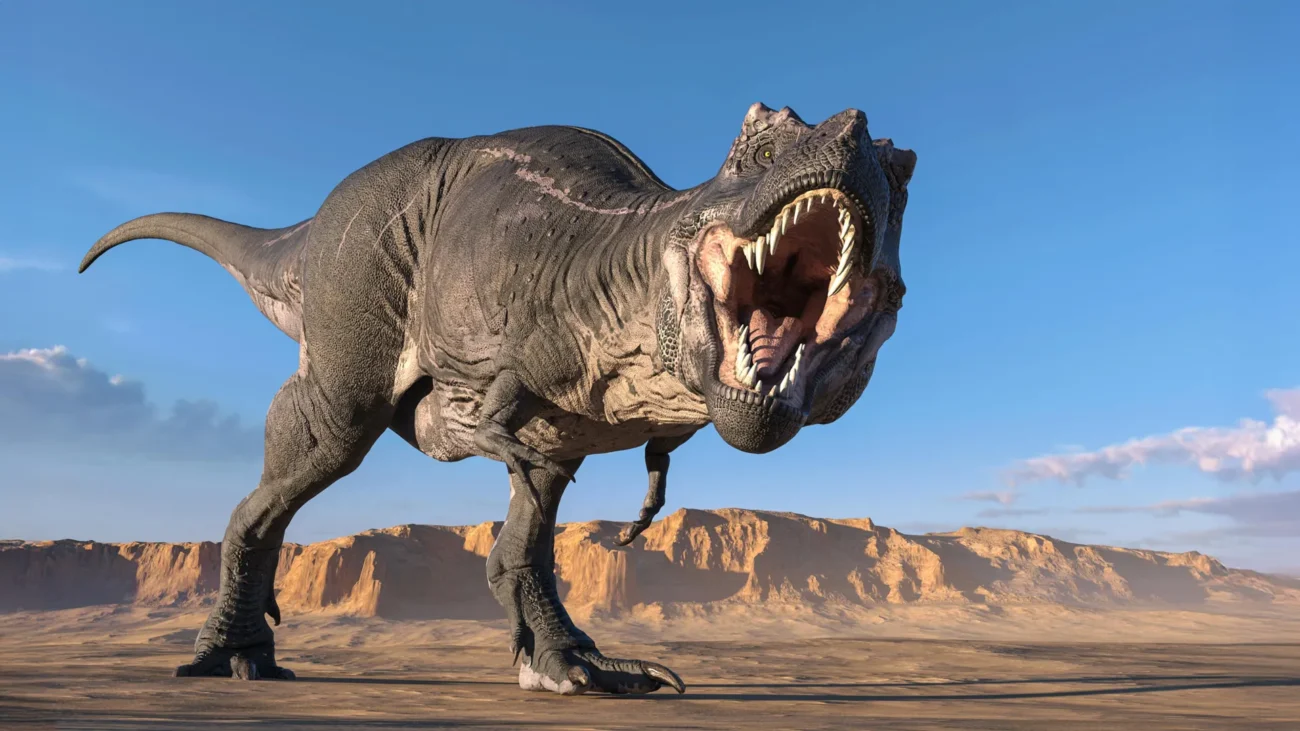
For more than a century, the physiological nature of the Tyrannosaurus rex has remained one of the most fiercely debated topics in paleontology. Researchers have long sought to bridge the gap between cold-blooded reptiles and warm-blooded birds by reconstructing the biology of this iconic apex predator from fragmentary evidence, including fossilized bones, teeth, footprints, and ancient nest sites. While previous discoveries—such as T. rex fossils unearthed in the subpolar expanses of ancient Alaska—strongly hinted that the colossal carnivore could tolerate bitter cold, definitive proof of its metabolic inner workings had remained elusive. Now, a team of researchers at the University of California, Los Angeles (UCLA), has achieved what was once considered impossible: they have successfully and accurately taken the body temperature of a Tyrannosaurus rex.
Utilizing a refined chemical technique applied to fossilized teeth provided by the Natural History Museum of Los Angeles County, the researchers calculated that T. rex maintained a steady internal body temperature of approximately 97 degrees Fahrenheit (36 degrees Celsius). This reading places the king of the dinosaurs remarkably close to the average core temperature of a modern human. Published in the journal Science Advances, the findings provide unprecedented empirical support for the long-held hypothesis that T. rex was an active, high-metabolism hunter rather than a sluggish, sun-basking scavenger. Furthermore, this internal thermal regulation sheds vital light on how tyrannosaurs successfully conquered diverse environments, from tropical floodplains to freezing polar regions, during the Cretaceous period.
The Evolution of a Prehistoric Thermometer
The breakthrough rests upon a decade of meticulous methodological refinement by geobiologists at UCLA. About ten years ago, researchers pioneered a technique designed to determine whether extinct creatures were warm-blooded (endothermic) or cold-blooded (ectothermic) by analyzing the atomic composition of their skeletal remains. However, applying this nascent technology to a T. rex presented an insurmountable hurdle during its early development: the technique demanded a destructive sample size far too large for any museum to responsibly sacrifice from a rare, irreplaceable, and historically significant fossil specimen.
Undeterred, the UCLA research team spent the ensuing decade drastically optimizing the protocol. By drastically reducing the quantity of fossilized material required for testing by roughly 90 percent, the scientists transformed the procedure from a high-stakes, destructive process into a micro-sampling technique. This technological leap was the turning point that finally persuaded curatorial staff at the Natural History Museum of Los Angeles County to grant access to tiny, otherwise obscured portions of two teeth belonging to "Thomas"—one of the most complete and towering T. rex skeletons ever displayed in the museum’s dinosaur hall.
Robert Eagle, a UCLA geobiologist and co-author of the study, emphasized the novelty of the achievement. "No one’s been able to make a temperature measurement like this before," Eagle stated. "We found T. rex was 36 Celsius (97 Fahrenheit), about the same as humans. The temperature is about what I would have guessed—higher than a reptile or a slow mammal like a sloth, but lower than an avian." While T. rex remained fundamentally a scaly, egg-laying reptile in terms of its evolutionary lineage, its core operating temperature aligned far more closely with modern warm-blooded mammals than with contemporary cold-blooded reptiles, which typically hover between 82 and 86 degrees Fahrenheit (28 to 30 degrees Celsius). Conversely, modern birds—the direct evolutionary descendants of theropod dinosaurs—boast even higher body temperatures, frequently ranging from 104 to 109 degrees Fahrenheit (40 to 43 degrees Celsius).
Inside the Enamel: The Chemistry of Ancient Heat
The foundation of this paleothermometry lies locked within microscopic chemical bonds preserved safely inside durable tooth enamel. Within these structures, rare isotopes of carbon and oxygen can bond together, with the frequency of their bonding directly dictated by temperature. Cooler conditions encourage a higher volume of these specific bonds to form, whereas warmer conditions inhibit their creation. Consequently, the chemical signature locked within fossilized teeth acts as an immutable molecular thermometer, distinguishing the stable internal heat of an endotherm from the ambient-dependent thermal profile of an ectotherm.
To preserve the integrity of the data across millions of years, researchers must select the ideal skeletal material. While bones undergo constant biological remodeling, resorption, and replacement throughout an animal’s life, tooth enamel features exceptionally robust crystalline structures. These large crystals resist environmental contamination and chemical alteration far better than spongy or cortical bone, shielding the original biological signal from groundwater leaching and geological transformation over eons.
To execute the measurement for this study, Eagle and lead author Randy Flores utilized a specialized dental drill to harvest microscopic quantities of enamel powder from the Thomas the T. rex teeth. This powder was subsequently dissolved in concentrated phosphoric acid, releasing carbon dioxide gas containing the targeted isotope bonds. The gas was then introduced into a mass spectrometer to measure precise isotope ratios. By pressurizing the gas sample to generate a denser stream of carbon dioxide, the researchers successfully coaxed usable, highly accurate readings out of minuscule amounts of fossil material—paving the way for future analyses of other rare specimens.
Metabolic Implications for an Apex Predator
The verification of a 97-degree Fahrenheit body temperature adds robust physical data to the long-standing debate concerning dinosaur physiology. An animal of such colossal proportions—weighing up to nine tons—faced massive physiological challenges, including the risk of overheating if it possessed an inefficient internal cooling system, or sluggishness if it relied entirely on environmental heat. Maintaining an elevated, internally regulated body temperature provided T. rex with the stamina and metabolic output necessary to sustain an active lifestyle as a top-tier predator or opportunistic scavenger.
Furthermore, this internal heat engine conferred a massive ecological advantage: the capacity to colonize colder latitudes. Co-author Alessandro Chiarenza, a paleontologist at University College London, noted that an internally regulated temperature would have allowed tyrannosaurs to thrive in environments where strictly cold-blooded reptiles would rapidly perish. During the Cretaceous Period, Earth experienced a profound greenhouse climate, with global temperatures roughly 11 to 25 degrees Fahrenheit warmer than they are today. Yet, despite this global warmth, ancient polar winters—such as those in prehistoric Alaska—still posed severe thermal and ecological challenges.
This physiological capability neatly mirrors the fossil record. While modern paleontologists have systematically failed to uncover the fossilized remains of cold-blooded reptiles such as lizards, turtles, and crocodiles in Cretaceous Alaska, T. rex fossils are notably present. "Now we have empirical evidence using this geologic thermometer," Chiarenza explained. "Using paleoclimate models of the past, we were able to reconstruct a range in North America 66 million years ago that stretched from Mexico to Alaska, based on where T. rex could have survived with a 97-degree Fahrenheit body temperature."
Balancing Conservation and Discovery in the Museum Vault
Granting access to world-class fossils for destructive testing is a decision that museum curators do not take lightly. Because scientific techniques continually evolve, removing any portion of a specimen permanently alters a priceless historical object. However, the dramatic reduction in sample size achieved by the UCLA team fundamentally shifted the risk-benefit equation for the Natural History Museum of Los Angeles County.
Luis Chiappe, curator of the museum’s Dinosaur Institute and head of research and collections, detailed the rigorous internal deliberations that preceded the sampling. "We’re asked for fossils for use in destructive analysis all the time," Chiappe said. "The museum contains tens of millions of specimens of minerals, animals, and fossils that are irreplaceable. We have to make decisions that balance the damage to the specimen against gaining knowledge about the natural world. Sacrificing small portions of two teeth to learn about T. rex’s body temperature is definitely worth the trade-off." The teeth selected for the study were carefully harvested from non-publicly displayed specimens, ensuring that the museum’s main gallery exhibition remained undisturbed while enabling world-class scientific inquiry.
Validating the Data: The Crocodilian Control
To ensure that the 97-degree reading was not a false positive driven by diagenesis—the chemical alteration of fossils by surrounding ground minerals and pressure over millions of years—the researchers employed a crucial geological control. Alongside Thomas the T. rex, the Hell Creek formation in Montana yielded ancient crocodilian fossils that were subjected to the exact same isotopic analysis.
The results yielded a stark contrast: the ancient crocodilians registered a body temperature of approximately 86 degrees Fahrenheit (30 degrees Celsius)—a full eleven degrees cooler than the T. rex specimen. This significant temperature differential effectively eliminated the hypothesis that surrounding geological processes or uniform ground temperature shifts were responsible for shaping the molecular signatures of both animals. If local geology had driven the readings, both species would have displayed identical thermal profiles. Instead, the distinct readings confirm that the isotopic data genuinely reflect the intrinsic biological differences between the two prehistoric animals, validating the accuracy of the paleothermometer.
Broader Impact and Future Horizons
The successful deployment of this refined isotopic thermometer marks a watershed moment in vertebrate paleontology, opening the door to re-evaluating the metabolic histories of countless other extinct creatures. By bridging the gap between anatomical theory and chemical reality, scientists can now map the evolutionary transition from primitive ectothermy to advanced endothermy with unprecedented precision. As researchers continue to refine these molecular techniques and apply them across diverse dinosaur clades, our understanding of how these majestic animals lived, hunted, and conquered a dynamic planet continues to deepen, transforming our view of the ancient world one microscopic bond at a time.

