


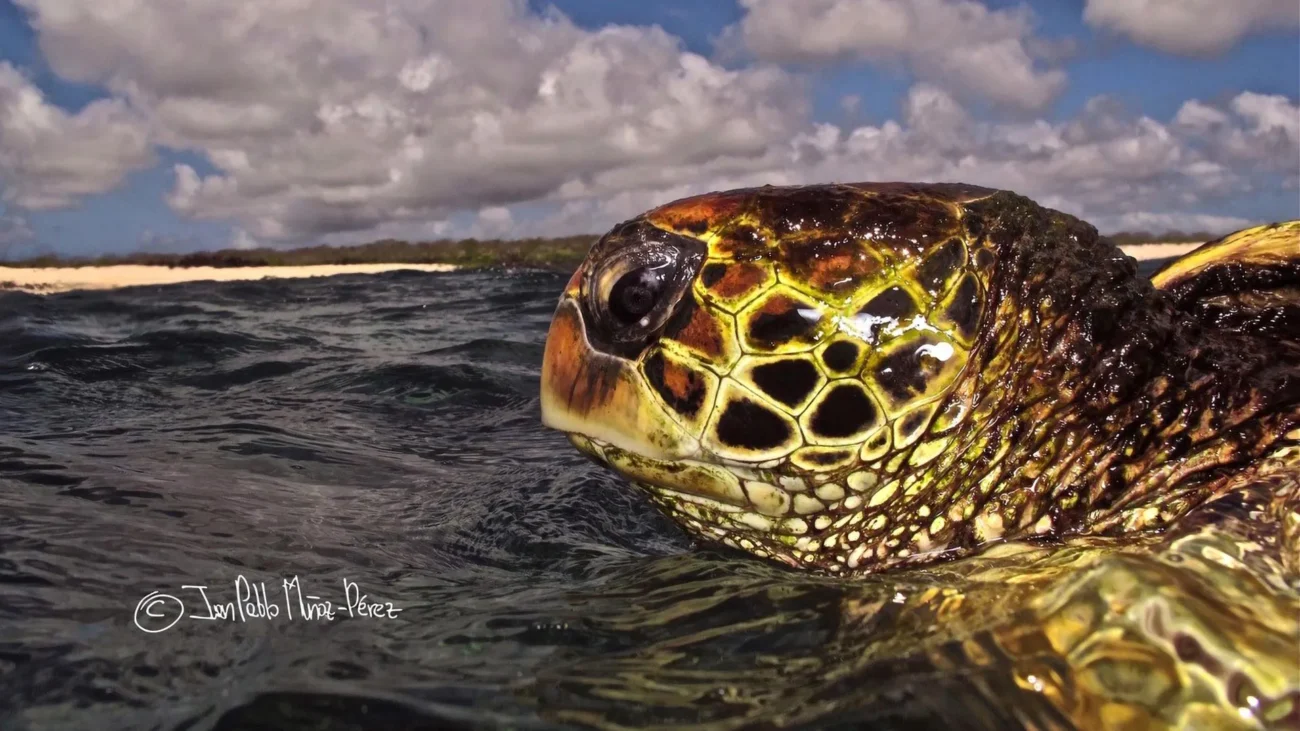
For generations, the general consensus within the marine biology community has framed sea turtles as the ultimate global commuters of the open ocean. Armed with an innate, sophisticated internal compass—calibrated by the Earth’s geomagnetic field, the position of the sun, and the shifting dynamics of vast oceanic currents—these aquatic reptiles are renowned for undertaking epic, transoceanic migrations. They routinely traverse thousands of miles from coastal foraging grounds to pelagic zones, and eventually back to the very beaches where they hatched to perpetuate their species.
This entrenched paradigm of perpetual motion has long governed conservation strategies and ecological models. However, a groundbreaking study recently published in the journal Frontiers in Amphibian and Reptile Science has disrupted this traditional understanding. Focusing on a unique population residing within the pristine waters of the Galapagos Islands, researchers have uncovered an unexpected behavioral twist: rather than roaming across vast ocean basins, a distinct subset of green sea turtles prefers to stay remarkably close to home.
The findings challenge deeply rooted assumptions about marine reptile mobility, shedding light on the complex behavioral ecology of species that share the same habitat yet adhere to profoundly different life strategies. By tracking these animals via satellite telemetry over a multi-year period, scientists are rewriting the playbook on how we perceive, study, and ultimately protect marine megafauna in isolated oceanic archipelagos.
Understanding the Distinct Lineages of Green Sea Turtles
To fully grasp the significance of the recent Galapagos discovery, one must examine the broader taxonomy and life history of the green sea turtle (Chelonia mydas). Distinct among the seven living species of sea turtles, adult green sea turtles transition from an omnivorous diet during their early developmental stages to a strictly herbivorous adult diet. As they mature, their nutritional focus shifts decisively toward marine vegetation, predominantly consuming nutrient-rich seagrasses and various species of algae.
Within this species, scientists recognize multiple genetically distinct morphs, or forms, which exhibit variations in coloration, geographic distribution, and physiological traits. Among these, the "yellow-morph" green sea turtle is traditionally found across the tropical and subtropical expanses of the western Pacific Ocean. Conversely, the "black-morph" variant predominantly occupies the eastern Pacific, ranging from the waters west of the Americas down to the latitudes south of southern California.
The Galapagos Islands serve as a rare and ecologically unique intersection—the only known geographic location on Earth where these two distinct forms coexist in the same marine environment. Here, yellow and black morphs mingle freely in shallow coastal waters, grazing side-by-side on the same foundational marine vegetation. Yet, despite sharing dietary preferences and spatial territory, the two morphs are not entirely identical. Observational and physiological data indicate that juvenile yellow morphs experience a more rapid growth rate than their black-morph counterparts. This growth disparity hints at underlying physiological, metabolic, or genetic differences that researchers are only beginning to identify and characterize.
Chronology of the Galapagos Telemetry Study
The journey toward challenging the nomadic narrative began in earnest well before the study’s formal publication. In 2015, an international research coalition led by Dr. John W. Rowe, a professor of biology at Alma College in the United States, and Dr. Juan Pablo Muñoz Pérez, a professor at the Universidad San Francisco de Quito in Ecuador, set out to map the precise movements of yellow-morph green sea turtles in the Galapagos Marine Reserve.
The chronology of the investigation unfolded in several methodical phases:
- Initial Planning and Capture (2015): Researchers strategically targeted shallow coastal waters near four distinct islands within the archipelago. Utilizing careful, non-invasive handling protocols, the team successfully captured a cohort of nine adult yellow-morph green sea turtles, consisting of seven males and two females.
- Tagging and Telemetry Deployment: Each turtle was assigned an identifying nickname and fitted with advanced electronic satellite transmitters. These transmitters were securely fastened to the animals’ carapaces to relay precise positioning data via the low-orbit Argos satellite network.
- Long-Term Monitoring Phase (2015–2018): The tagged animals were continuously tracked for varying durations, with individual monitoring windows extending up to 418 days. Tracking data naturally concluded as transmitters eventually detached through natural wear or ceased functioning.
- Data Synthesis and Analysis (2019–2023): The accumulated spatial data underwent rigorous geographic and statistical analysis to map individual home ranges, inter-island transit routes, and seasonal movement patterns.
- Publication (2024): The culmination of the multi-year effort was peer-reviewed and published in Frontiers in Amphibian and Reptile Science, formally introducing the scientific community to the remarkably sedentary nature of the archipelago’s yellow morphs.
Supporting Data and Spatial Dynamics
The telemetry data yielded results that fundamentally surprised the research team. Conventional wisdom suggested that these animals would utilize the Galapagos merely as a temporary fueling station before embarking on massive journeys across the Pacific. Instead, the satellite tracking revealed an intense affinity for localized, shallow coastal habitats.
Over the span of the study, none of the nine satellite-tagged yellow-morph turtles left the boundaries of the 198,000-square-kilometer Galapagos Marine Reserve. While occasional exploratory excursions brought individuals as far as 25 kilometers offshore, the vast majority of their time was spent lingering within close proximity to the islands’ coastlines.
Individual spatial usage varied considerably, yet shared common structural themes:
- Fidelity to Single Islands: Five of the nine monitored turtles restricted the vast majority of their daily activities to the immediate waters surrounding a single island.
- Inter-Island Corridors: Other individuals demonstrated broader intra-archipelago travel. Turtles nicknamed Bernardo and Sara were documented moving fluidly between Isabela and San Cristóbal islands. Leandro chose a route connecting Isabela and Española.
- The Most Adventurous Subject: The turtle designated as Ainoa earned the title of the most mobile participant in the cohort. Initially tagged near San Cristóbal, Ainoa subsequently undertook documented journeys to Santa Cruz before ultimately traveling to Isabela.
- Seasonal Behavioral Shifts: The data also exposed a distinct temporal rhythm. Movement between different islands was not distributed randomly throughout the year; rather, transit exclusively occurred during the cooler seasonal window spanning from April through October.
- Home Range Metrics: On average, each individual turtle maintained a sprawling home range covering approximately 1,498 square kilometers, though the actual size of these territories fluctuated significantly from animal to animal based on local resource availability and geography.
Expert Analysis and Official Perspectives
The revelation that yellow-morph green sea turtles can be so strictly homebound has prompted extensive dialogue among researchers regarding the evolutionary and ecological drivers behind these behaviors.
"Here we show that ‘yellow-morph’ green sea turtles—one of two genetically distinct forms—occupy individual foraging areas which span one or more islands in the Galapagos," explained Dr. John W. Rowe, the corresponding author of the study. "We expected them to migrate to distant beaches in the western Pacific to reproduce, yet interestingly, none of our satellite-tagged turtles even left the Galapagos Marine Reserve over the three years of our study."
This localized residency, however, introduces fascinating biological questions—particularly concerning the females of the population. Because female yellow-morph green sea turtles have never been documented laying eggs on the sandy beaches of the Galapagos archipelago, scientists are forced to conclude that these individuals must eventually undertake monumental reproductive migrations.
"Since female yellow-morph green sea turtles are not known to lay eggs on the beaches of the Galapagos, we believe that they will eventually leave the area to return to their natal beaches in the western Pacific," noted co-author Dr. Juan Pablo Muñoz Pérez.
Dr. Muñoz Pérez contrasted this with the behavior of their black-morph counterparts: "In contrast, some female black-morph green turtles do nest in the Galapagos: depending on the individual, those may be year-round residents in the archipelago, travel to other nearby oceanic islands, or even to feeding grounds off Central and South America."
This behavioral dichotomy highlights how two closely related forms of the same species have evolved vastly different life-history strategies while sharing the exact same geographic waters, pointing toward complex evolutionary trade-offs related to energy conservation, predation risk, and reproductive success.
Broader Environmental Impact and Conservation Implications
Beyond advancing theoretical marine ecology, the findings carry immediate, actionable implications for conservation management within the Galapagos Marine Reserve and international waters. Historically, marine conservation initiatives have often focused on protecting isolated breeding beaches or static, localized feeding hotspots. However, the discovery that individual yellow-morph turtles routinely traverse the open waters between multiple islands demonstrates that single-site protection models are fundamentally inadequate.
Because these reptiles rely on a network of distinct marine habitats throughout their daily lives and seasonal movements, the degradation of a single connecting corridor or secondary feeding ground could destabilize the entire local population. The researchers emphasize that preserving the integrity of the marine ecosystem requires a holistic, interconnected approach to environmental stewardship.
"Since individual turtles may rely on waters around multiple islands, the quality of habitat that is available for foraging should be maintained intact across all islands, and not allowed to degrade anywhere," Dr. Rowe stressed.
As human pressures—including maritime traffic, climate-induced shifts in water temperature, and coastal development—continue to mount across the globe’s oceans, baseline studies of this caliber become indispensable. By mapping the precise micro-movements and geographical dependencies of cryptic marine species, conservationists can design resilient marine protected areas (MPAs) that safeguard not just where animals feed, but the vital pathways they travel along the way. The sedentary yellow-morphs of the Galapagos have proven that while sea turtles are masters of the open ocean, their survival depends just as heavily on the tranquil, interconnected home waters they choose never to truly leave.

