


Marine biology has long defined sea turtles through the lens of epic, trans-oceanic migrations. Across the globe, these ancient mariners utilize an intricate suite of biological compasses—ranging from the earth’s geomagnetic field lines and solar cues to deep-ocean thermal currents—to traverse thousands of miles. They undertake these massive voyages to secure rich foraging grounds, only to navigate back to the precise beaches where they hatched decades prior to reproduce. This established paradigm of boundless oceanic wandering forms the foundation of modern marine conservation strategies, which typically assume that protecting these species requires managing massive, multinational oceanic corridors.
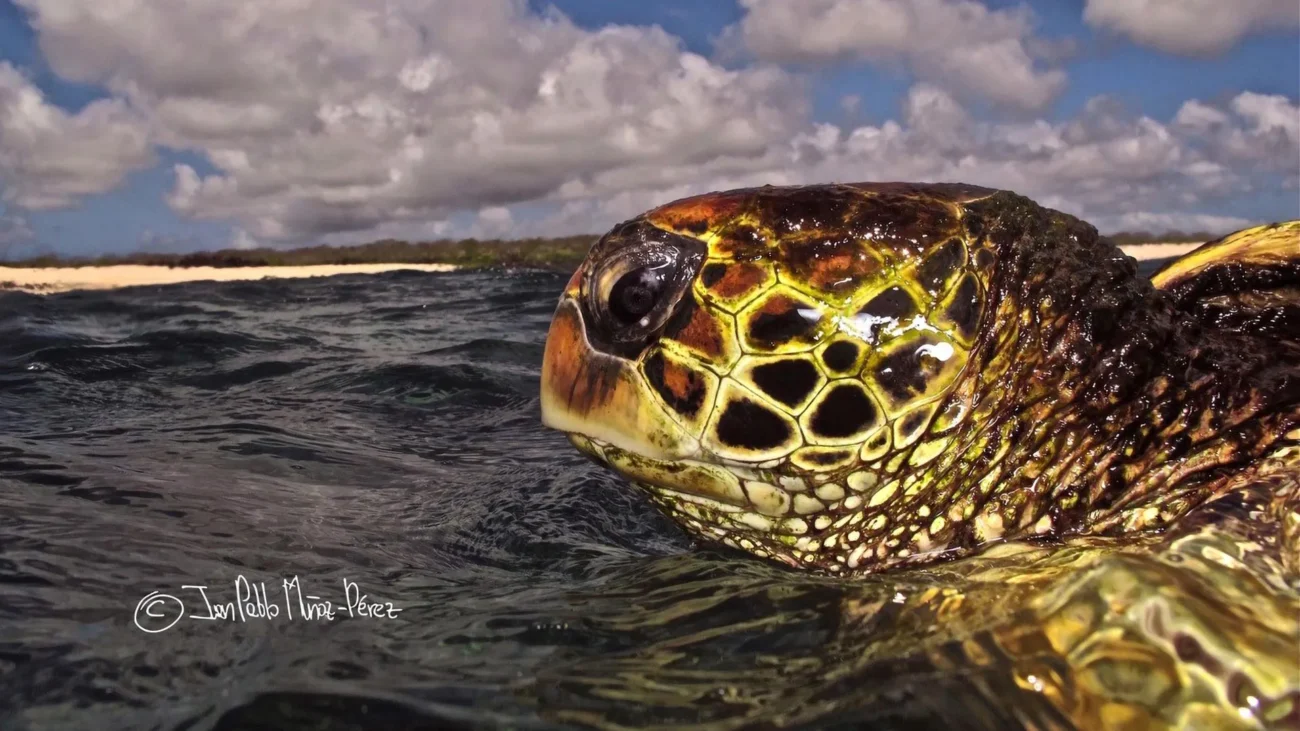
However, a groundbreaking study published in Frontiers in Amphibian and Reptile Science is upending these entrenched assumptions. Focusing on a unique population of green sea turtles within the Galápagos archipelago, researchers have discovered a sub-group of animals that dramatically buck the migratory trend. Rather than roaming across vast stretches of the Pacific Ocean, these resident animals exhibit a remarkably localized lifestyle, spending years confined almost entirely to the sheltered waters of a single island group. This revelation not only refines our understanding of chelonian behavioral plasticity but also introduces complex new variables into the management of vulnerable marine ecosystems.
Decoding the Two Morphotypes of Chelonia mydas
To understand the weight of this discovery, it is essential to examine the biological taxonomy of the green sea turtle, scientifically known as Chelonia mydas. Distinct among the seven living species of sea turtles, adult green sea turtles transition from an omnivorous diet during their juvenile years to a strictly herbivorous adult lifestyle, subsisting almost exclusively on marine algae and lush seagrass meadows. Within this species, however, scientists recognize distinct regional morphotypes characterized by subtle physiological and geographical divergences.
In the eastern and western expanses of the Pacific Ocean, researchers track two genetically distinct forms: the black-morph green sea turtle, predominantly found in the eastern Pacific from southern California down the western coast of the Americas, and the yellow-morph green sea turtle, which typically populates the tropical and subtropical waters of the western Pacific. The Galápagos archipelago serves as a unique ecological melting pot—the only known location globally where these two distinct morphotypes converge, inhabit the exact same waters, and graze side-by-side on identical marine vegetation.
Despite their overlapping habitats and shared dietary preferences, the two morphs are not entirely identical. Field observations indicate that juvenile yellow-morph turtles experience accelerated early growth rates compared to their black-morph counterparts. This developmental divergence hints at underlying physiological, metabolic, or genetic differences that marine biologists are only beginning to decode. It was this backdrop of ecological coexistence and biological mystery that prompted an international team of scientists to launch a multi-year tracking initiative in 2015 to observe the daily lives and movement patterns of the Galápagos yellow-morph population.
A Chronology of Investigation: Tracking the Galápagos Yellow-Morph
The research initiative, spearheaded by Dr. John W. Rowe, a professor of biology at Alma College in the United States, alongside co-author Dr. Juan Pablo Muñoz Pérez of the Universidad San Francisco de Quito in Ecuador, was designed to map the spatial ecology of the yellow morph in unprecedented detail. Specifically, the team sought to quantify the size of the turtles’ home ranges, determine whether they routinely transit between the disparate islands of the Galápagos Marine Reserve, and identify critical foraging hotspots.
The operational phase commenced in 2015 with the careful capture of nine adult yellow-morph green sea turtles in the shallow coastal waters surrounding four distinct islands within the archipelago. The cohort comprised seven males and two females, reflecting the demographic availability encountered by the research divers. Following standard marine biological protocols, researchers fitted each animal with an individual alphanumeric nickname and secured advanced electronic satellite transmitters to their carapaces. These tracking units were programmed to interface with the low-orbit Argos satellite network, transmitting precise geolocation data whenever the turtles surfaced to breathe.
The monitoring phase extended across a substantial temporal window, with individual turtles tracked for durations reaching up to 418 days. The termination of tracking signals was typically governed by natural tag detachment, biofouling, or transmitter battery exhaustion. As the telemetry data began accumulating at research headquarters, a clear and surprising behavioral pattern emerged. Far from embarking on the expected trans-oceanic migrations, the tagged subjects demonstrated an overwhelming affinity for shallow coastal habitats, rarely venturing far from the protection of the archipelago’s volcanic shores.
Spatial Dynamics and Seasonal Movement Patterns
The telemetry data painted a vivid picture of localized habitation. Although individual turtles occasionally ventured outward into deeper waters—reaching maximum distances of approximately 25 kilometers from the nearest coastline—the vast majority of their time was spent lingering within the shallow, nutrient-rich environments hugging the island peripheries.
When analyzing individual trajectories, the researchers observed varying degrees of localized fidelity. Five of the nine monitored turtles restricted their activities almost entirely to the waters surrounding a single island for the duration of the study. Others exhibited more expansive, yet still constrained, inter-island movements. For instance, the individuals nicknamed Bernardo and Sara demonstrated regular movement corridors bridging the marine spaces between Isabela Island and San Cristóbal Island. Similarly, an individual designated as Leandro charted a regular route connecting Isabela to Española.
The most ambitious traveler of the cohort was an individual named Ainoa. Initially captured and tagged near San Cristóbal, Ainoa subsequently embarked on a localized island-hopping journey, moving first to the coastal waters of Santa Cruz before establishing residency near Isabela.
Further analysis of the spatial data revealed a distinct temporal rhythm governing these movements. Inter-island transits were not distributed randomly throughout the calendar year; rather, travel between islands occurred exclusively during the cooler seasonal period spanning from April through October. During the warmer months, the turtles exhibited even tighter site fidelity. On average, each individual maintained a home range spanning approximately 1,498 square kilometers, though the precise footprint varied considerably depending on the specific animal and its chosen foraging grounds.
Contrasting Behaviors: The Enigma of Female Migration
The collective weight of the tracking data suggests that yellow-morph green sea turtles inhabiting the Galápagos possess a remarkably homebound nature during their foraging phases. However, the researchers emphasize a vital caveat: these observations capture a localized snapshot of the animals’ broader life cycles, and longer migratory events could theoretically manifest during specific reproductive windows not fully captured during the multi-year study.
This temporal limitation is particularly significant when considering the behavior of adult females. In the pantheon of marine turtle biology, the female’s imperative to nest is absolute. Yet, female yellow-morph green sea turtles are conspicuously absent from the roster of species known to deposit eggs on Galápagos beaches. This biological disconnect leads the research team to formulate a compelling hypothesis regarding the ultimate fate of these resident females.
"Since female yellow-morph green sea turtles are not known to lay eggs on the beaches of the Galápagos, we believe that they will eventually leave the area to return to their natal beaches in the western Pacific," explained Dr. Muñoz Pérez. This anticipated long-distance journey stands in stark contrast to the behavioral repertoire of the archipelago’s black-morph green turtles. Certain female black morphs complete their entire life cycles within the Galápagos, acting as year-round resident nesters, while others undertake localized migrations to nearby oceanic islands or travel entirely out of the archipelago to distant feeding grounds off the coasts of Central and South America. The coexistence of these contrasting behavioral strategies within the same island ecosystem underscores the evolutionary complexity governing Chelonia mydas in the eastern Pacific.
Conservation Implications for the Galápagos Marine Reserve
Beyond its academic contributions to behavioral ecology, the study carries profound implications for conservation planning and resource management within the 198,000-square-kilometer Galápagos Marine Reserve. For decades, marine conservation frameworks have occasionally operated on the assumption that protecting a single localized marine park or a prominent nesting beach is sufficient to safeguard resident species. However, the discovery that individual yellow-morph turtles regularly traverse the marine corridors separating distinct islands shatters this oversimplified model.
Because these animals rely on an interconnected network of shallow foraging habitats scattered across multiple islands, enacting localized conservation measures that protect only isolated pockets of the archipelago leaves the animals dangerously exposed during their seasonal inter-island transits. If a single foraging ground or transit corridor suffers from environmental degradation, pollution, or illegal fishing pressures, the ecological stability of the entire resident population could be compromised.
Dr. Rowe underscored the necessity of an integrated, system-wide approach to habitat preservation in the wake of the findings. "Since individual turtles may rely on waters around multiple islands, the quality of habitat that is available for foraging should be maintained intact across all islands, and not allowed to degrade anywhere," he stated.
As anthropogenic pressures mount across global marine ecosystems—driven by climate change, shifting ocean temperatures, and human encroachment—understanding the precise spatial ecology of keystone marine species is more critical than ever. The homebound yellow-morph green sea turtles of the Galápagos remind the scientific community that nature constantly defies broad generalizations. Protecting these ancient voyagers—and their surprisingly localized cousins—demands a sophisticated conservation strategy that views the ocean not merely as a vast, homogenous highway, but as a complex, interconnected mosaic of fragile marine habitats.

