


Navigating the complex landscape of legislative proposals, municipal ordinances, and federal regulations is an increasingly vital responsibility for bird owners, aviculturists, and pet industry professionals across the United States. Proposed laws that appear distant or unrelated to avian care can carry profound implications for the future of bird breeding, exhibition, and pet ownership. Organizations such as the American Federation of Aviculture (AFA) and various coalition partners actively monitor these legal developments to safeguard the rights of responsible animal keepers against sweeping legislative overreaches.
Understanding the Mechanics of Legislation and Bills
Historically defined as the formal proposing of a law, modern legislation typically manifests in the form of a bill. A bill serves as the intended text of a new law, frequently accompanied by an introductory summary that outlines its core objectives, enforcement mechanisms, and expected community impacts. However, legal analysts and advocacy groups frequently note that these introductory summaries can be misleading, masking broader regulatory scopes.
While elected representatives formally introduce bills into local, state, or federal legislative systems, the origin of these texts often traces back to specialized lobbying organizations. Animal rights and animal welfare groups with active legislative arms frequently draft model legislation and present it to sympathetic lawmakers. Consequently, the agendas driving these bills do not always align with the practical realities, scientific consensus, or general needs of the public and responsible animal caretakers.
The Hidden Risks of Local Animal Ordinances
For average pet owners and specialized breeders, the most immediate legislative threats often materialize at the municipal or county level through local ordinances. Local laws are frequently drafted under the guise of public safety, consumer protection, or population control, commonly beginning with broad categories of animals such as dogs, cats, fish, birds, and primates.
A typical point of vulnerability for aviculturists involves ownership caps. For example, a municipality might propose an ordinance limiting the number of specific pets—such as dogs or cats—per residential household. While such a regulation may initially appear reasonable to the general public, subsequent amendments can easily expand the scope of the ordinance to encompass companion birds, small mammals, or aquatic life.
Consider a small-scale canary breeder maintaining six pairs of birds within a residential home. If an ordinance restricting animal numbers is amended to include avians under a generalized cap, that breeder instantly falls out of compliance, exposing themselves to municipal fines, administrative penalties, or mandatory court appearances.
Civil Enforcement Versus Criminal Prosecution
It is essential for animal owners to understand the distinction between criminal statutes and civil ordinances. Local animal ordinances generally operate within the civil domain rather than the criminal justice system.
By way of analogy, consider municipal codes prohibiting inoperable motor vehicles on residential properties. If a homeowner stores an unregistered car in their driveway, the city typically issues civil fines rather than arresting the property owner. If the vehicle is not removed or repaired, the case proceeds to a civil court where a judge can enforce compliance through escalating financial penalties or contempt of court citations. Similarly, violations of municipal animal ordinances result in civil enforcement actions, administrative hearings, and potential court-ordered remedies rather than criminal incarceration, though the financial and operational consequences for a breeding facility or pet owner can still be devastating.
The Regulatory Process and Administrative Changes
While formal laws and municipal ordinances require legislative action—such as votes by city councils, county boards of supervisors, state general assemblies, or the United States Congress—administrative regulations function differently. Regulations represent the specific operational rules enacted under the authority of an existing law.
Crucially, regulatory changes can frequently be implemented without a direct vote by elected officials, though specific procedural frameworks and public comment periods must generally be observed. A prominent example includes the United States Fish and Wildlife Service (USFWS) adding a new species to the federal Endangered Species Act or altering the permitting requirements for exotic bird imports and interstate commerce. These regulatory adjustments can fundamentally alter the legal status of keeping certain avian species overnight, bypassing the traditional legislative debate floor.
The Strategy Behind Broad Animal Prohibitions
Avicultural monitoring committees frequently raise alarms over seemingly unrelated legislative proposals, such as local circus prohibition acts or exotic animal bans. To the casual observer, a ban on traveling animal exhibitions may appear to have no connection to a private aviary or pet parrot owner.
However, experienced legislative watchdogs recognize that strategic phrasing within these bills often leaves room for unchecked amendments. Over time, poorly defined terminology can be stretched to encompass private pet ownership, aviculture, and specialized breeding operations. Industry analysts point to a significant surge in anti-animal use bills introduced at both the state and local levels over recent legislative cycles.
While the stated intent of these legislative packages often emphasizes the elimination of inhumane treatment or animal overpopulation, the resulting regulatory framework can ultimately render the keeping of pet birds or specific exotic species entirely prohibited. Vague terminology regarding "adequate housing," "commercial exploitation," or "public safety" can easily ensnare hobbyist breeders and educational exhibitors who maintain the highest standards of animal husbandry.
The Cascading Effect of State and Federal Precedents
Legislative trends rarely remain isolated within a single municipality or state. When restrictive animal-keeping laws are successfully enacted in one jurisdiction, they frequently serve as template legislation for other regions across the country. Advocacy groups opposing private animal ownership often utilize successful state-level models to lobby federal agencies or neighboring state legislatures, creating a cascading effect that threatens the broader avicultural community nationwide.
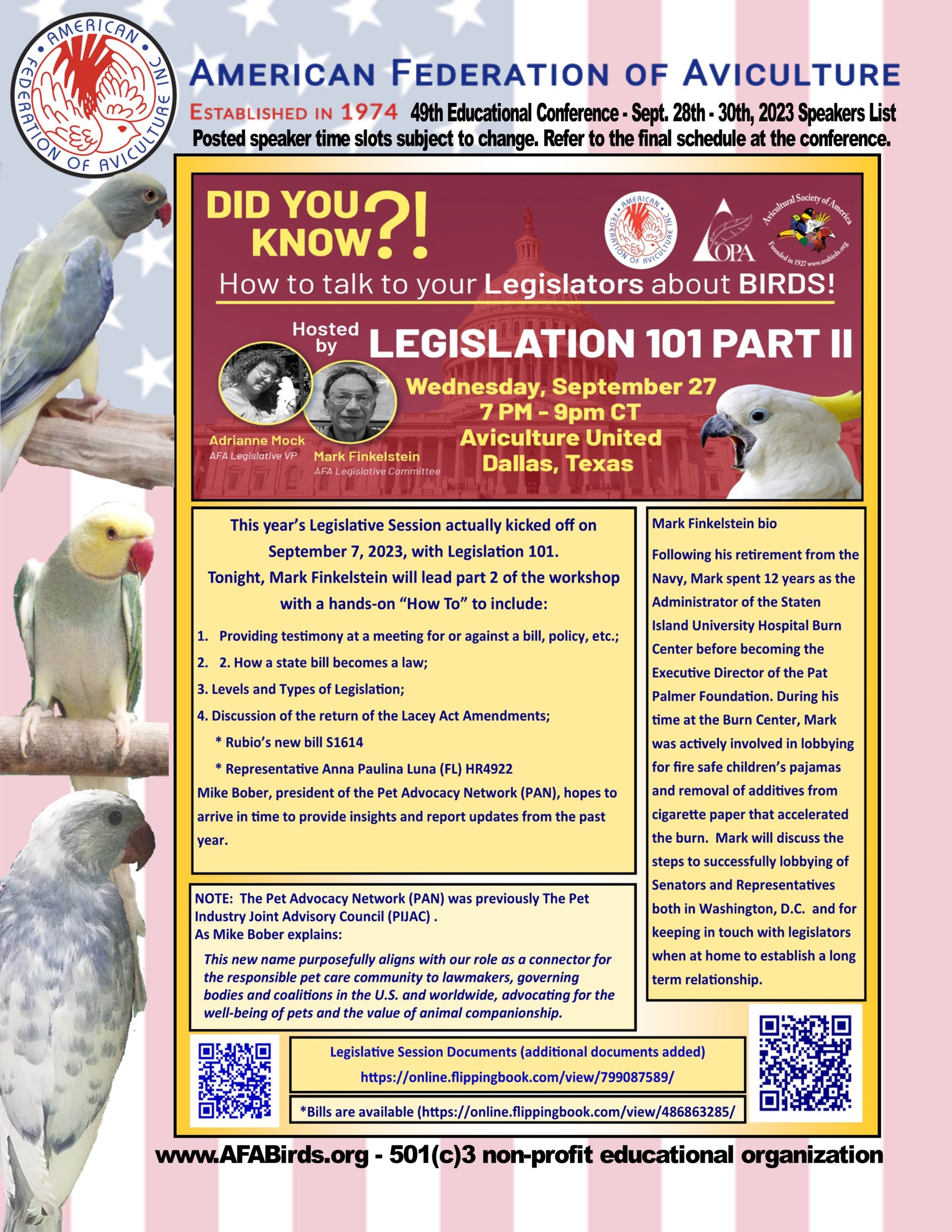
Organizations like the AFA Legislative Committee, alongside national and regional animal-keeping coalitions, continuously track these developments to provide timely updates to the public. Resources such as specialized training courses (including "Legislation 101" educational programs) and dedicated regulatory monitors—such as updates on the USDA Animal Welfare Act—help bridge the knowledge gap for bird owners who wish to remain informed and proactive.
Conclusion: The Necessity of Ongoing Vigilance
Active participation in the legislative process begins with awareness. Bird owners, breeders, and commercial enterprise operators are encouraged to regularly review tracking pages, such as dedicated legislative issue dashboards hosted by avicultural organizations, to monitor pending bills and local ordinances in their geographic regions.
Even when a proposed law appears unlikely to create an immediate impact, failing to engage with early-stage legislative debates allows restrictive precedents to take root. By understanding how bills are drafted, how ordinances are enforced, and how administrative regulations evolve, the avicultural community can better advocate for sensible, science-based policies that protect both animal welfare and the longstanding tradition of responsible bird keeping.

