


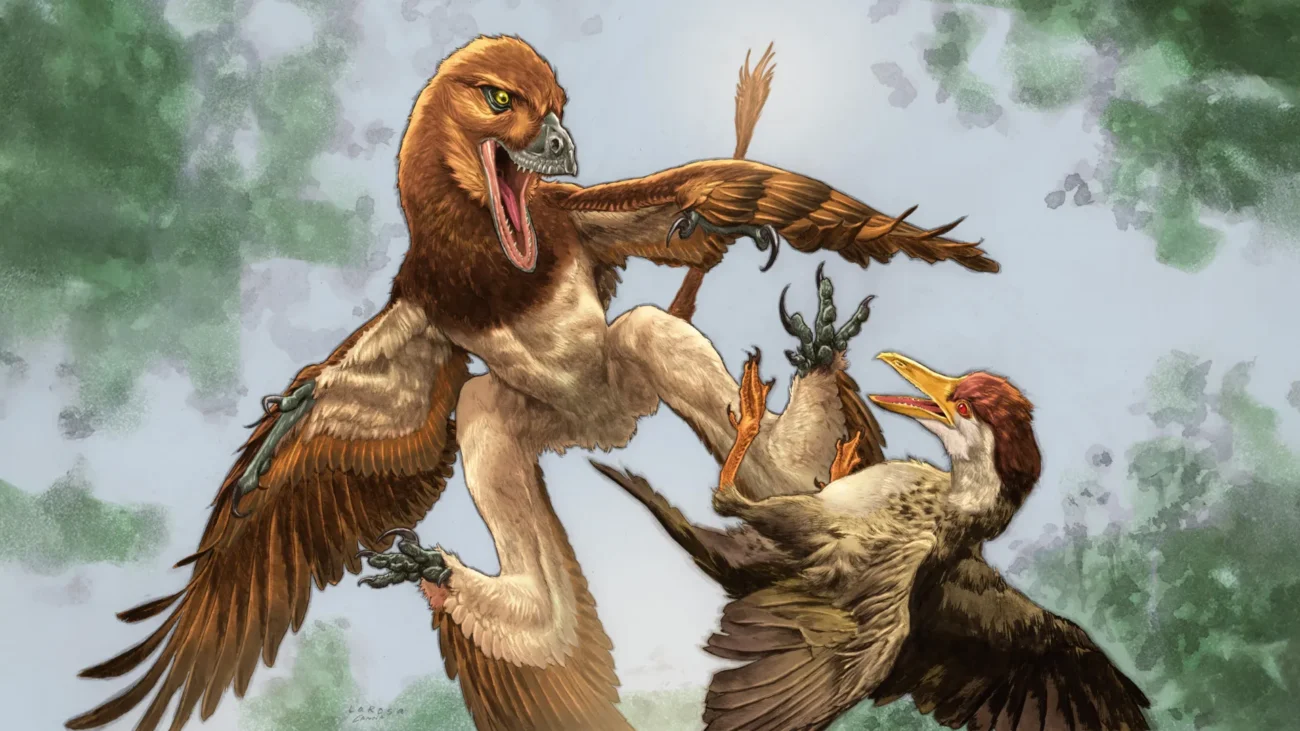
The enigmatic fossil site in northwestern China, renowned for its abundant prehistoric bird remains, has long puzzled paleontologists with its peculiar clusters of shattered avian bones. These compressed masses, resembling the pellet-like regurgitations of modern owls, suggested the presence of a significant predator that systematically hunted the ancient avifauna. However, definitive evidence of such an animal had remained elusive until now. A recently described dinosaur species, unearthed from the very same fossil bed, is poised to provide the long-sought answer, offering crucial insights into the complex ecosystems of the Late Jurassic or Early Cretaceous period.
The groundbreaking discovery, detailed in a study published in the esteemed Annals of Carnegie Museum, introduces a previously unknown dinosaur species. This newly identified creature is a feathered relative of the iconic Velociraptor, distinguished by its striking long feathers adorning both its forelimbs and hind limbs. Through meticulous analysis of distinctive features in its arm and shoulder bones, scientists have concluded that this dinosaur likely served as the predator responsible for the perplexing accumulations of bird bones.
Dr. Jingmai O’Connor, Associate Curator of Fossil Reptiles at the Field Museum in Chicago and senior author of the paper unveiling the new species, elaborated on the significance of this find. "For years, paleontologists have encountered these peculiar, fragmented aggregations of bird bones at this site, and the origin remained a mystery," Dr. O’Connor stated. "This new microraptor dinosaur, Jianchangmaensis, represents our most compelling hypothesis. It is the only non-avian dinosaur discovered at this locality that was a carnivore and substantially larger than the other fauna we’ve recovered, making it a prime candidate for the predator."
A Feathered Hunter Emerges: Jianchangmaensis, a New Dromaeosaurid
The evolutionary lineage of modern birds traces directly back to a group of theropod dinosaurs. These avian dinosaurs successfully navigated the cataclysmic asteroid impact 66 million years ago, a planetary event that led to the extinction of the non-avian dinosaurs. However, for millions of years prior to this extinction event, birds coexisted with a diverse array of other dinosaur groups during the Jurassic and Cretaceous periods, forging complex ecological interactions.
Among the closest relatives to early birds were the dromaeosaurs, a family of feathered dinosaurs characterized by their agile, predatory nature and relatively small to medium size. The Velociraptor, immortalized in popular culture, is perhaps the most famous member of this clade. It is important to note that paleontological evidence suggests that real Velociraptors were significantly smaller and more extensively feathered than their cinematic portrayals, often depicted as scaly and larger than their actual fossil record indicates.
The newly described species, Jianchangmaensis, belongs to a subgroup within the dromaeosaurs known as microraptors. These dinosaurs are typically characterized by their diminutive size, with some species comparable to the size of a crow. However, Jianchangmaensis stands out as an unusually large specimen within this group.
"Jian is one of the largest microraptor specimens ever discovered," Dr. O’Connor remarked. "The recovered segment of its upper arm bone measures approximately four inches in length, suggesting that the entire dinosaur likely possessed a wingspan of around four feet, placing it in a size category comparable to a modern barn owl." This considerable size, relative to other microraptors, further strengthens its potential role as a significant predator in its ancient environment.
A Four-Winged Glider with Predatory Prowess
While only a portion of the animal’s arm has been recovered, scientists infer that Jianchangmaensis shared a defining characteristic with its microraptor kin: the presence of extensive feathering on both its arms and legs. This anatomical feature would have created the striking visual impression of four wings, a unique adaptation among dinosaurs.
Contrary to the powered flight of modern birds, it is believed that these four-winged dinosaurs were primarily adapted for gliding. "Jian and the other microraptors were likely not capable of true, powered flight in the manner of modern birds," Dr. O’Connor explained. "Instead, they probably utilized their feathered limbs for gliding, much like a flying squirrel utilizes its patagium." This suggests a niche where they could efficiently traverse arboreal environments or descend from elevated positions.
The nomenclature of this fascinating dinosaur honors both its distinctive morphology and its geographical origin. In Chinese mythology, "Jian" refers to a winged creature, a fitting appellation for a dinosaur with extensive feathering on its limbs. The specific epithet, "changmaensis", denotes its discovery in the Changma Basin, located within China’s Gansu province.
Unraveling Ancient Ecosystems: The Changma Fossil Site
The discovery of Jianchangmaensis is pivotal in filling a critical gap in our understanding of the ancient ecosystem represented by the Changma fossil site. This locality is already celebrated for its rich fossil record of prehistoric birds, making the presence of a significant non-avian predator particularly illuminating.
Dr. Matt Lamanna, corresponding author of the study and the Mary R. Dawson Curator of Vertebrate Paleontology and Senior Dinosaur Researcher at the Carnegie Museum of Natural History, emphasized the importance of this find. "Jianchangmaensis confirms the presence of non-avian dinosaurs within the Changma Basin, an area previously celebrated for its fossil birds," Dr. Lamanna stated. "Our team has unearthed over a hundred bird fossils from Changma, yet this single specimen of Jianchangmaensis is the only non-avian dinosaur recovered to date. This discovery provides invaluable new insights into the biological history of the Changma region and the ecological context in which the ancestors of today’s birds lived."
The find also contributes significantly to the ongoing scientific effort to comprehend avian evolution and to delineate the unique characteristics that set the avian lineage apart from its close dinosaur relatives.
"To truly understand the diversity of life on Earth today, we must delve into its origins," Dr. O’Connor asserted. "Birds represent arguably the most successful group of terrestrial vertebrate animals on our planet today. By studying early birds and their closely related non-avian dinosaur relatives, we gain a profound understanding of what made the avian lineage, which ultimately survived the mass extinction, so remarkably resilient and successful."
Chronology of Discovery and Research
The fossil site in northwestern China, known for its exceptional preservation of Late Jurassic or Early Cretaceous fauna, has been a focus of paleontological research for decades. The discovery of hundreds of prehistoric bird remains has made it a cornerstone for understanding early avian evolution. However, the persistent presence of concentrated, fragmented bird bones, suggestive of predation, remained an enduring enigma.
The initial suspicion of a larger predator was based on the consistent pattern of bone breakage and the pellet-like composition of the fossilized aggregations. These features bore a striking resemblance to the feeding habits of modern birds of prey, particularly owls, which regurgitate undigested bone and fur as pellets.
For years, paleontologists meticulously excavated and studied the bird fossils, cataloging species and their diversity. The absence of any corresponding predatory dinosaur fossils within these bone beds, however, left a significant void in the ecological narrative.
The recent expedition that led to the discovery of Jianchangmaensis was part of a collaborative effort involving international institutions. Researchers were specifically targeting areas where avian fossils were concentrated, hoping to uncover evidence of the ecosystem’s apex predators.
The partial skeleton of Jianchangmaensis was unearthed from a geological stratum consistent with the age of the bird fossils. Subsequent detailed analysis of the recovered bones, particularly the forelimb and shoulder girdle, revealed anatomical features indicative of a dromaeosaurid dinosaur with specialized adaptations.
The research team, comprising specialists in paleontology, anatomy, and evolutionary biology, embarked on a comprehensive study of the specimen. This involved high-resolution imaging, comparative anatomy with known dromaeosaurid species, and biomechanical modeling to assess its potential predatory capabilities and locomotion.
The publication of the study in the Annals of Carnegie Museum marked the culmination of this intensive research phase, officially introducing Jianchangmaensis to the scientific community and proposing its role in the ancient predatory landscape. The study’s publication date signifies the formal resolution of a long-standing paleontological mystery.
Supporting Data and Scientific Analysis
The fossil evidence supporting the predatory role of Jianchangmaensis is multifaceted. The dinosaur’s classification as a dromaeosaurid places it within a group known for its carnivorous diet and predatory adaptations. Its size, estimated at approximately four feet in wingspan, would have been substantial enough to hunt and overpower small to medium-sized birds.
Key anatomical features identified in the fossil provide further corroboration. The structure of the humerus (upper arm bone) and the scapula (shoulder blade) in Jianchangmaensis suggests a robust musculature and range of motion suitable for grasping and tearing prey. While direct evidence of stomach contents or bite marks on the bird fossils has not been definitively linked to Jianchangmaensis, the circumstantial evidence is compelling.
The presence of long feathers on both forelimbs and hind limbs, characteristic of microraptors, would have enhanced its agility and potentially aided in maneuvering while pursuing prey. While not capable of sustained powered flight, these feathered limbs would have been advantageous for gliding between trees or from higher vantage points, allowing for surprise attacks on unsuspecting avian prey.
The chemical composition of the fossilized bone clusters has also been a subject of study. While not a direct indicator of the predator’s identity, the consistency of these aggregations across the site suggests a recurring predatory behavior. The absence of other large non-avian carnivores in the immediate fossil record of the Changma site further isolates Jianchangmaensis as the most plausible candidate.
The scientific analysis of Jianchangmaensis also contributes to a broader understanding of dromaeosaurid evolution and the diversification of feathered dinosaurs. Its relatively large size within the microraptor clade suggests a specialized ecological niche, potentially exploiting a readily available food source – the abundant small birds of the Changma ecosystem.
Broader Implications for Understanding Early Bird Evolution and Ecosystems
The discovery of Jianchangmaensis has profound implications for our understanding of prehistoric ecosystems and the evolutionary trajectory of birds. It provides concrete evidence of the predator-prey dynamics that shaped the survival and diversification of early avian lineages. The existence of a significant non-avian predator in a fossil site rich in bird remains highlights the complex interplay between different dinosaur groups and the constant selective pressures that drove evolutionary innovation.
This finding reinforces the idea that the survival of birds beyond the Cretaceous-Paleogene extinction event was not solely due to inherent resilience but also shaped by the ecological pressures and opportunities present in their environment. Understanding the predators that birds faced in their formative stages helps us appreciate the evolutionary adaptations that allowed avian dinosaurs to thrive.
Furthermore, Jianchangmaensis offers a clearer picture of the ecological landscape in which the direct ancestors of modern birds evolved. The presence of a large, gliding, feathered predator suggests that the skies and arboreal environments were dynamic arenas with multiple forms of aerial locomotion and predatory strategies. This context helps explain why certain avian traits, such as efficient flight and keen eyesight, became so critical for survival.
The study also contributes to the ongoing debate about the definition of "dinosaur" and the evolutionary continuum between birds and their non-avian relatives. By showcasing a feathered, bird-like dinosaur that was not itself an avian dinosaur, Jianchangmaensis underscores the blurred lines and gradual transitions that characterize major evolutionary shifts. It serves as a potent reminder that birds are, in essence, living dinosaurs, a testament to the enduring legacy of this ancient and diverse group.
The implications extend to the broader understanding of biodiversity and extinction events. By reconstructing the intricate ecological webs of the past, scientists can gain valuable perspectives on the factors that contribute to species success and vulnerability, offering lessons applicable to conservation efforts in the present day. The story of Jianchangmaensis is not just about a single fossil; it is a crucial chapter in the grand narrative of life on Earth, revealing the ancient dramas that unfolded millions of years ago and ultimately paved the way for the feathered wonders we see today.

