


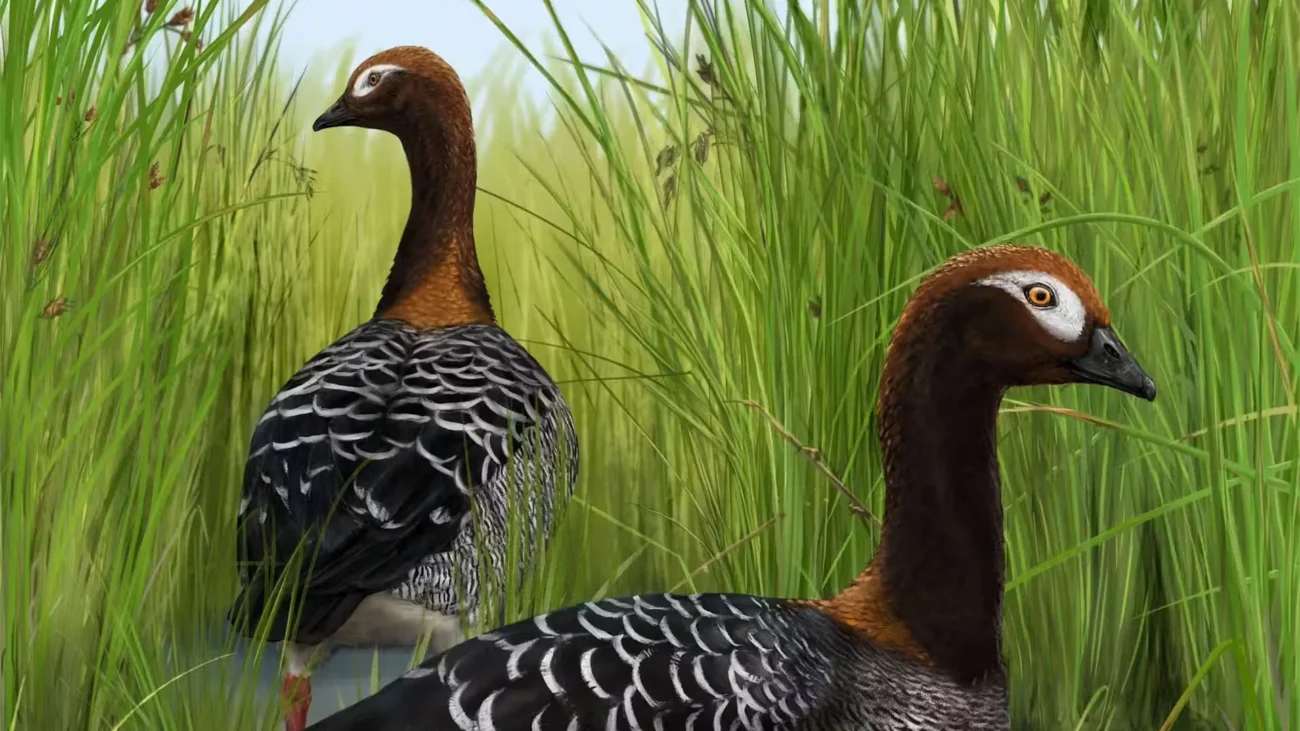
The discovery of a previously unknown species of fossil goose, unearthed from the ancient lakebed deposits of Central Otago, is prompting a significant re-evaluation of how New Zealand’s distinct avian fauna evolved. Researchers from the University of Otago, known locally as ÅŒtÄkou Whakaihu Waka, have presented compelling evidence that the origins of Aotearoa’s birdlife were far more dynamic and complex than previously theorized. This remarkable find, detailed in a recent publication in the esteemed journal Historical Biology, adds crucial pieces to the intricate puzzle of avian evolution in the region.
Unearthing a New Lineage: The Story of Meterchen luti
The cornerstone of this groundbreaking research is the identification and description of a new fossil species, officially named Meterchen luti. This diminutive goose, roughly the size of a small modern goose, was discovered among the rich paleontological treasures of the well-known St Bathans fossil deposits. These deposits, renowned for preserving a diverse array of ancient life from a subtropical New Zealand approximately 16 to 19 million years ago, have yielded an abundance of waterfowl fossils. However, the remains of geese have historically been notably scarce.
Associate Professor Nic Rawlence, the Director of the Otago Palaeogenetics Laboratory and a co-author of the study, explained the meticulous process undertaken by the international research team. "While waterfowl fossils are relatively common at St Bathans, true goose remains are considerably less so," Rawlence stated. "This scarcity prompted us to undertake a comprehensive re-examination of every fossil bone that had been previously classified as belonging to a goose."
The team’s rigorous approach involved a detailed comparative analysis. They meticulously compared these re-examined fossil bones not only with other fossil waterfowl recovered from the St Bathans site but also with an extensive global collection of modern and extinct bird skeletons. This painstaking work allowed them to distinguish the unique anatomical features that set the newly identified bird apart. "We determined that among these remains were bones belonging to an entirely undescribed species, one that was notably smaller than what we might typically associate with a goose," Rawlence elaborated.
The chosen scientific name, Meterchen luti, is a poignant tribute to the bird’s ancient origins and its discovery context. "Meterchen" is derived from ancient Greek, meaning "mother goose," a nod to the idea of an ancestral bird emerging from the deep geological past. The specific epithet, "luti," is Latin for "of the mud," directly referencing the sedimentary environment from which the fossil was recovered. This nomenclature encapsulates the essence of a prehistoric avian ancestor being brought to light from the ancient muds of the St Bathans fossil beds.
Crucially, Rawlence highlighted that Meterchen luti does not appear to be closely related to the giant, flightless New Zealand geese, known scientifically as Cnemiornis species, which became extinct relatively recently in the Holocene epoch. Furthermore, it is not closely allied with their closest living relative, the Cape Barren goose of Australia. This finding immediately challenged existing hypotheses about the evolutionary lineage of New Zealand’s geese.
Rethinking the Timeline: A More Dynamic Arrival Story
The implications of identifying Meterchen luti extend far beyond simply adding a new species to the fossil record. This discovery, when considered in conjunction with recent advancements in avian genetics and paleontology, fundamentally alters our understanding of how bird species colonized and diversified in New Zealand. The prevailing narrative is shifting from a story of ancient, long-established lineages to one of more recent arrivals and dynamic evolutionary processes.
Alan Tennyson, the lead author of the study from the Museum of New Zealand Te Papa Tongarewa, emphasized this paradigm shift. "Our research suggests that New Zealand’s avian history is far more intricate than we once assumed," Tennyson explained. "It appears that many bird species have successfully reached these islands over vast geological timescales, but the ancestors of some of our most iconic large birds arrived surprisingly late in the evolutionary story."
Tennyson pointed to several well-known New Zealand endemic species whose ancestors are now understood to have arrived much more recently, within the last four to five million years. These include the kākāpō (a flightless parrot), Forbes’ harrier (a raptor), and the formidable Haast’s eagle, the largest eagle known to have ever existed. The relatively recent arrival of these significant species challenges older theories that posited a much deeper, ancient origin for New Zealand’s unique avifauna, often linked to the now-submerged continent of Zealandia.
Challenging Long-Held Theories: The Case of the Giant Geese
A significant aspect of the new research directly confronts a long-standing hypothesis concerning the origins of the extinct Cnemiornis geese. Previously, it was theorized that the St Bathans goose represented a direct ancestor of these giant flightless birds, implying a continuous lineage within Zealandia stretching back at least 14 million years. This theory was attractive as it provided a deep historical context for the unique evolution of flightless birds in isolation.
However, this hypothesis now directly conflicts with robust genetic evidence. Molecular studies, which analyze the DNA of extinct and extant species, strongly suggest that the ancestors of the Cnemiornis geese arrived in New Zealand from Australia much more recently, approximately seven million years ago. This genetic data had previously been considered problematic by proponents of the older theory, leading to its dismissal or reinterpretation.
The current study, through its rigorous re-examination of the fossil evidence and the identification of Meterchen luti as a distinct lineage, provides crucial support for the later arrival theory. "Our detailed reassessment of the fossil material aligns with and strengthens the genetic evidence pointing to a more recent colonization event for the ancestors of the giant flightless geese," Tennyson stated. This reconciliation of fossil and genetic data is a hallmark of modern paleontological research and underscores the power of interdisciplinary scientific inquiry.
The Dynamic Nature of Zealandia’s Avian Landscape
The research indicates that the ancestors of Meterchen luti themselves reached Zealandia over 14 million years ago, predating the arrival of the Cnemiornis ancestors. However, their evolutionary journey appears to have ended without leaving any surviving descendants. This suggests that the ancient avian landscape of Zealandia was not static but was subject to periods of colonization, diversification, and eventual extinction, even for lineages that arrived early.
Associate Professor Rawlence emphasized the power of integrating multiple scientific disciplines to reconstruct these complex evolutionary narratives. "By employing the full spectrum of scientific tools available to us, including advanced genetic techniques and detailed fossil analysis, we can now reconstruct with ever-increasing precision how the dynamic geological, climatic, and even human-induced history of Zealandia has shaped the evolution of Aotearoa’s fauna," he remarked. This holistic approach allows for a more nuanced understanding of evolutionary processes, acknowledging both long-term isolation and more recent migratory events.
The story of the giant flightless Cnemiornis geese serves as a particularly compelling illustration of the rapid evolutionary changes that can occur when species colonize island environments. These magnificent birds, standing up to a meter tall and weighing as much as 18 kilograms, were among the largest geese to have ever existed. Their development of flightlessness and gigantism in the absence of mammalian predators highlights the potent selective pressures present on isolated islands.
"The relatively rapid evolution of the giant flightless Cnemiornis geese offers another striking example of the remarkable morphological changes that can occur within a comparatively short geological timeframe on islands," Rawlence noted. This rapid adaptation underscores the unique evolutionary laboratories that island ecosystems represent, allowing for the emergence of extraordinary forms of life. The discovery of Meterchen luti adds another layer to this understanding, revealing an earlier, distinct goose lineage that ultimately did not persist, further emphasizing the ever-shifting currents of avian evolution in New Zealand.
Broader Implications for Understanding Island Biogeography
The findings from the St Bathans fossil goose study have profound implications for the broader field of island biogeography and the study of avian evolution worldwide. New Zealand, with its long history of isolation, has long been considered a natural laboratory for understanding how species evolve in the absence of continental influences. However, this research suggests that the narrative of isolation may be punctuated by periods of significant faunal exchange.
The study reinforces the idea that island colonization is not a one-time event but rather a continuous process, with different lineages arriving at different times and with varying degrees of success. The ancestors of some of New Zealand’s most striking endemic birds, once thought to have ancient roots, are now understood to be relatively recent arrivals. This implies that the unique biodiversity of many islands may be the result of a complex interplay between ancient endemic lineages and more recent colonists, each adapting to the specific island environment.
Furthermore, the research highlights the importance of ongoing paleontological exploration and the re-examination of existing museum collections. The discovery of Meterchen luti underscores that even in well-studied fossil sites like St Bathans, significant new insights can be gained by applying new analytical techniques and by revisiting specimens with fresh perspectives. The integration of paleontology, genetics, and comparative anatomy provides a powerful toolkit for unraveling evolutionary mysteries.
Future Research Directions and the Unfolding Story
This discovery opens up several avenues for future research. Scientists will undoubtedly be keen to explore whether other St Bathans goose fossils might represent further distinct lineages or provide additional clues about the diet and lifestyle of Meterchen luti. Continued genetic analysis of related extinct and extant bird species could further refine our understanding of the migratory routes and timings of avian arrivals in New Zealand.
The ongoing work at the University of Otago and its international collaborators promises to continue illuminating the fascinating and complex evolutionary history of New Zealand’s birds. As Associate Professor Rawlence aptly put it, "Using all the tools in the toolbox, including DNA and fossils, we can reconstruct how the dynamic geological, climatic and human history of Zealandia has shaped the evolution of Aotearoa fauna in ever more detail." The story of Meterchen luti is not an endpoint but a significant chapter in the unfolding narrative of life’s remarkable journey in the unique landscape of Aotearoa. The fossilized remains of this small goose, once lost to the ancient muds, are now speaking volumes, compelling scientists to rewrite the very history of New Zealand’s extraordinary birdlife.

