


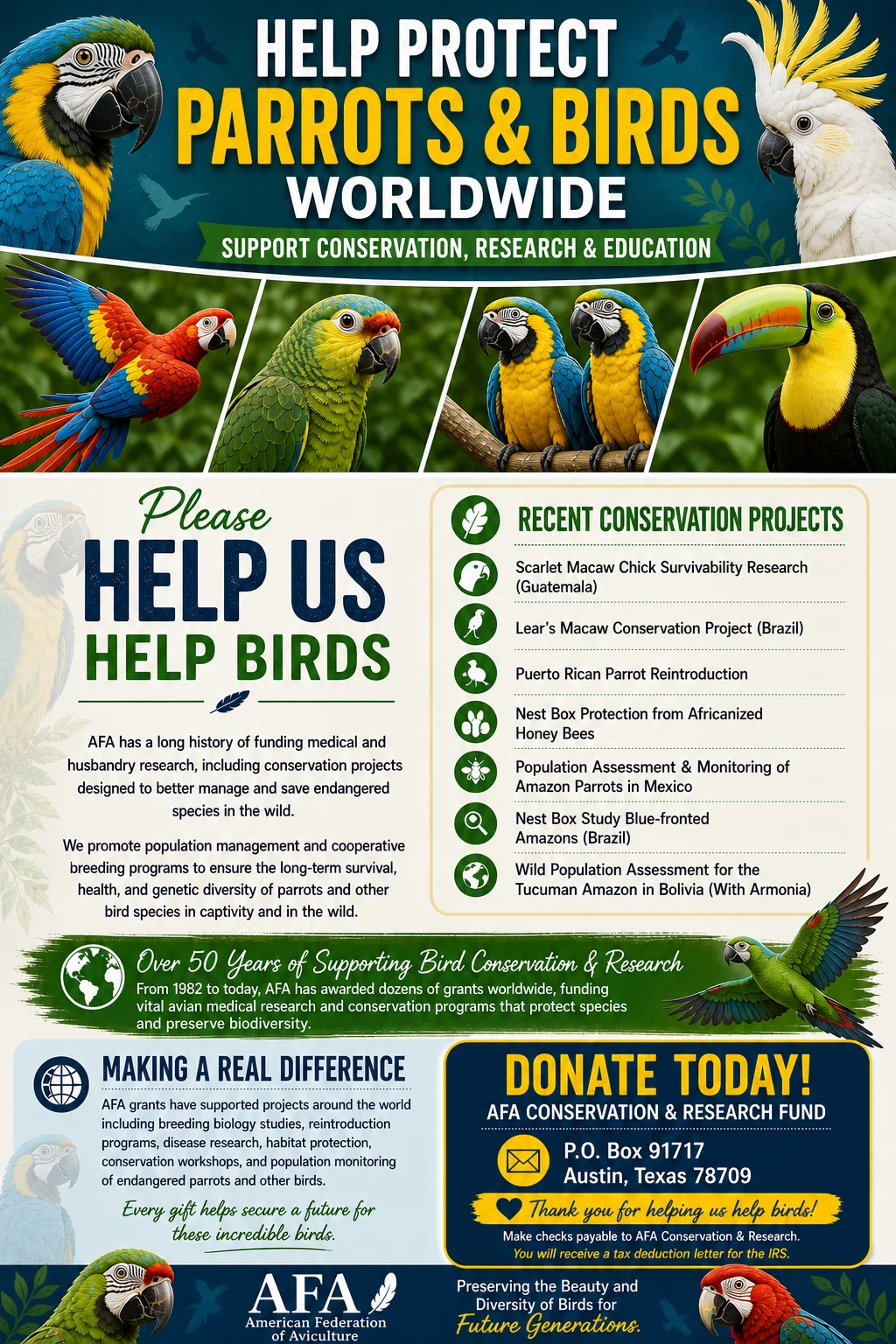
The American Federation of Aviculture (AFA) has announced a significant expansion of its global avian conservation initiatives, underscored by a major corporate partnership and ongoing funding commitments to field research projects across the Americas. Operating as a leading non-profit umbrella organization for aviculturists, the AFA continues to bridge the gap between captive breeding practices and wild habitat preservation. This multi-faceted effort relies on collaboration with corporate entities like Harrison’s Bird Foods, field research stations, and federal wildlife authorities to safeguard vulnerable parrot populations and ensure sustainable aviculture standards.
Corporate Collaboration and Field Grant Allocations
The cornerstone of the AFA’s recent financial mobilization is a substantial $25,000 contribution from Harrison’s Bird Foods, presented to AFA Chief Financial Officer Janice Lang. This partnership directly supports the AFA’s 2024–2025 conservation grant cycle, which provides financial assistance to wild parrot conservation projects in native habitats. Small grant applications, evaluated annually by the AFA Conservation Committee, target field biology, veterinary research, and husbandry initiatives that align with the organization’s core mission.
Among the primary beneficiaries of these ongoing conservation efforts is the Chajul Biology Station, operated by Natura Mexicana in the Lacandon rain forest of southern Mexico. Historically plagued by poaching for local and international trade, nest production of wild scarlet macaws in the region faced near-zero fledgling rates without intervention. Since the station’s biologists began monitoring nests, identifying hatchlings, and utilizing a head-start program to rear and release wild-hatched macaws, the initiative has successfully fledged more than 150 scarlet macaws back into the wild. Current fundraising efforts aim to procure critical field equipment, including incubators, brooders, gram scales, and medical supplies.
Ongoing International Research and Habitat Protection
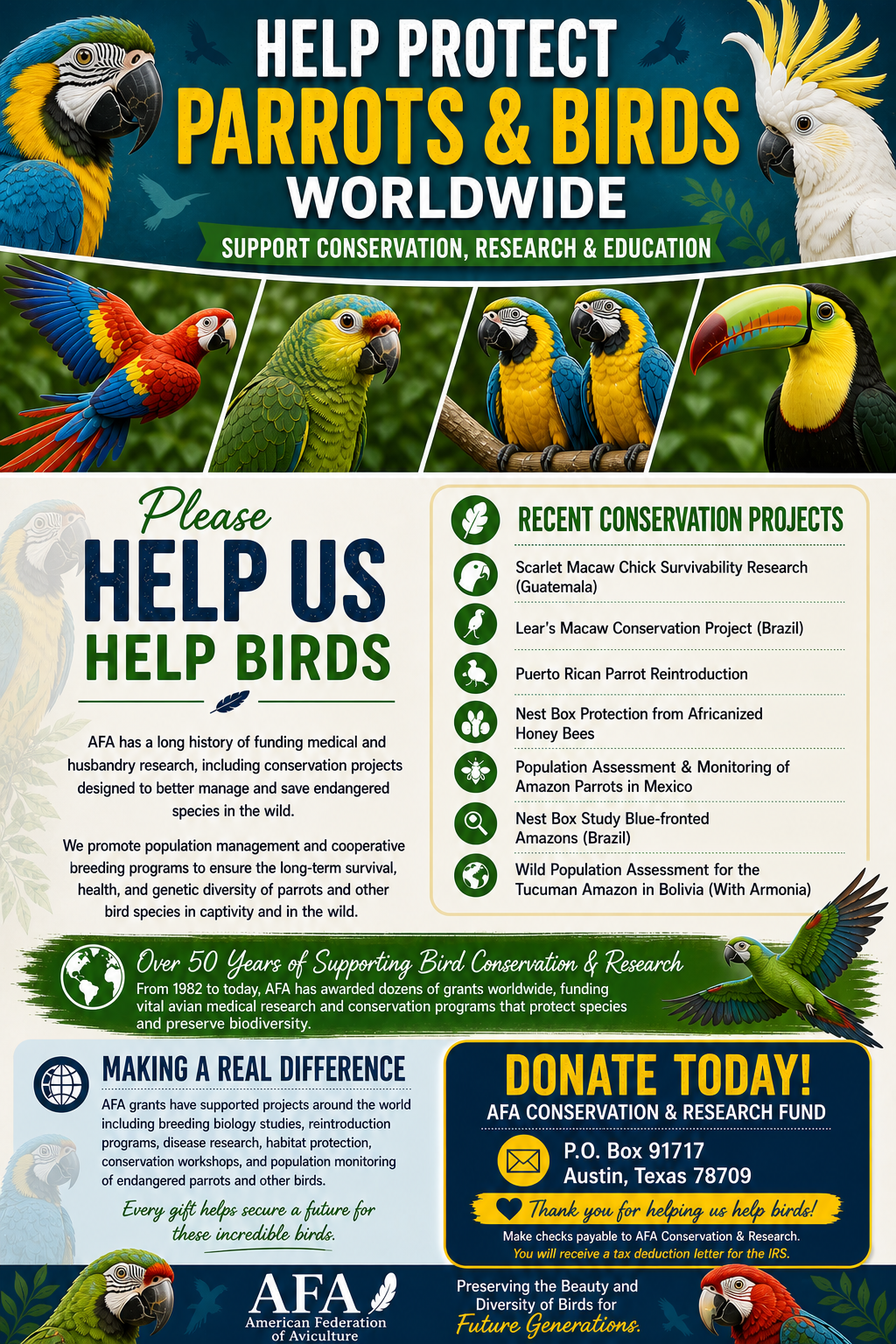
In addition to the Chajul project, the AFA channels member contributions and partner funds into several high-impact field programs:
- Selva Maya Living Landscape Program (Guatemala): Administered by the Wildlife Conservation Society (WCS) since 2002, this initiative monitors the conservation status of scarlet macaws within the Maya Biosphere Reserve. Recent efforts focus on experimental interventions designed to increase chick survivability, cementing the scarlet macaw as a flagship species for the region.
- Africanized Honey Bee Prevention Protocol: Principal Investigator Caroline A. Efstathion has developed a "push-pull" prevention method to protect natural and artificial parrot nest boxes from destructive colonization by Africanized honey bees. Utilizing bird-safe insecticides like permethrin to repel scout bees while drawing them to more attractive, pheromone-baited traps, the protocol mitigates a critical nesting hazard for psittacines.
- Tambopata Region Health and Ecology Studies (Peru): Led by researchers J. Jill Heatley, Lizzie Ortiz-cam, and Donald Brightsmith, this project utilizes field-side analyzers to collect physiological baseline data—including electrolytes, venous blood gases, and complete blood counts—from growing nestlings and free-flighted adult macaws. These findings inform both wild conservation strategies and domestic avian veterinary medicine, while exploring theories regarding why macaws consume mineral-rich clay licks.
- Lear’s Macaw Corn Subsidy Program (Brazil): Working alongside regional partners, this initiative provides agricultural subsidies to farms in Brazil that suffer crop losses due to foraging wild Lear’s macaws, thereby mitigating human-wildlife conflict and protecting the endangered birds from retaliatory measures.
Historical Context and Institutional Evolution
The American Federation of Aviculture was incorporated as a 501(c)(3) non-profit educational organization in California in March 1974, with its business operations currently headquartered in Austin, Texas. The organization’s formation was catalyzed by a public health crisis in the early 1970s involving an outbreak of Exotic Newcastle Disease in California. During the outbreak, the United States Department of Agriculture (USDA) euthanized thousands of healthy exotic birds held in private collections. Concurrently, the State of California introduced legislation aimed at severely restricting or banning the private ownership of exotic birds.

In response, bird owners, breeders, and regional clubs united to establish the AFA as a national and international umbrella organization. Over the subsequent decades, the organization has expanded its mandate beyond legislative advocacy to encompass scientific research, educational outreach, and international wildlife trade monitoring.
Regulatory Frameworks: CITES and the Wild Bird Conservation Act
A critical function of the AFA involves monitoring and engaging with international and domestic regulatory bodies, including the Convention on International Trade in Endangered Species of Wild Fauna and Flora (CITES) and the U.S. Fish and Wildlife Service (USFWS). The AFA CITES Committee regularly participates in animal committee meetings, often holding official Non-Governmental Observer (NGO) status to provide practical avicultural insights to international regulators.

Trade and movement of exotic birds in the United States are heavily governed by two primary federal statutes:
- The Wild Bird Conservation Act (WBCA) of 1992: Signed into law on October 23, 1992, the WBCA imposed a moratorium on the commercial importation of wild-caught birds listed under CITES appendices, effectively halting the mass import of parrots (Psittacines) for the U.S. pet trade. Exceptions exist for specific "clean list" species bred sustainably in captivity abroad, as well as through approved Cooperative Breeding Programs (CBPs). CBPs allow accredited avicultural groups to import limited numbers of underrepresented species to diversify captive gene pools and establish sustainable populations without drawing from wild sources.
- The U.S. Endangered Species Act (ESA) of 1973: Enacted to protect critically endangered species from extinction, the ESA regulates interstate commerce, import, and export of listed exotic birds. While possessing legally acquired listed species generally does not require a federal permit within a single state, commercial transactions, sales, or barters across state lines necessitate specific permits, such as Interstate Commerce Permits or Captive-bred Wildlife Permits, unless exemptions apply based on captive-propagation status.
Implications for the Future of Aviculture and Conservation
The dual approach maintained by the AFA—combining direct financial support for field conservation with the promotion of meticulous captive breeding standards—reflects a modern consensus in wildlife management. By ensuring that captive populations of exotic birds remain genetically robust through structured programs like the Blue-eyed Cockatoo Cooperative Breeding Program, and simultaneously investing in in situ habitat protection, research, and anti-poaching measures, the organization seeks to secure self-sustaining populations of psittacines for future generations.
Individuals or organizations interested in applying for AFA conservation grants, becoming conservation partners, or participating in cooperative breeding initiatives may submit proposals or inquiries through the official AFA administrative channels in Austin, Texas, or via electronic correspondence to the AFA office.

