


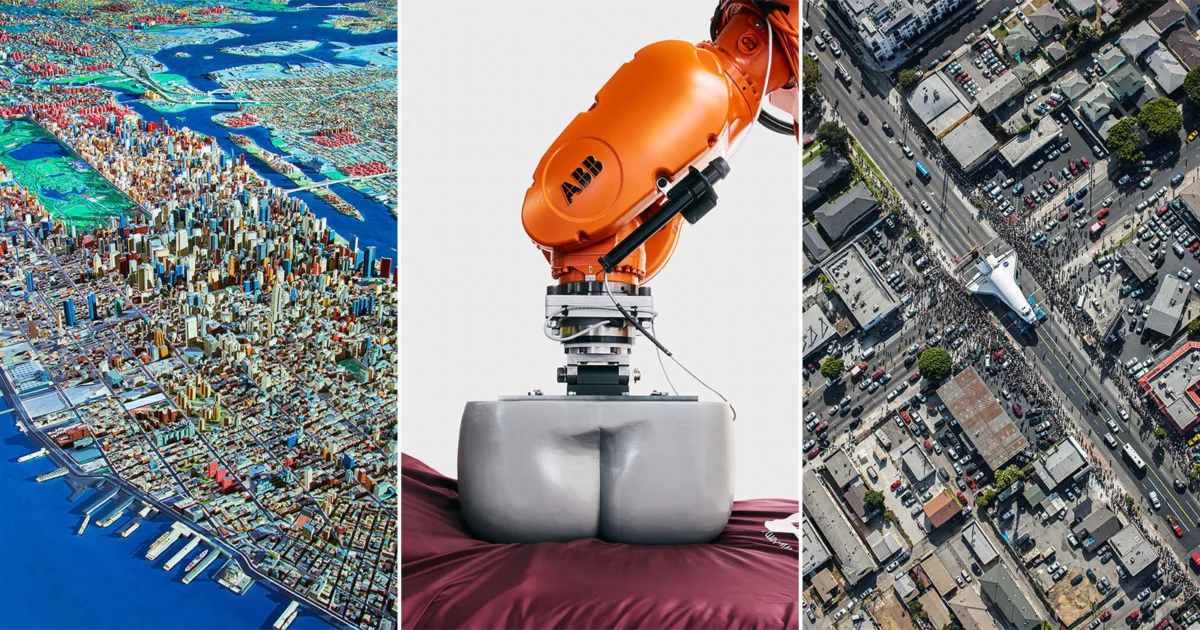
The debut monograph by acclaimed photographer Spencer Lowell, titled Futures Past, offers a comprehensive visual investigation into the shifting boundaries between biological existence and the rapid proliferation of technological systems. Published by KGP Monolith, the collection presents 57 curated color images spanning nearly 100 pages, functioning as a definitive archive of Lowell’s professional output over the last two decades. The work is not merely a documentation of industry, but a philosophical inquiry into how humanity, environment, and engineering have become increasingly inseparable, yet often remain unevenly aligned.
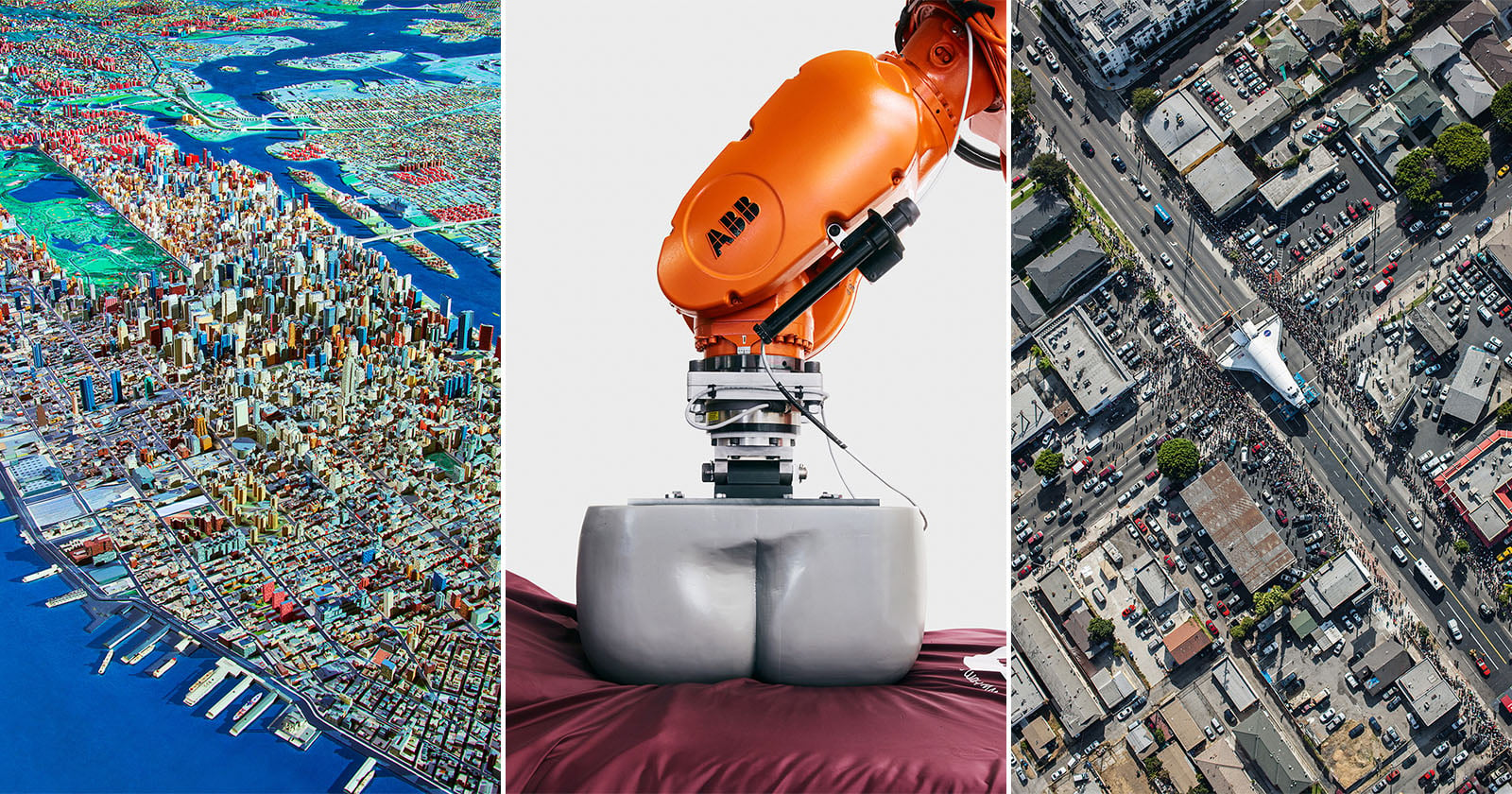
Lowell, a Los Angeles-born and New York City-based photographer, has spent the better part of 20 years building a reputation for capturing the intersection of science, industry, and the natural world. His portfolio includes high-profile collaborations with organizations such as NASA, Apple, Google, Meta, Bloomberg, and OpenAI, providing him with rare, intimate access to some of the most restricted and technologically advanced environments on the planet.
A Chronology of Technological Ambition
The images compiled in Futures Past are not presented in a strictly linear timeline, but rather as a thematic exploration of human progress from the early 21st century to the present day. The collection documents the physical artifacts of our era: from the 2008 space communication testing at NASA’s Jet Propulsion Laboratory—where anechoic chambers lined with blue, pyramid-shaped foam create an eerie, silent aesthetic—to the 2024 refinement of molten gold at the Cortez Gold Mine in Nevada.
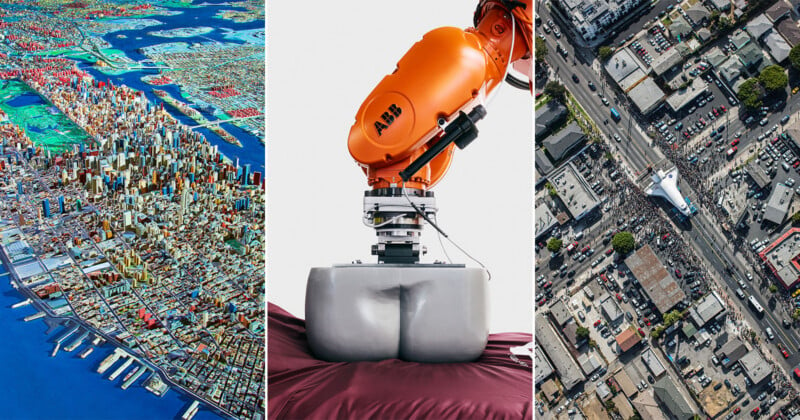
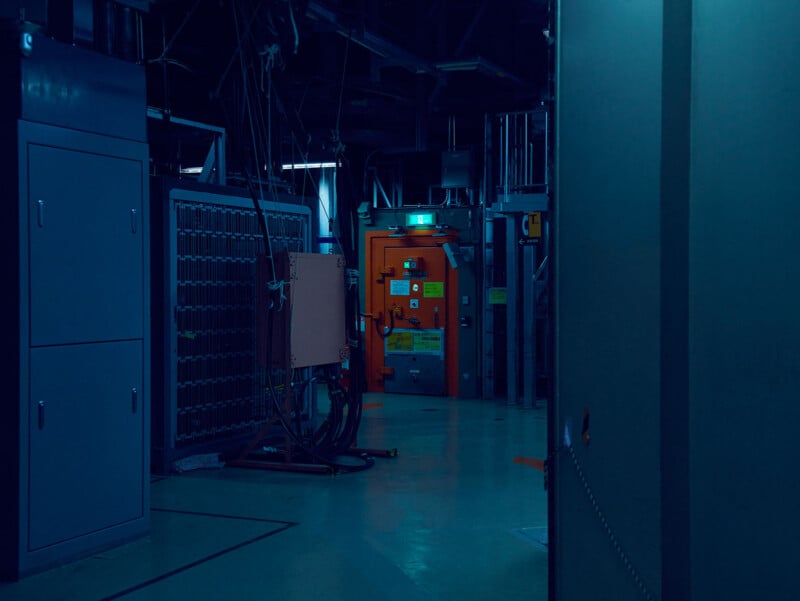
Between these poles, Lowell captures specific milestones of the modern age. The 2011 launch of the Mars Rover Curiosity at Cape Canaveral represents the outward-facing ambition of space exploration, while the 2012 photograph of the Space Shuttle Endeavour navigating the dense, narrow streets of Los Angeles offers a stark contrast: the colossal scale of aerospace engineering forced into the cramped, human-centric infrastructure of a city. The 2017 documentation of the Unit 4 reactor door at the Fukushima Daiichi Nuclear Power Plant serves as a sobering reminder of the volatility inherent in our most powerful energy sources, balancing the cold, industrial precision of nuclear engineering against the human tragedy of the disaster.
The Intersection of Biological and Synthetic Life
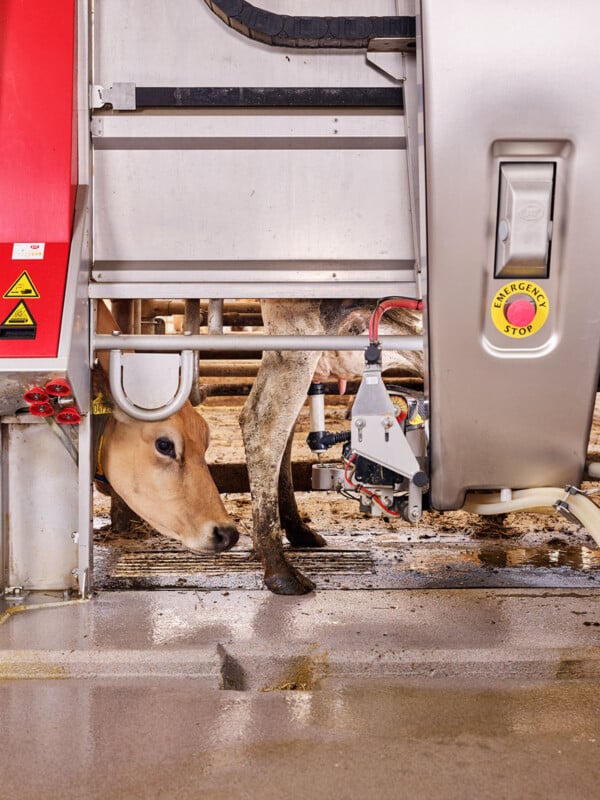
One of the most compelling aspects of Lowell’s work is his focus on the blurring lines between organic life and artificial systems. In a 2019 photograph captured in Katwoude, the Netherlands, Lowell documents an automated cow milking system. The image features a robotic arm positioned near the udder of a cow, a stark representation of how agriculture, traditionally a deeply manual and organic pursuit, has been subsumed by high-speed automation and sensor-based management.
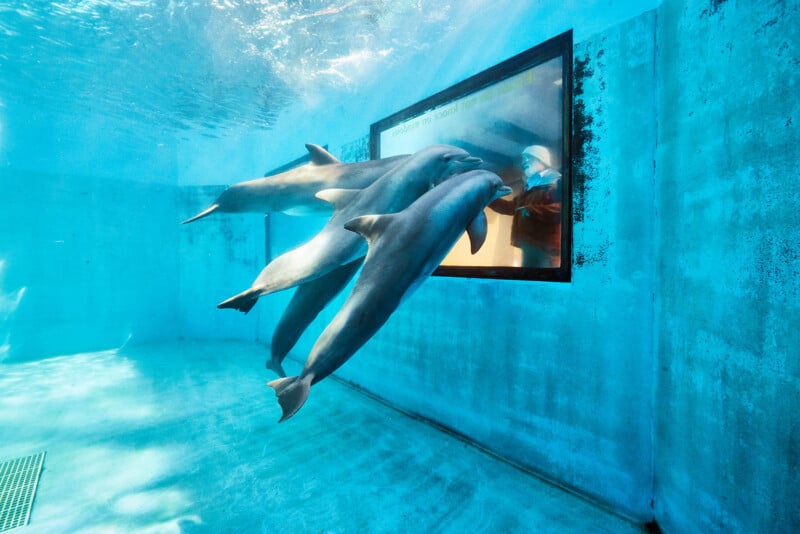
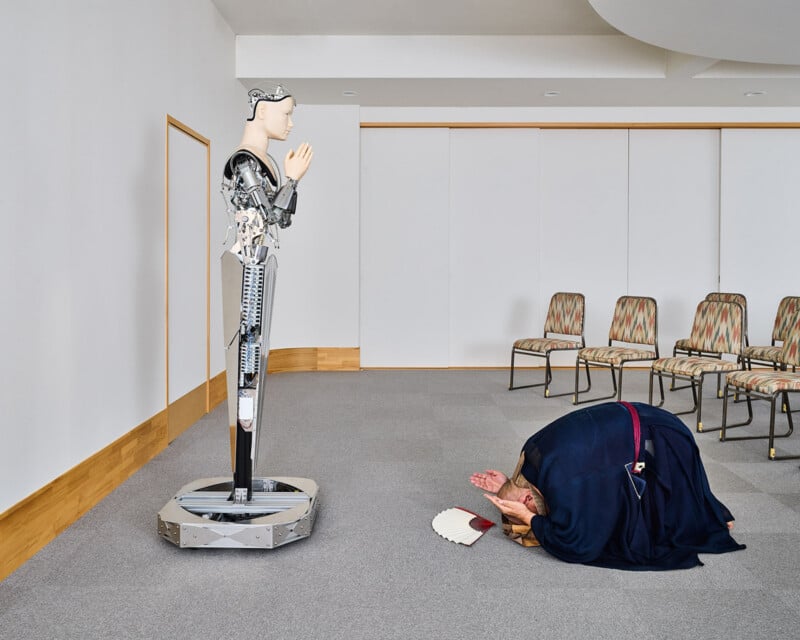
This theme is further explored in a 2019 image from Kyoto, Japan, featuring "Mindar," a robotic priest. The photograph captures a person in traditional religious robes kneeling in a deep, reverent bow before the humanoid machine. This visual pairing poses fundamental questions about the future of spirituality and belief in an age where the divine or the transcendental may be mediated by artificial intelligence.
Climate activist and Fulbright Award-winning writer Daniel Sherrell, who provided the opening essay for the monograph, notes that in Lowell’s world, "the technologies are the real individuals, protagonists of their own cryptic story." According to Sherrell, these photographs do not merely document tools, but capture the "alien beauty" of the worlds we have built—worlds that simultaneously serve and exclude the human population.
Data, Environment, and the Anthropocene
The monograph also addresses the byproduct of global industrialization. A 2014 image of microplastics recovered from the Mediterranean Sea provides a jarring, microscopic look at the environmental legacy of human manufacturing. By placing the image alongside grand displays of engineering, such as the experimental fire tornado lab in Missoula, Montana, Lowell emphasizes the sheer scale of the human footprint.
The inclusion of these images suggests a broader narrative about the Anthropocene—the current geological age where human activity is the dominant influence on climate and the environment. Data from international scientific bodies indicates that global technological output has grown exponentially in the last two decades, with energy consumption and resource extraction reaching historic peaks. Lowell’s photography acts as a silent witness to these trends, capturing the physical infrastructure—the wires, the turbines, the clean rooms, and the debris—that powers this rapid expansion.
Professional Context and Industry Impact
Spencer Lowell’s career has been defined by his ability to bridge the gap between technical complexity and artistic composition. By working with entities like Bloomberg and TIME, he has mastered the ability to distill abstract concepts—such as computing power, algorithmic decision-making, and structural engineering—into single, legible frames.
The publication of Futures Past arrives at a pivotal moment in the discourse surrounding artificial intelligence and automation. As society grapples with the integration of Large Language Models (LLMs), autonomous robotics, and the potential for a "post-human" labor market, Lowell’s images provide a necessary anchor in physical reality. They remind the viewer that these technologies are not ephemeral code, but massive, heavy, and often beautiful physical objects that require infrastructure, electricity, and human oversight.

The monograph is designed by Luminosity Lab and represents a high-water mark for the artist. KGP Monolith, the publisher, has released the volume in several tiers, reflecting the increasing collector interest in contemporary documentary photography. The standard edition, priced at $75, offers the complete collection of images, while special editions ranging up to $1,000 include signed, limited-edition prints. This tiered pricing structure reflects the growing status of documentary monographs as both critical cultural records and high-value art assets.
Implications and Future Outlook
The implications of the work showcased in Futures Past suggest a future where the distinction between "nature" and "machine" is increasingly untenable. Lowell himself argues that the technology he photographs does not stand in opposition to nature but is rather a continuation of it. This perspective challenges the traditional view of technology as an external, invasive force. Instead, he presents it as an evolutionary extension of human necessity and curiosity.
The lack of a "conclusion" in the book is intentional. Lowell admits that his work is meant to document a condition, not provide an answer to the complex ethical or environmental questions raised by his subjects. By allowing the images to exist without heavy-handed editorializing, he enables the reader to confront the "alien beauty" of the modern world on their own terms.
As we look toward the next two decades, the images in Futures Past will likely serve as a foundational record of a transition period—a time when humanity built the foundations of a world that we are only beginning to understand. The photographs function as a visual diary of our collective ingenuity and, perhaps, our collective hubris. Whether these technologies will lead to a harmonious future or a total displacement of the human experience remains the central tension of the 21st century.
For researchers, sociologists, and art historians, the collection provides a vital snapshot of the tools and environments that defined the early 2000s. As industry continues to advance, and as the "robotic priests" and "automated milking systems" of today become the legacy infrastructure of tomorrow, Lowell’s work will serve as an essential reference point for understanding the trajectory of the human condition. The book is currently available for preorder through the KGP Monolith website, marking a significant milestone in the career of one of the most observant photographers of our time.

