


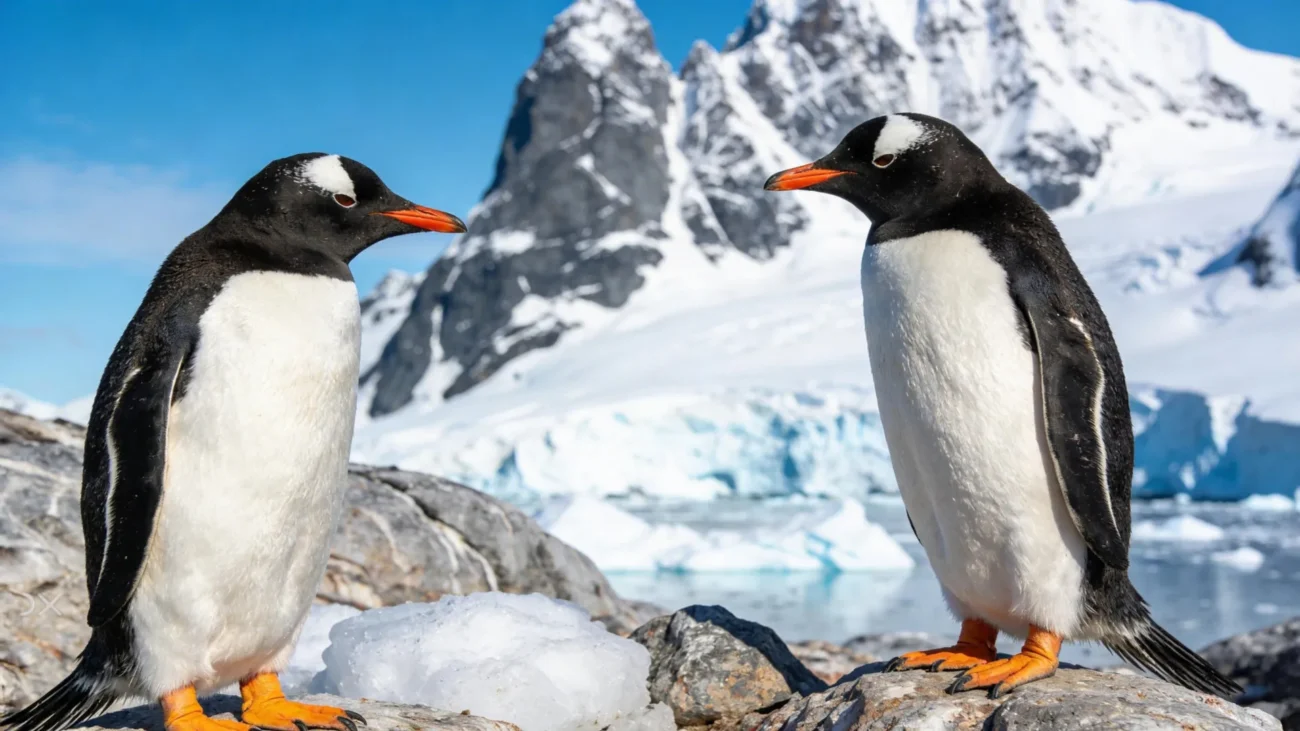
For more than a century, the scientific community has debated the classification of the gentoo penguin, a charismatic inhabitant of the Southern Hemisphere traditionally categorized as a single, widely distributed species. Now, an international team of researchers has reshaped our understanding of avian taxonomy by discovering that what was once considered one species is actually four distinct lineages, including one entirely new to formal science. This landmark finding marks the first time a new penguin species has been officially named in over a century, providing critical insights into how these birds evolved, adapted, and spread across the globe.
The findings, published in the peer-reviewed journal Communications Biology, are the result of a comprehensive genomic study spearheaded by researchers in Chile and the University of California, Berkeley. By analyzing the whole-genome sequences of 64 penguins collected across 10 distinct breeding colonies, the collaborative team successfully resolved decades of disagreement regarding gentoo taxonomy. This rigorous genetic mapping, combined with behavioral and physical analyses, offers a masterclass in modern conservation science and evolutionary biology.
Main Facts and the Discovery of a Cryptic Species
At the heart of the discovery is a population of gentoo penguins residing on the Kerguelen Islands—geographically isolated landmasses in the southern Indian Ocean often referred to in French as the Desolation Islands. Situated nearly 2,000 miles away from any permanently inhabited landmass, this remote archipelago provided the ideal conditions for evolutionary divergence.
While the birds on the Kerguelen Islands share the familiar physical traits of their relatives—a striking white underside and a sleek black back designed for aquatic predation—genetic evidence reveals they are profoundly distinct. Scientists classify this newly identified group as a "cryptic species," an organism that looks remarkably similar to related species despite possessing significant genetic differences.
In addition to formally recognizing this new species, the research team elevated three previously designated gentoo subspecies to full species status. Consequently, the gentoo penguin family has expanded into four distinct entities:
- Pygoscelis kerguelensis: The newly recognized southeastern gentoo penguin, native to the Kerguelen Islands and likely nearby Heard Island, situated near the Antarctic Polar Front.
- Pygoscelis ellsworthi: The southern gentoo penguin, which inhabits the Antarctic Peninsula, coastal Antarctica, and South Georgia Island. This is the only one of the four species to make its home directly on the Antarctic continent.
- Pygoscelis taeniata: The eastern lineage, distributed across the sub-Antarctic Crozet, Marion, and Macquarie Islands north of the Polar Front.
- Pygoscelis papua: The northern lineage, restricted primarily to the Falkland/Malvinas and Martillo Islands in South America.
A Century of Taxonomic Debate and Chronology of Research
The path to this taxonomic revision spans generations of scientific inquiry. For over 100 years, ornithologists and evolutionary biologists debated how many species or subspecies existed within the gentoo complex, with some historical proposals suggesting as many as six distinct subspecies. However, these past assertions largely relied on limited morphological observations, such as minor variations in body size, plumage, and vocalizations, without the backing of comprehensive genetic data.
To finally settle the debate, a global consortium of biologists was assembled. Co-senior authors Juliana Vianna, a professor of ecosystems and environment at Andrés Bello National University in Santiago, Chile; Rauri Bowie, a professor of integrative biology and curator in UC Berkeley’s Museum of Vertebrate Zoology; and Elie Poulin, a professor at the University of Chile, joined forces to orchestrate the study.
The investigative timeline gained significant momentum over the past decade. In 2019, Bowie and Vianna published foundational research mapping out the broader evolutionary history of penguins. Their work indicated that the penguin family originated near Australia and New Zealand approximately 22 million years ago. Following the evolutionary split of Emperor and King penguins—with Emperors adapting to extreme Antarctic conditions and Kings claiming sub-Antarctic territories—major geological and oceanographic shifts altered the Southern Hemisphere. Around 12 million years ago, the establishment of the Antarctic circumpolar current acted as a marine highway, facilitating the dispersal of other penguin lineages to remote islands, archipelagoes, and as far north as the coasts of Africa and South America.
Building upon this chronological framework, University of Chile graduate student Daly Noll, the paper’s first author, led the recent genomic analysis. By examining thousands of single nucleotide polymorphisms (SNPs) across a broad portion of the genome, the team mapped out how geographic isolation and oceanographic barriers drove the divergence of the four gentoo species between 300,000 and 500,000 years ago.
Dietary Flexibility and the Mechanics of Speciation
The diversification of gentoo penguins is deeply intertwined with their unique ecological habits, particularly their diet. Unlike many of their penguin relatives, which rely heavily on a single primary food source—such as krill—gentoo penguins are opportunistic generalists. Their flexible diet includes fish, squid, cuttlefish, and various crustaceans.
This dietary adaptability affords gentoos a distinct advantage. Because they can exploit a wide variety of prey found relatively close to their breeding grounds, they do not need to undertake massive foraging migrations. Consequently, breeding populations tend to return faithfully to the same nesting sites year after year, reinforcing geographic isolation. Over hundreds of millennia, populations restricted to specific island ecosystems adapted to their local environments through natural selection, cementing genetic differences across the lineages.
Genomic data vividly illustrates these localized adaptations:
- Southern Gentoos (Pygoscelis ellsworthi): Thriving in the harsh Antarctic environment, their genomes exhibit an enrichment of genes linked to heat production, fat and lipid storage, and advanced light perception. The latter adaptation is crucial for navigating dramatic seasonal shifts in daylight and the intense glare of sunlight reflected off polar ice.
- Eastern Gentoos (Pygoscelis taeniata): Inhabiting warmer, saltier waters north of the Polar Front where biological productivity can be lower, these birds possess genes associated with efficient carbohydrate metabolism and enhanced diving performance. Traits governing oxygen transport, blood vessel formation, mitochondrial activity, and lung development allow them to remain submerged longer while hunting.
- Northern Gentoos (Pygoscelis papua): Exhibiting yet another pattern, their genomes show enrichments in genes related to digestion, heart contraction, and muscle excitation, supporting the prolonged physical exertion required for sustained underwater foraging in South American waters.
Official Responses and Conservation Implications
While the discovery of a new species is a triumph for taxonomy, it carries urgent conservation warnings. Climate projections and ecological modeling suggest that the future will not treat all four gentoo species equally.
Under moderate climate change scenarios heading toward 2050, sub-Antarctic island-dwelling gentoo species face severe habitat loss. Because these islands are isolated and lack neighboring landmasses with suitable climates, these populations risk becoming stranded with nowhere to migrate.
"In terms of climate change, island species that have really low population sizes could be compared with the sub-Antarctic gentoo penguins," noted Juliana Vianna. "Galapagos and other island penguin species, because they’re endemic to these islands, will find no place to go after a change in their environment. Those islands are very isolated, and these penguins cannot adapt easily to colonize any other region."
Conversely, the southern gentoo (Pygoscelis ellsworthi) residing in Antarctica is projected to experience relatively little negative impact and may even expand its range southward as ice sheets recede. However, Vianna emphasizes that this positive outlook for one lineage does not diminish the threats facing others. She stresses the vital importance of international cooperation across the sub-Antarctic region. Governments governing these waters—including Chile, South Africa, France, the Netherlands, Australia, and New Zealand—must formally recognize the three newly delineated sub-Antarctic gentoo species and implement targeted conservation strategies.
Furthermore, climate change is far from the only threat. Warming oceans, habitat degradation, competition with commercial fisheries, accidental entanglement in fishing nets, and introduced predators like rats and feral dogs continue to pressure vulnerable populations.
Broader Impact and Future Applications of Genomic Conservation
Beyond redefining penguin taxonomy, the extensive dataset compiled for this study establishes a powerful framework for future conservation efforts. Rauri Bowie highlighted that whole-genome sequencing has fundamentally transformed how scientists study both evolutionary diversification and real-world wildlife management.
Already, researchers are looking beyond baseline taxonomy. Vianna and her colleagues are actively scanning penguin genomes to identify genetic markers associated with resistance or susceptibility to avian influenza—a pathogen currently devastating wild bird and mammal populations globally. Pinpointing which populations possess natural resilience could allow conservationists to prioritize interventions for the most vulnerable groups.
As human-induced pressures continue to reshape marine and terrestrial ecosystems across the Southern Hemisphere, this integration of genomics, climatology, and international diplomacy provides a vital toolset. By accurately identifying who our wild neighbors are on a genetic level, humanity stands a much better chance of ensuring their survival into the next century and beyond.

