



Kodak Professional Tri-X 400, a name synonymous with the golden age of photojournalism and street photography, continues to maintain its status as a cornerstone of the analog film industry. While digital sensors have achieved unprecedented levels of clarity and low-light performance, the enduring popularity of this black-and-white emulsion suggests that photographic value is often found in texture, contrast, and historical resonance rather than mere technical perfection. Recently, the intersection of this classic medium and the world’s most popular sport—football—has highlighted the film’s unique ability to capture the raw energy of athletic competition. Through the lens of a Tri-X disposable camera, the nuances of local matches and the fervor of global tournaments are rendered with a grit and timelessness that modern digital captures often struggle to replicate.

A Chronological History of an Industry Standard
The lineage of Kodak Tri-X is one of the longest in the history of photographic technology. To understand its current position, one must look back to the late 1930s, an era when Eastman Kodak was rapidly expanding its "X" series of films. In 1938, the company released Panatomic-X, which was followed in short order by Plus-X, Super-X, and Super-XX. These films represented significant leaps in emulsion sensitivity and grain refinement.
In 1940, Kodak introduced Tri-X to the market, though not in the 35mm format most familiar to enthusiasts today. It debuted as a sheet film for large-format cameras, catering to professional studio and press photographers who required high speed for difficult lighting conditions. At the time of its release, it was rated at an ASA of 200 in daylight. However, historians of the medium note that this "slower" rating was largely a result of the conservative safety factors used in film speed calculations during the early 20th century rather than a lack of sensitivity in the emulsion itself.

The true revolution for Tri-X occurred in 1954, which many historians consider the "official" birthday of the modern film. This was the year Kodak made Tri-X available in the 35mm and 120 (medium format) rolls. This transition coincided with the rise of the 35mm rangefinder and SLR cameras, tools that allowed photographers to move more freely and capture life as it happened. For over 70 years, the emulsion has remained remarkably consistent, surviving the company’s transition through the digital revolution and the corporate restructuring that led to the formation of Kodak Alaris.
Technical Specifications and Visual Identity
What distinguishes Tri-X from its contemporaries, such as Kodak’s own T-Max or Ilford’s Delta series, is its traditional "cubic" grain structure. Modern films often utilize T-Grain technology, where silver halide crystals are flattened to create a larger surface area, resulting in a smoother, more "clinical" appearance. Tri-X, conversely, embraces a more random, three-dimensional grain. This results in what photographers frequently describe as "grit" or "soul."

The film is officially rated at ISO 400, a speed that provides an ideal balance for a variety of environments. It is fast enough to allow for relatively high shutter speeds in overcast conditions—essential for sports like soccer—while remaining manageable in bright sunlight with the use of smaller apertures.
One of the film’s most celebrated technical attributes is its "latitude," or its ability to produce usable images even when significantly overexposed or underexposed. This versatility is further extended through "push processing." Photographers frequently expose Tri-X as if it were ISO 800, 1600, or even 3200, and then compensate by increasing development time. This process increases contrast and grain size, producing the high-drama, moody aesthetic that defined 20th-century documentary photography.
The Cultural Impact: From Presidents to Pitch-side
The historical weight of Tri-X is reinforced by the roster of legendary photographers who made it their primary medium. Henri Cartier-Bresson, the father of modern street photography and a co-founder of Magnum Photos, famously switched to Tri-X in the 1950s. His philosophy of the "Decisive Moment"—capturing a fleeting, significant instant in time—was perfectly served by the film’s speed and reliability.
In the United States, Robert Frank utilized Tri-X to create The Americans, a seminal book that changed the course of photographic history by moving away from the polished aesthetic of Life Magazine toward a more raw, subjective view of society. Similarly, Garry Winogrand and Bruce Gilden used the film’s high contrast to document the chaotic energy of New York City streets.

The film has also been a staple for humanitarian and conflict photographers. Sebastião Salgado used Tri-X to document the harrowing realities of famine in Ethiopia, while Mary Ellen Mark utilized its rich tonal range to capture marginalized communities with dignity and depth. Even Vivian Maier, the posthumously discovered nanny-photographer, left behind thousands of rolls of Tri-X that documented mid-century Chicago and New York. This collective body of work has effectively trained the human eye to associate the "look" of Tri-X with authenticity and historical truth.
Case Study: Documenting the "Beautiful Game"
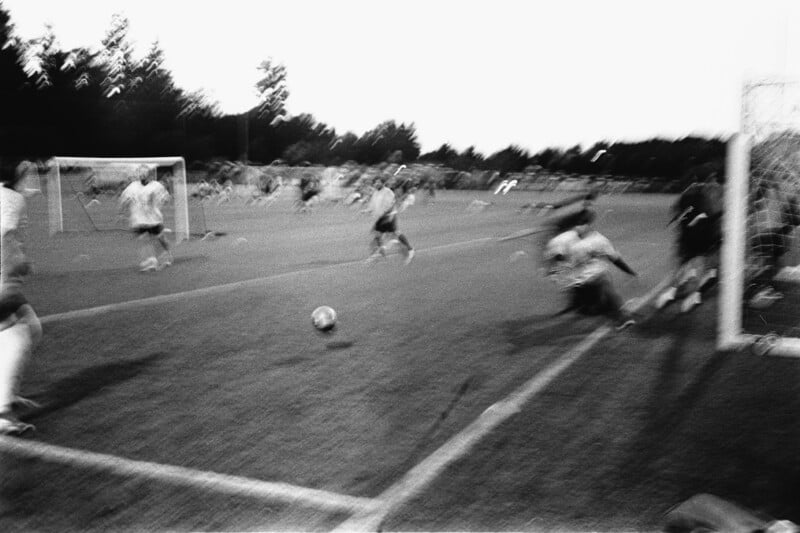
The synergy between the "beautiful game" of football and the "beautiful film" of Tri-X was recently showcased through a project at Blue Moon Camera and Machine in Portland, Oregon. Jovanni Lopez, a staff member and active soccer player, documented his local weekend matches using Tri-X disposable cameras.

Sports photography is traditionally dominated by high-speed digital bursts and telephoto lenses designed to freeze every blade of grass. However, Lopez’s use of Tri-X provides a different perspective. The resulting images—ranging from blurred shots of a ball hitting the back of the net to candid portraits of players during halftime—emphasize the community and emotion of the sport.
The inherent contrast of Tri-X works particularly well in outdoor sports settings. The deep blacks of the shadows and the crisp highlights of the jerseys create a sense of three-dimensional depth. Furthermore, the use of a disposable camera—a fixed-lens, simple-operation device—strips away the technical distractions of modern gear, forcing the photographer to focus on composition and the spirit of the match.

Market Analysis and the Analog Renaissance
The continued production of Tri-X is a significant indicator of the health of the analog photography market. Despite the ubiquity of smartphones, the sales of film have seen a steady resurgence over the last decade, driven largely by a younger demographic seeking a tactile and intentional creative process.
Kodak Alaris currently offers Tri-X in an impressive array of formats, ensuring its compatibility with almost any camera ever made. These include:

- 35mm and 120: The standard for enthusiasts and professionals.
- Sheet Film: 4×5, 5×7, and 8×10 for large-format fine art photography.
- Motion Picture Stock: Super 8 and 16mm formats, used by filmmakers seeking a vintage aesthetic.
- Niche Formats: Specialty cuts like 620 and 828, catering to collectors of vintage cameras.
From a business perspective, Tri-X remains a premium product. While more expensive than some budget black-and-white alternatives from overseas manufacturers, its consistency and the infrastructure of lab support (nearly every film lab in the world is calibrated for Kodak chemistry like D-76) justify its price point.
Broader Implications and Future Outlook
The endurance of Kodak Tri-X suggests that in the digital age, there is a growing appreciation for "permanent" media. A digital file is subject to bit rot, platform obsolescence, and the ephemeral nature of cloud storage. A Tri-X negative, if processed and stored correctly, is a physical object that can last well over a century.

Furthermore, the "Tri-X look" has become so desirable that it is the most emulated aesthetic in digital post-processing. Countless software filters and "presets" attempt to mimic its grain and tonal curve. However, as purists argue, there is a fundamental difference between a mathematical algorithm and the chemical reaction of light hitting silver halide crystals.
As major sporting events like the World Cup continue to captivate global audiences, the role of film in documenting these cultural milestones remains vital. It provides a visual counter-narrative to the hyper-saturated, ultra-sharp broadcasts of modern media. By stripping away color, Tri-X forces the viewer to look at the geometry of the play, the tension in a player’s posture, and the shared humanity of the crowd.

In conclusion, Kodak Tri-X 400 is more than just a photographic tool; it is a cultural artifact. Its 85-year journey from large-format sheet film to the pocket of a soccer player’s shorts reflects the evolution of how we see the world. Whether it is used to document a presidential inauguration or a local soccer match on a Saturday morning, Tri-X remains the definitive champion of black-and-white photography, proving that some classics are, by their very nature, irreplaceable.

