


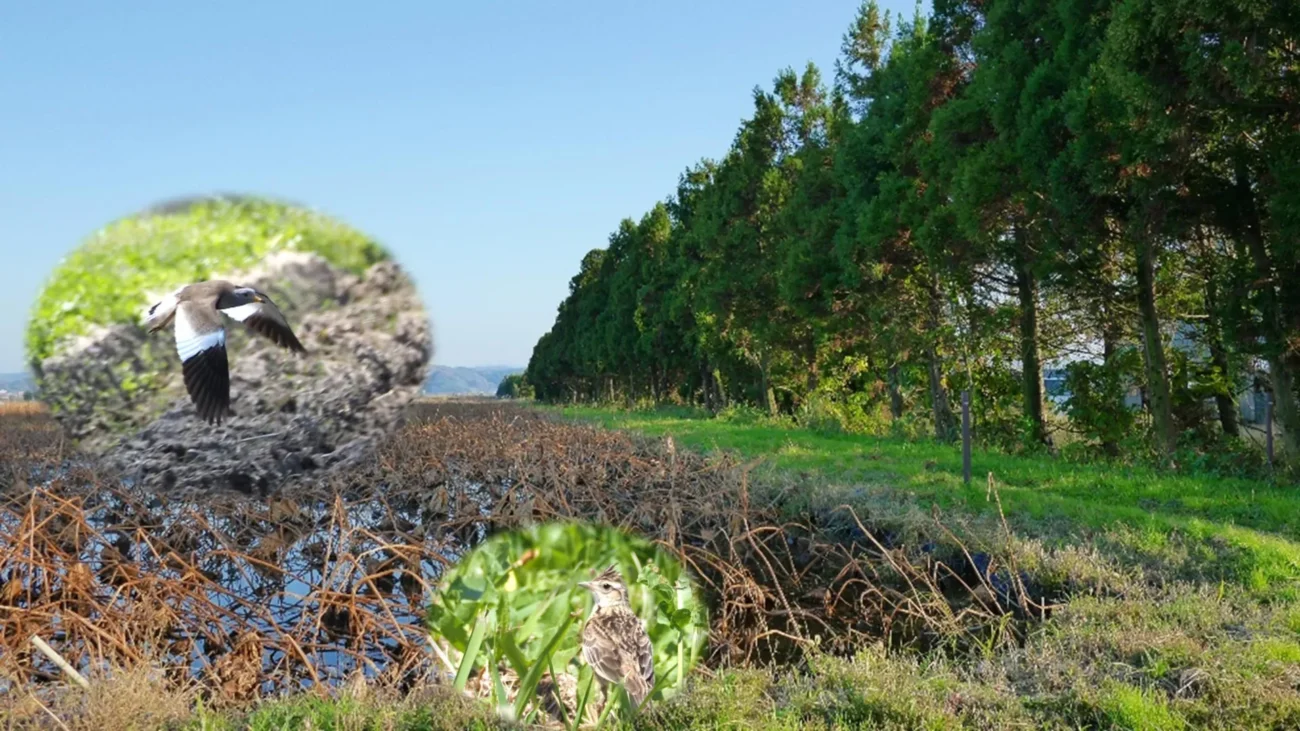
The global push to integrate trees into agricultural landscapes as a universal remedy for biodiversity loss is facing a critical scientific reality check. While conservation frameworks across North America, Europe, and Asia have long championed the planting of shelterbelts—rows of trees acting as windbreaks—to foster wildlife, new empirical research reveals a complex ecological trade-off. In agricultural wetlands, these linear woody features can inadvertently devastate populations of birds that rely on vast, unobstructed vistas, challenging decades of well-intentioned environmental management policies.
The findings, published recently in the Journal of Environmental Management, stem from an exhaustive study conducted in central Japan’s agricultural wetlands. Led by a multidisciplinary team of researchers from institutions including Hiroshima University, The University of Tokyo, and Kyoto University, the study demonstrates that shelterbelts do not distribute ecological benefits equitably. Instead, they function as "ecological walls," creating clear demographic winners and losers among avian communities that share the same rural spaces.
Background Context: The Global Push for Agroforestry and Its Blind Spots
In recent decades, agri-environmental schemes worldwide have heavily incentivized farmers and landowners to adopt agroforestry practices, particularly planting hedgerows, shelterbelts, and buffer strips. These interventions are widely documented to enhance biodiversity in simplified terrestrial ecosystems, such as intensive crop fields and dryland pastures. By providing nesting sites, foraging resources, and protective corridors, woody elements are frequently viewed as unalloyed benefits for nature.
However, the scientific consensus underpinning these programs is predominantly derived from terrestrial, dryland systems in Western nations. Far less attention has been paid to wet farming landscapes—such as rice paddies, lotus fields, and low-lying agricultural floodplains—which dominate rural geography across monsoon and temperate Asia. These dynamic wetlands serve a dual purpose: they are vital nodes for global food security and irreplaceable substitute habitats for millions of waterbirds, grassland species, and migratory flocks traversing major flyways.
As global wetlands continue to experience severe degradation and disappearance, agricultural wetlands have increasingly become the last line of defense for migratory and resident wetland birds. Yet, the introduction of woody features into these inherently open environments has largely evaded rigorous ecological scrutiny until now. Researchers questioned whether policies encouraging uniform tree-planting might be fundamentally misaligned with the ecological requirements of open-habitat specialists.
Chronology and Methodology of the Kahokugata Lake Study
To test these hypotheses, the research team turned to the agricultural landscape surrounding Lake Kahokugata in central Japan. Situated in a region historically plagued by fierce winter winds and severe seasonal storms, the area heavily relies on shelterbelts to shield sensitive crops and infrastructure from meteorological damage. At the same time, the broader Kahokugata ecosystem forms a critical stopover and wintering ground along the East Asian-Australasian Flyway, hosting nearly 300 recorded bird species across shifting seasonal cycles.
The investigation was structured around two distinct field survey periods designed to capture seasonal variations in bird populations:
- Late Winter Fieldwork (February and March 2021): Focused on wintering migratory species and resident birds enduring harsh, windy conditions.
- Early Summer Fieldwork (June 2023): Focused on breeding populations utilizing the agricultural wetlands during the reproductive season.
Using standardized point-count methodologies across various sites—ranging from open rice paddies to locations directly adjacent to established shelterbelts and others positioned roughly one kilometer away—the researchers meticulously recorded bird abundance, species richness, and community composition.
Quantitative Findings: Winners, Losers, and Ecological Walls
The survey data laid bare a stark ecological division within the avian communities inhabiting the wetland fringes. While shelterbelts successfully attracted shrub-land and edge-dwelling species—birds adapted to brushy, enclosed microhabitats—they exerted a profound, negative impact on open-land specialists.
The most striking metric yielded by the study revealed that the abundance of grassland-dependent birds was more than 70 percent lower at monitoring sites situated immediately adjacent to shelterbelts compared to open control sites located one kilometer away. Furthermore, overall species diversity among wetland-reliant birds plummeted near the tree lines.
Lead and corresponding author Dr. Masumi Hisano, an assistant professor at Hiroshima University’s Graduate School of Advanced Science and Engineering, encapsulated the mechanism behind these numbers. According to the research team, shelterbelts act as psychological and physical barriers—ecological walls—that fragment a previously continuous landscape. For species evolved to detect predators across expansive horizons and forage in wide-open expanses, tall rows of trees not only shrink usable foraging and nesting space but also dramatically increase vulnerability to ambush predators lurking within the woody cover.
Official Responses and Expert Analysis
The implications of the Kahokugata study extend far beyond the borders of central Japan, carrying immediate weight for global environmental policy makers. Conservation scientists and regional planners are being forced to re-evaluate the prevailing dogma that "more trees equal better biodiversity."
Dr. Hisano and her colleagues emphasize that the research does not frame trees as inherently harmful, but rather underscores that spatial configuration and geographic context are paramount. "Biodiversity-friendly farmland management must balance structural complexity with the ecological needs of open-habitat species, especially in landscapes where wetlands have already been heavily modified by humans," Hisano noted.
Agricultural extension officers and environmental policy consultants are taking note of the warnings. For years, government subsidies have rewarded tree-planting metrics without requiring landscape-level spatial analysis. Critics argue that blanket incentives risk displacing specialized fauna in exchange for generalist species that are already abundant elsewhere.
From an agronomic perspective, windbreaks remain undeniably valuable for preventing soil erosion, protecting delicate crops, and improving microclimatic conditions on the farm. However, the study points to a pressing need to reconcile agricultural engineering needs with conservation biology. If a windbreak successfully protects a crop but functionally eradicates an endangered migratory snipe or grassland bunting from the watershed, the net ecological gain of the landscape is compromised.
Broader Implications and Future Research Directions
As land-use planners look toward the future of climate-resilient agriculture, the insights from the Lake Kahokugata study chart a new path for evidence-based agri-environmental policy. The research team advocates moving away from one-size-fits-all mandates toward sophisticated, landscape-level zoning that strategically alternates open expanses with necessary woody infrastructure.
Future research phases will aim to untangle the finer variables of shelterbelt design. Scientists plan to investigate how specific physical parameters—including tree height, strip width, species composition, tree spacing, and spatial orientation relative to prevailing wind and migration corridors—influence wildlife dynamics across diverse geographic regions and seasonal shifts. Additionally, researchers hope to model indirect ecological cascades, such as how shelterbelts influence mammalian predator densities, insect distribution vectors, and inter-species competition.
Ultimately, the study serves as a timely reminder that ecological restoration is rarely straightforward. In delicately balanced ecosystems like agricultural wetlands, where human survival and wildlife conservation are inextricably linked, thoughtful planning must prevail over generalized assumptions. By optimizing the placement of both open habitats and woody features, rural landscapes can maintain their vital agricultural productivity while continuing to serve as secure, sustainable sanctuaries for vulnerable wildlife in a rapidly changing world.

