


For generations, the prevailing dogma of paleontology and molecular biology was built upon a foundation of decay. Conventional scientific understanding dictated that the process of fossilization—wherein groundwater minerals slowly replace the porous components of bones, teeth, and other biological tissues over vast expanses of time—was a destructive force. According to this long-standing view, fragile organic molecules such as proteins, DNA, and soft tissues were chemically incapable of surviving for tens or hundreds of millions of years. They were believed to inevitably succumb to microbial degradation, hydrolysis, and thermal breakdown long before an animal could pass completely into the geological record.
However, a groundbreaking study led by researchers at the University of Liverpool has shattered this decades-old assumption. Providing some of the most robust and incontrovertible evidence to date, the international research team has successfully demonstrated that original organic materials can indeed endure within specific Mesozoic fossils, including the bones and teeth of dinosaurs. By deploying cutting-edge analytical methodologies, the researchers detected authentic remnants of collagen—the primary structural protein found in bone—embedded deep within the hip bone of an Edmontosaurus, a duck-billed herbivorous dinosaur that roamed North America during the Late Cretaceous epoch.
This monumental discovery injects definitive empirical data into a contentious, three-decade-long scientific debate regarding the survival limits of ancient biomolecules. For thirty years, claims of recovered dinosaur proteins have been met with intense skepticism, methodological challenges, and fierce academic disputes. By rigorously addressing the primary criticism of past discoveries—namely, the possibility of modern environmental contamination—this new research establishes a secure foundation for a burgeoning sub-discipline: molecular paleontology. The findings were officially published in the peer-reviewed journal Analytical Chemistry, marking a watershed moment in how scientists interpret the fossil record and interact with ancient biological data.
An Exceptional Specimen from the Hell Creek Formation
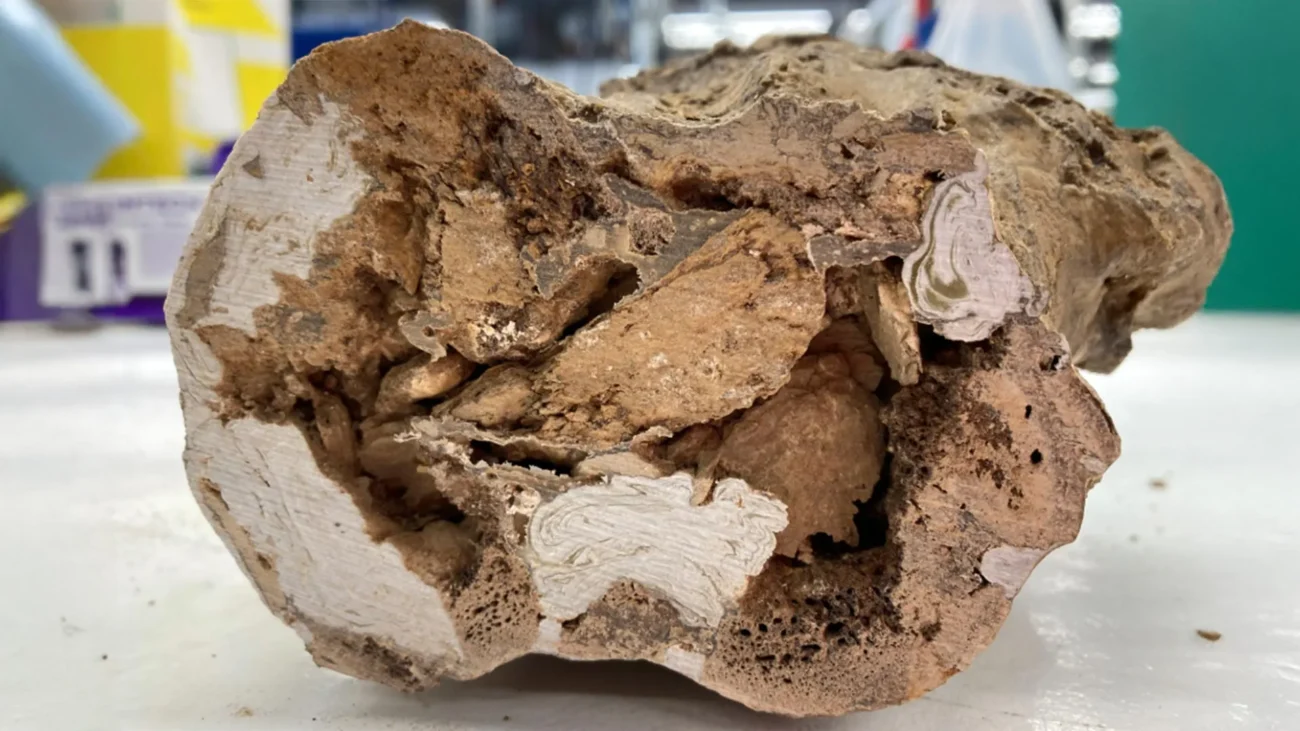
At the heart of this milestone research is an exceptionally well-preserved 22-kilogram sacrum belonging to an Edmontosaurus. The sacrum, a complex anatomical structure comprising fused vertebrae connected to the pelvis, forms a crucial load-bearing component of the lower spine in tetrapods. This specific specimen was excavated from the richly fossiliferous Upper Cretaceous rock layers of the Hell Creek Formation in South Dakota, a geological treasure trove renowned for yielding some of the most complete and pristine dinosaur fossils from the twilight of the Mesozoic era, just prior to the catastrophic asteroid impact that ended the Cretaceous period approximately 66 million years ago.
Following its excavation, the sacrum was integrated into the permanent paleontological collections of the University of Liverpool. Because the bone exhibited an unusually high degree of structural preservation—shielding its interior microenvironment from circulating groundwater and microbial invasion—it presented an ideal candidate for advanced molecular probing. Rather than relying solely on traditional macro-scale morphology and comparative anatomy, the research team resolved to examine the fossil at the atomic and molecular levels, deploying state-of-the-art instruments capable of detecting infinitesimal traces of surviving biochemistry.
A Multidisciplinary Assault on Deep-Time Biochemistry
To confirm the presence of ancient organic remnants, the University of Liverpool spearheaded a collaborative effort involving several premier institutions, including the University of California, Los Angeles (UCLA) and the University’s own Materials Innovation Factory and Centre for Proteome Research. This multidisciplinary framework was designed to eliminate false positives and provide mutually reinforcing lines of chemical evidence.
The investigative pipeline relied heavily on advanced mass spectrometry and protein sequencing. Mass spectrometry operates by ionizing chemical samples and measuring the mass-to-charge ratios of their constituent ions, allowing scientists to identify distinct molecular signatures and peptide sequences. The research team from the University of Liverpool’s Mass Spectrometry Research Group, operating within the Department of Electrical Engineering & Electronics, conducted initial high-resolution protein sequencing and mass spectrometry analyses to map the molecular constituents of the bone matrix.
Concurrently, specialists from UCLA applied tandem mass spectrometry to search for specific amino acid markers. Crucially, the team successfully detected and quantified hydroxyproline—an amino acid that, within the context of vertebrate biology, is overwhelmingly specific to collagen. Because hydroxyproline acts as a reliable chemical proxy for collagen degradation, finding it structurally bound within the fossilized bone matrix provided undeniable chemical validation that the organic signatures did not belong to modern microbial biofilms or handling residues.
Further reinforcing these conclusions, the Centre for Proteome Research at the University of Liverpool successfully identified specific fragments of collagen alpha-1, the primary structural form of collagen found abundantly in modern vertebrate bone tissue. Additional confirmatory tests carried out at the University’s Materials Innovation Factory cemented the validity of the data, ensuring that the detected peptides matched expected fragmentation patterns of ancient vertebrate proteins rather than laboratory artifacts.
Addressing the Contamination Controversy
The central controversy surrounding claims of ancient proteins has always revolved around contamination. Critics of earlier high-profile claims argued persuasively that organic materials isolated from ancient fossils were invariably modern interlopers—introduced via fungal hyphae, bacterial biofilms, handling by excavators, or organic molecules leaching from surrounding soils during millions of years of burial. Proving that a peptide sequence extracted from a 75-million-year-old fossil is genuinely indigenous to the animal has remained an immense analytical hurdle.
The Liverpool-led study directly confronted this skepticism by utilizing stringent extraction protocols, blank controls, and high-precision amino acid quantification. By isolating deep internal matrices of the Edmontosaurus sacrum and identifying specific degraded peptide markers like hydroxyproline, the researchers built a formidable case for authenticity.
Professor Steve Taylor, chair of the Mass Spectrometry Research Group at the University of Liverpool, emphasized the definitive nature of the work. "This research shows beyond doubt that organic biomolecules, such as proteins like collagen, appear to be present in some fossils," Professor Taylor stated. He further noted that the findings effectively neutralize the blanket assumption that any organics recovered from ancient remains are purely the product of modern contamination.
Revisiting a Century of Microscopy Data
Beyond the immediate chemical confirmation of dinosaur proteins, the study’s authors suggest that the discovery has immediate, practical implications for how museums and research institutions screen existing fossil collections around the globe. For nearly a century, paleontologists and geologists have utilized cross-polarized light microscopy to examine thin sections of fossilized bone. These images reveal distinct optical patterns and structural birefringences within the mineralized bone matrix, though their precise interpretation has often been debated.
According to Professor Taylor, these historical archives of cross-polarized light microscopy images should now be systematically revisited. The research team posits that specific visual patches historically dismissed as preservation artifacts or mineral anomalies may actually represent intact, protected micro-domains of fossil bone collagen. Recognizing these optical signatures could provide the scientific community with a ready-made, worldwide trove of high-potential fossil candidates for targeted protein sequencing.
Instead of randomly sampling valuable and scarce museum specimens, researchers could use established microscopy techniques to pre-screen bones for structural preservation before subjecting them to destructive mass spectrometry protocols. This workflow optimization could drastically accelerate the pace of molecular paleontology.
Unlocking New Phylogenetic Dimensions
The ability to consistently extract and analyze proteins from Mesozoic fossils promises to revolutionize our understanding of evolutionary relationships. Traditional paleontology relies almost exclusively on osteological morphology—the shape, size, and articulation of skeletal elements—to construct evolutionary trees and phylogenetic lineages. While invaluable, morphology can sometimes be misleading due to convergent evolution, where unrelated lineages develop similar physical traits in response to similar ecological pressures.
Biomolecular analysis bypasses these morphological ambiguities. Proteins such as collagen are direct translations of an organism’s genetic code; comparing the amino acid sequences of extinct taxa with those of their living relatives (such as birds and crocodilians) allows scientists to construct molecular phylogenies with mathematical precision.
By unlocking access to dinosaur proteomes, researchers may soon be able to resolve long-standing debates regarding dinosaur taxonomy, metabolic rates, and precise evolutionary connections between extinct groups and modern clades. The recovery of these molecular traces transforms dinosaur bones from static stones into dynamic biological archives.
The Enigma of Deep-Time Preservation
Despite the triumph of the analytical findings, the discovery revives one of the most profound biological mysteries in modern science: How can fragile proteins endure largely intact across tens of millions of years?
Thermodynamic and kinetic models of protein degradation dictate that covalent bonds within peptide chains should break down via hydrolysis over thousands, or at most a few million years, particularly under fluctuating geological temperatures and pressures. The persistence of collagen fragments in Cretaceous specimens implies that natural preservation mechanisms exist which science does not yet fully comprehend.
Researchers hypothesize that certain micro-environments within dense bone architecture—such as mineralized collagen fibrils shielded by dense hydroxyapatite crystals—may create a localized "molecular cage" that halts water circulation, blocks microbial access, and passivates catalytic chemical reactions. Furthermore, processes like advanced glycation end-products (AGEs) or natural cross-linking within the bone matrix may artificially stabilize protein chains, rendering them remarkably resistant to thermal and enzymatic decay.
Unresolved questions regarding these preservation kinetics mean that the biochemical community still has much work to do. Scientists must now focus theoretical and experimental efforts on modeling the exact geochemical conditions that facilitate deep-time macromolecular survival.
A New Horizon for Paleontological Science
The collaborative study published in Analytical Chemistry marks a definitive turning point in the study of deep-time biology. By resolving the long-running dispute over whether original biological molecules can survive the rigors of fossilization, the research team has opened an unprecedented window into the physiology, biochemistry, and evolutionary history of extinct animals.
As laboratories worldwide begin to re-examine archival specimens, apply advanced mass spectrometry, and decode the degraded peptide remnants hidden within dinosaur bone matrices, paleontology is poised to transition from a science of pure form to a discipline of profound molecular depth. The secrets locked within the bones of creatures that walked the Earth tens of millions of years ago are finally beginning to yield, offering a breathtaking glimpse into the living chemistry of a lost world.

