


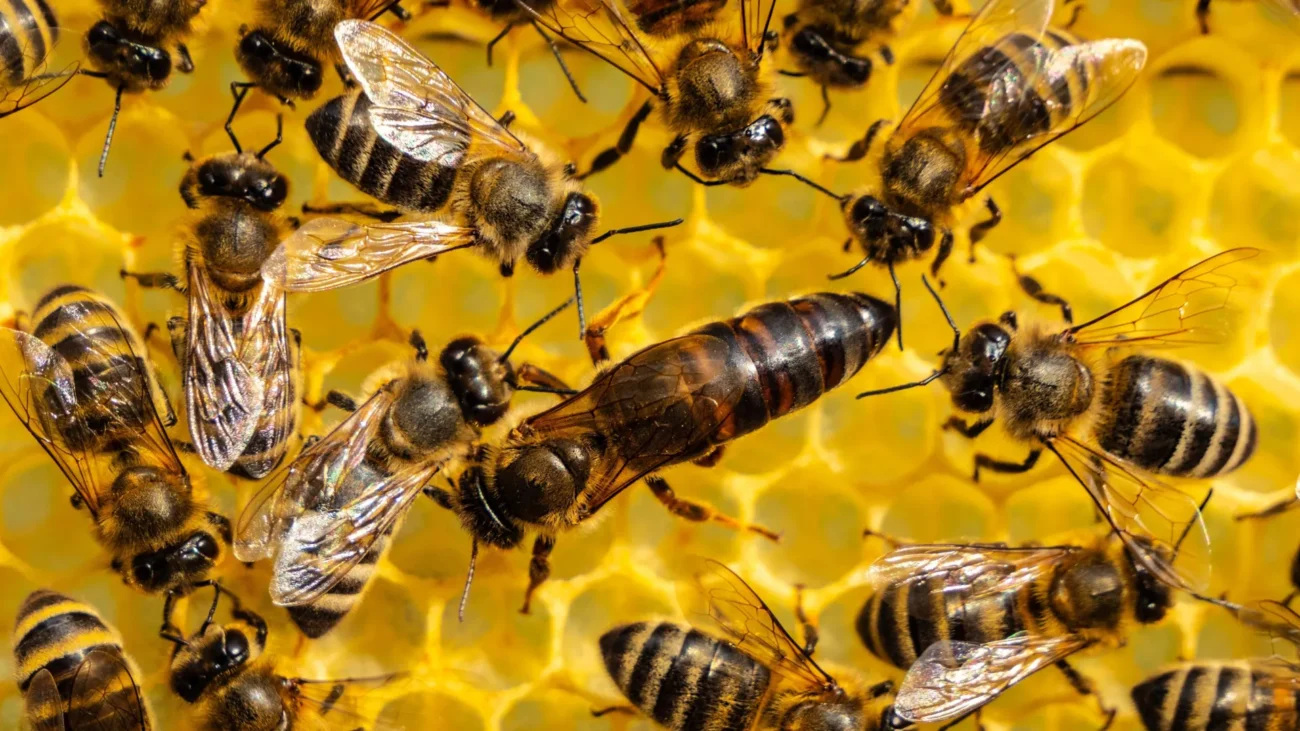
The delicate architecture of a honeybee hive has long been admired as one of nature’s most sophisticated cooperative systems. Within this intricate society, worker bees traditionally act as the primary shield against environmental hazards, serving as an organic filtration system that intercepts harmful agricultural chemicals before they can penetrate the core of the colony. However, groundbreaking new scientific research reveals that this frontline defense is not foolproof. When the chemical burden inside a hive reaches a threshold that overwhelms the worker bees, honeybee queens deploy an astonishing biological mechanism of self-preservation: they transfer accumulated toxins directly into their own eggs.
This process, known scientifically as maternal offloading, provides the first definitive evidence of how far a honeybee queen will go to safeguard her own physiology from toxic accumulation. Published in the journal Current Biology, the study was spearheaded by researchers at the University of California, Davis, in close collaboration with the Lawrence Livermore National Laboratory (LLNL) and the U.S. Department of Agriculture’s Agricultural Research Service (USDA-ARS). The findings offer a concerning new perspective on how chemical pollutants permeate honeybee colonies, threatening not only the immediate health of the queen but also the viability of future generations and, by extension, agricultural ecosystems worldwide.
Unraveling the Limits of Worker Bee Protection
For decades, entomologists and toxicologists maintained a comforting consensus regarding hive contamination: worker bees bore the brunt of environmental toxins. As foragers scour surrounding fields for nectar and pollen, they inevitably encounter agricultural pesticides. Upon returning to the hive, worker bees consume, process, and metabolize much of this contaminated food, effectively acting as chemical sponges that protect the developing larvae and the egg-laying queen.
Yet, this biological firewall has definitive limits. According to Angela Encerrado-Manriquez, the paper’s lead author and a recent Ph.D. graduate from UC Davis, those limits are frequently tested in modern agricultural landscapes. "In our study, pesticides began to accumulate in queens over time, suggesting that worker filtration capacity can be overwhelmed," Encerrado-Manriquez explained. "When this happens, queens have their own defense. Maternal offloading allows them to shunt the toxic burden to their eggs."
This shift in toxicological understanding highlights a vulnerable vulnerability at the heart of the colony. While worker bees successfully filter out a vast majority of contaminants during initial exposures, the relentless, cumulative drip of modern agricultural chemicals can saturate the hive’s defense mechanisms. As these toxins bypass the worker barrier, they begin to concentrate within the tissues of the queen, targeting her ovaries and threatening her fundamental biological role as the sole reproductive engine of the colony.
Inside the Laboratory: Simulating Hive Dynamics with Nanocolonies
To observe and measure this complex physiological dynamic, the research team had to develop an innovative experimental model. Replicating the vast and chaotic environment of a full-scale beehive in a controlled laboratory setting is notoriously difficult. To overcome this hurdle, the scientists engineered specialized experimental systems known as "nanocolonies."
Each nanocolony was housed within a compact conical plastic container featuring a netted bottom to ensure proper ventilation. Designed to accurately mimic the functional micro-environment of a natural hive, every single nanocolony contained exactly one queen bee accompanied by a cohort of 60 worker bees. This controlled setup allowed researchers to isolate variables and closely monitor the exact movement of chemical substances throughout the micro-society.
The experiment relied on a controlled diet administered to the bees. The colonies were provided with standard pollen, water, and food sources deliberately laced with methyl parathion, a widely recognized organophosphate insecticide. Crucially, the researchers tagged the pesticide with a low-level radioactive marker. This radioactive tracing capability was the linchpin of the methodology, enabling the science teams to pinpoint the exact trajectory and accumulation sites of the pesticide across various parts of the colony, including the worker bees, the comb wax, the queen’s body, her ovaries, and her eggs.
Chronology of Contamination and Breakdown
The multi-day observation period revealed a stark decline in the hive’s collective ability to filter out toxins over time, painting a picture of systemic fatigue.
On the very first day of exposure, the worker bees demonstrated remarkable efficiency. Through their natural processing and feeding behaviors, the workers successfully filtered out approximately 95% of the introduced pesticide, sequestering the harmful substances away from the core inhabitants and into the honeycomb. This initial high-efficiency phase reinforces the long-held belief in the potency of worker-led defense mechanisms.
However, as the days progressed, that protective barrier steadily eroded. By the tenth day of continuous exposure, the worker bees’ filtration effectiveness had dropped significantly to 86%. This degradation in filtration capacity corresponded directly with a measurable accumulation of pesticides inside the bodies of the queen bees. As the chemical saturation of the workers increased, they could no longer prevent the toxins from reaching the queen, forcing her to initiate maternal offloading to survive.
Advanced Technology: Tracking Trace Chemicals with BioAMS
The success of this study hinged heavily on the integration of cutting-edge analytical technology capable of detecting microscopic traces of chemical residue without harming the test subjects or altering natural behaviors. This capability was provided by LLNL and its specialized infrastructure.
The research team utilized Accelerator Mass Spectrometry, specifically adapted for biological applications known as BioAMS. This ultra-sensitive instrument allowed scientists to track the radioactive markers tagging the methyl parathion down to extraordinarily minute concentrations.
"With BioAMS, we can trace very low levels of a pesticide," noted Bruce Buchholz, an LLNL scientist and co-author of the study. "The pesticide concentrations we used were not lethal and were environmentally relevant to that seen in nature." By utilizing non-lethal, environmentally realistic doses rather than catastrophic, high-dose exposures, the researchers ensured that the behavioral and physiological responses observed in the lab accurately reflected what honeybees experience in natural agricultural settings where low-level chemical drift is a constant hazard.
Broader Implications for Agriculture and Colony Health
The implications of these findings extend far beyond academic toxicology, raising serious questions for beekeepers, commercial growers, and agricultural policymakers engaged in integrated pest management.
Sascha Nicklisch, senior author of the paper and an associate professor in the UC Davis Department of Environmental Toxicology, emphasized the delicate tipping point that colonies face. "When pesticides accumulate to the extent that the queen bee has eggs that are so loaded they may no longer develop properly, there could be a tipping point," Nicklisch warned. "There may be a slow creeping effect of chemical accumulation that will contribute to delayed colony collapse."
The role of the queen bee is utterly irreplaceable within the hive. Capable of producing between 1,500 and 2,000 eggs every single day, she serves as the sole demographic engine sustaining the colony’s workforce. If maternal offloading saves the queen’s life by purging toxins into her eggs, it does so at a devastating reproductive cost. Eggs saturated with agricultural chemicals frequently suffer from developmental failure, structural deformities, or embryonic death. Consequently, even if the queen survives the chemical exposure, the next generation of worker bees is severely compromised, leading to a gradual, insidious depletion of the colony’s labor force.
This dynamic sheds new light on the mysterious phenomenon known as Colony Collapse Disorder (CCD), where worker bees suddenly disappear, leaving behind a queen, ample food stores, and a few nurse bees. While CCD is widely understood to be a multifactorial syndrome driven by pathogens, habitat loss, and chemical exposure, the "creeping effect" of cumulative pesticide buildup and reproductive sabotage via maternal offloading may represent a previously overlooked compounding factor.
The Economic and Environmental Stakes
The health of honeybee populations is intimately tied to global food security and agricultural economics. Honeybees and other managed pollinators are responsible for pollinating approximately one-third of the human diet, facilitating the production of billions of dollars worth of fruits, vegetables, nuts, and forage crops. Any systemic threat to honeybee reproduction carries immediate economic consequences for commercial agriculture and threatens the stability of food supply chains.
Despite the clarity brought by the UC Davis and LLNL study, several critical questions remain unanswered. Researchers have yet to determine the exact physiological threshold at which a queen can no longer sustain the transfer of contaminants into her eggs without suffering fatal internal damage. Furthermore, scientists do not yet know whether different classes of pesticides—such as neonicotinoids, pyrethroids, or systemic herbicides—trigger identical offloading responses, or if the long-term consequences vary depending on the chemical composition of the pollutant.
These unresolved questions form the primary roadmap for future research initiatives. The collaborative team plans to expand their investigations to encompass a wider array of agricultural chemicals and longer observation windows, seeking to map out the exact biochemical pathways involved in maternal offloading.
As regulatory agencies and agricultural planners grapple with the complexities of protecting pollinators in modern landscapes, this study underscores the urgent need for more refined pesticide management strategies. Protecting honeybees requires looking beyond acute toxicity thresholds and accounting for the slow, cumulative burden that accumulates within the most vital members of the hive. Until agricultural practices evolve to better shield these essential insects, honeybee queens will continue their desperate biological calculus—trading the viability of their own offspring for the fragile chance of personal survival.

