


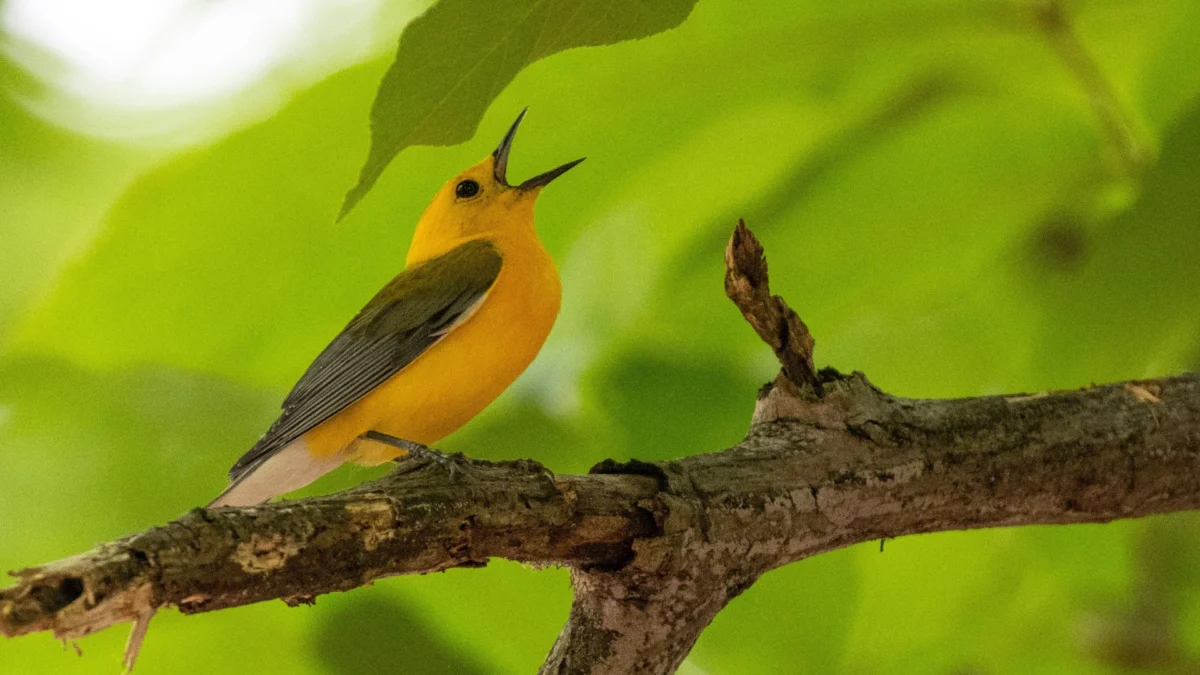
The emergence of these birds in Kansas represents a significant shift in avian distribution patterns. While individual Prothonotary Warblers have historically been spotted as rare migrants in the state, the confirmation of active breeding populations in southeastern Kansas marks a major milestone for regional ornithology. Researchers are now deploying advanced, miniaturized tracking technology to decipher the life history of these pioneers, uncovering a 5,000-mile odyssey that connects the former strip-mine wetlands of Kansas to the lush tropical landscapes of South America.
A Chronology of Colonization
The discovery of this breeding population was not the result of a single formal survey, but rather a series of serendipitous observations by local citizens. In 2023, resident Kathy Fox, a property owner near Pittsburg, Kansas, noted the presence of unfamiliar yellow birds occupying bluebird nest boxes on her land. Initially dismissed as transient migrants passing through during the spring, the birds’ behavior—specifically the construction of nests and the consistent feeding of nestlings—confirmed that they were, in fact, residents.
Following this discovery, the academic community mobilized. By June 2025, researchers from Pittsburg State University, led by graduate student Gabe McClain, initiated a formal study to track the movements of these birds. This research phase has evolved from a small-scale pilot project involving only six individuals to a robust monitoring program. As of the current 2026 breeding season, the project has scaled up to 36 tagged birds, providing a statistically significant data set that allows scientists to track individual migration paths, site fidelity, and survival rates with unprecedented accuracy.

Ecological Drivers and Habitat Transformation
The question of why the Prothonotary Warbler—a species biologically tied to mature, water-logged forests—has chosen to colonize southeastern Kansas is a subject of intense scientific interest. One of the leading theories involves the restoration of post-industrial landscapes. The region, which has a long history of coal mining, has seen significant reclamation efforts over the past several decades.
These reclaimed strip mines have often been transformed into mosaics of ponds, shrub-scrub habitats, and maturing woodlands. Researchers believe these man-made wetlands provide the specific environmental requirements the Prothonotary Warbler demands: quiet, shallow water and a steady supply of aquatic insects, combined with standing dead timber or nest-ready cavities. The presence of bluebird boxes, which the warblers have shown a surprising willingness to adopt, has likely acted as a catalyst, providing "ready-made" housing in areas where natural tree cavities might otherwise be scarce.
Technical Challenges in Avian Tracking
The research being conducted in Kansas relies on the use of light-level geolocators. These devices are marvels of modern engineering, designed to be small enough to fit a bird that weighs only about 15 grams. Because these trackers are too small to transmit data via satellite, they function as data loggers. They record ambient light levels, which allow researchers to calculate the bird’s approximate longitude and latitude based on day length and the timing of sunrise and sunset.
The primary limitation of this technology is the requirement for "recapture." To retrieve the data, the bird must return to the exact same site where it was tagged, and researchers must physically catch the bird to remove the device. The success of the project was solidified when a male bird, nicknamed "Hydrogen," returned to his original nesting box after a round-trip journey of approximately 5,000 miles. His journey revealed a flight path that took him from Kansas, through the Gulf of Mexico, and down into the tropical regions of Colombia by late October. This return confirmed that the Kansas population is not an isolated, "trapped" group, but a functioning part of the broader migratory network of the species.

Implications for Ornithology and Climate Science
The expansion of the Prothonotary Warbler into Kansas offers a case study in how species respond to environmental change. If the birds continue to thrive, it suggests that the species possesses a greater degree of behavioral plasticity than previously assumed. This has broader implications for conservationists, who must now consider how "restored" or "altered" habitats—such as reclaimed mines—can serve as critical refugia for species displaced by climate change or habitat loss elsewhere.
Furthermore, the data collected on these birds contributes to a larger understanding of the "fall migration bottleneck." As August transitions into September, millions of birds move across the United States. The Prothonotary Warbler’s movement from the interior of the continent to the tropical forests of South America provides a window into the energy requirements and stopover needs of long-distance migrants. By protecting the habitat in Kansas, conservationists are not just protecting a local population; they are safeguarding a vital link in a hemispheric chain.
How to Observe the Prothonotary Warbler
For birdwatchers and citizen scientists in Kansas, the coming weeks are critical. As the late summer heat begins to wane, these warblers are preparing for their southward journey. Because they are cavity nesters, they are often found in proximity to water, particularly in wooded wetlands or areas with abundant nest boxes.
Observers are encouraged to look for the males, which are highly territorial and brightly colored. Unlike the Northern Yellow Warbler, which is uniformly yellow, the Prothonotary Warbler is easily identified by its deep golden head, dark, unstreaked blue-gray wings, and white undertail feathers. When viewing these birds, it is essential to maintain a respectful distance, particularly if they are still attending to late-season nestlings or preparing for migration.

Future Research Directions
The expansion of the research team and the increase in the number of tagged birds mean that the coming years will likely yield a wealth of data regarding the "colonization phase" of this species. Scientists hope to determine whether these birds are offspring of the original pioneers or if they are attracted to the area by social cues from the existing population.
Moreover, as the Kansas population grows, the focus may shift toward the long-term sustainability of this group. Can this population survive harsh winters in South America and return to the same specific locations in Kansas? How do they compete with other cavity-nesting species, such as House Wrens or Tree Swallows, for limited nest box resources? These are the questions that will define the next chapter of this ongoing study.
Ultimately, the presence of the Prothonotary Warbler in Kansas is a reminder that the natural world is not static. Landscapes are constantly evolving, and wildlife is often more adaptable than we give it credit for. Whether this colonization is a temporary spike or a permanent expansion remains to be seen, but for now, it provides a unique opportunity for residents and scientists alike to witness a rare ecological success story in real-time. As the migration season approaches its peak, every flash of yellow in a Kansas woodland becomes a testament to the resilience of migratory birds and the unexpected ways in which human-altered landscapes can serve as a sanctuary for nature.

