


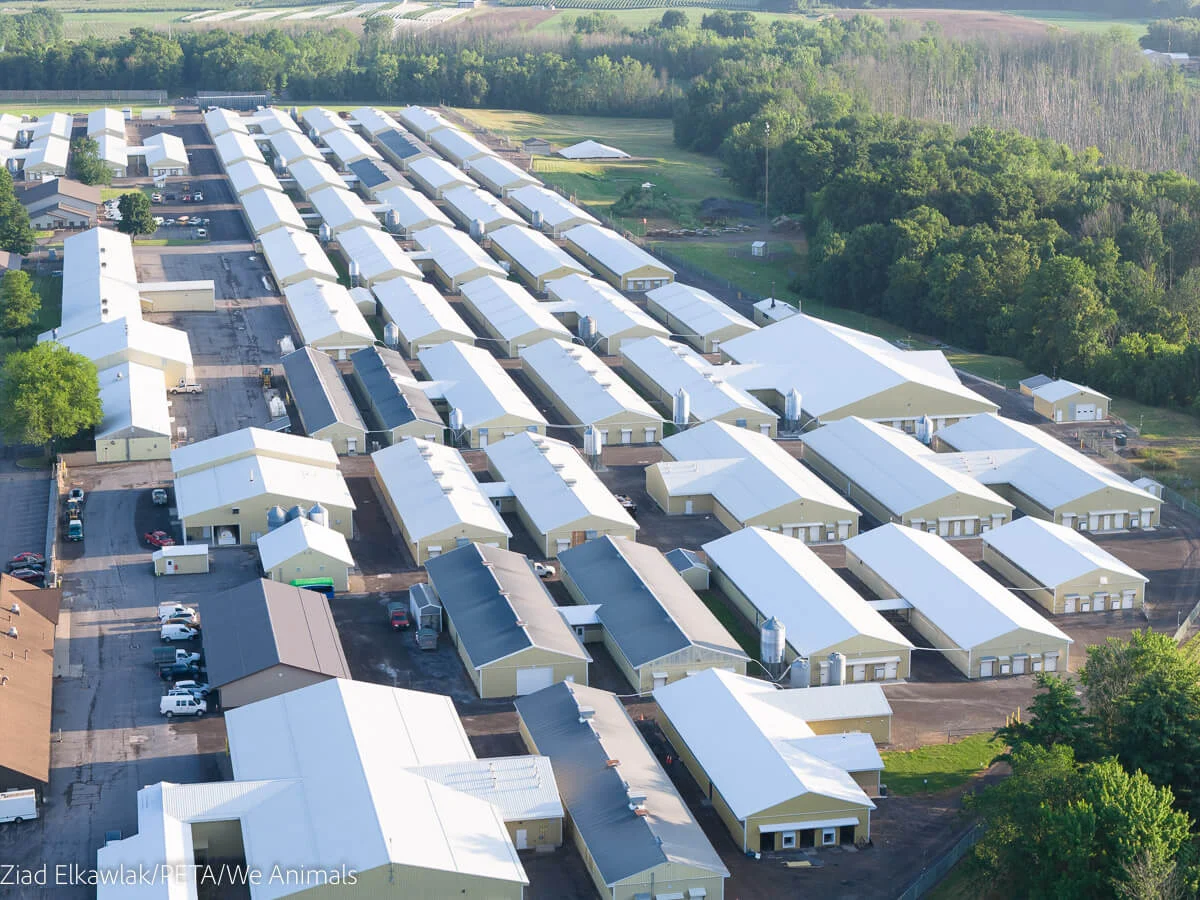
Nestled quietly behind dense rows of towering trees near North Rose, New York, lies one of the most controversial yet secretive animal breeding operations in the world. Marshall BioResources, a global enterprise that breeds and distributes dogs, cats, ferrets, minipigs, and other species to scientific laboratories, has long operated shielded from public view. Its understated, utilitarian exterior deliberately masks the large-scale industrial processing of animals occurring within its walls. However, recent aerial documentation has shattered this shroud of anonymity, exposing the true physical scale and operational reality of a facility that trades living creatures for commercial gain.
New drone footage, jointly obtained and published by People for the Ethical Treatment of Animals (PETA) and We Animals, provides a rare bird’s-eye view of the expansive North Rose property. The visual evidence reveals a sprawling concrete compound housing roughly 50 distinct warehouses. Inside these heavily fortified and isolated buildings, tens of thousands of animals—predominantly beagles and ferrets—are confined to indoor cages, entirely cut off from natural sunlight, fresh air, or soil.
Scale and Scope of the Facility
The sheer geographic footprint of the Marshall BioResources installation in New York is staggering. Spanning 103 acres, the property is vast enough to accommodate approximately 93 standard football fields or roughly 60 city blocks in Manhattan. Despite being surrounded by miles of open New York countryside and green fields, the animals imprisoned inside are denied any access to the outdoors. They are born into captivity, raised on steel and concrete surfaces, and eventually loaded onto transport vehicles bound for universities, pharmaceutical firms, contract testing facilities, and government laboratories.
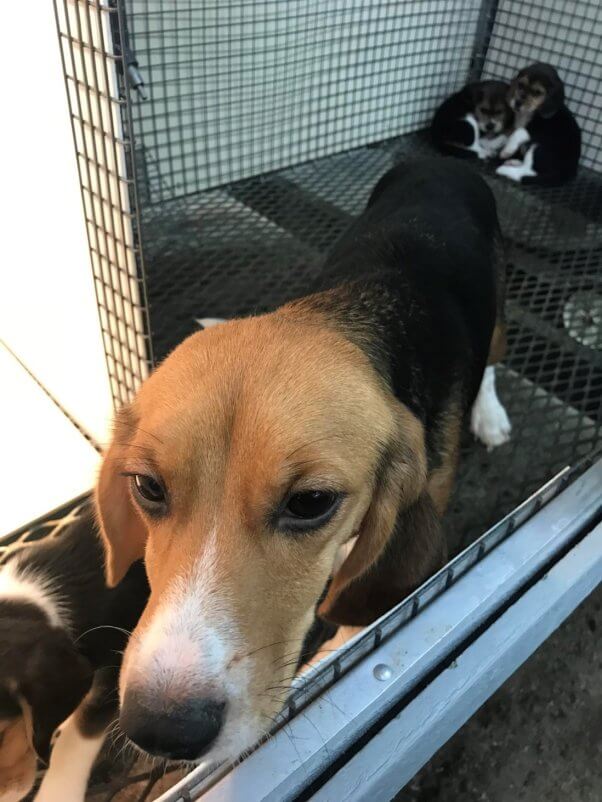
According to whistleblowers and previous investigative reports, conditions inside the 50 warehouses reflect the industrialized nature of the operation. Ferrets are routinely housed in cramped wire cages layered with dried feces, while breeding beagles and their litters languish in barren, elevated metal-floor enclosures suspended above soiled concrete waste channels. Stressed dogs have been documented displaying stereotypic behaviors, such as incessant pacing and bar-chewing, within their restricted confines. Furthermore, internal accounts and regulatory filings reveal that some animals are intentionally fitted with tight-fitting inhalation masks. This training allows Marshall BioResources to market and sell the dogs at a premium as pre-conditioned for toxicological aerosol testing—a process where animals are forced to breathe chemical fumes until they succumb or are euthanized.
Decades of Controversy and Regulatory Scrutiny
Marshall BioResources occupies a unique and dominant position in the American biomedical research supply chain. It stands as the last major commercial beagle breeder in the United States specifically dedicated to supplying dogs for laboratory experimentation. The company currently confines an estimated 16,000 dogs at its New York site alone, alongside thousands of other species distributed globally. The enterprise generates millions of dollars annually by provisioning living models for researchers testing everything from pharmaceuticals to consumer products, agrochemicals, and medical devices.
The company’s history is punctuated by consistent scrutiny from animal welfare advocates, federal regulators, and investigative journalists. Over the decades, the United States Department of Agriculture (USDA), which is tasked with enforcing the federal Animal Welfare Act, has repeatedly cited Marshall BioResources for regulatory violations. Documented infractions have included failures to provide adequate veterinary care, substandard housing conditions, failure to maintain structural integrity in enclosures to prevent injury, and inadequate tracking of animal health and mortality.
Despite these citations, the facility has largely maintained its operating licenses, adapting to regulatory pressures while continuing its high-volume production. Critics argue that periodic fines represent little more than a nominal cost of doing business for a corporation with multi-million-dollar revenues derived from the global animal testing market.
Chronology of Escalating Pressure
The release of the September 2026 drone footage represents the latest milestone in a sustained, multi-year campaign by animal rights organizations to shine a light on commercial laboratory animal breeding.
- Early 2020s: Animal welfare organizations increase surveillance of major U.S. animal breeders, shifting focus away solely from laboratories and toward the upstream suppliers that provide the test subjects.
- November 2024: Investigative disclosures and public advocacy draw intense regulatory and legislative interest following documentation of severe welfare concerns and fatalities within similar high-volume breeding networks.
- September 2026: PETA and We Animals publish comprehensive drone imagery and video analysis of the North Rose facility, quantifying its 50-warehouse layout and re-igniting public debate over the ethics and necessity of dedicated laboratory animal breeding.
- Present Day: Advocacy groups launch coordinated public action campaigns, petitioning the USDA to revoke Marshall BioResources’ federal dealer license based on cumulative welfare violations.
Industry Implications and the Broader Animal Testing Debate
The ongoing controversy surrounding Marshall BioResources highlights broader, systemic questions regarding the future of biomedical research and product testing. For decades, traditional pharmaceutical and chemical development models relied heavily on animal subjects—particularly dogs and rodents—to assess safety, toxicity, and pharmacokinetic profiles before human clinical trials. Proponents of these traditional methods argue that complex biological systems require whole-animal models to accurately predict human physiological responses.
However, scientific consensus and regulatory frameworks are gradually evolving. Advances in non-animal testing methodologies—such as organ-on-a-chip technology, advanced computer modeling, high-throughput in vitro cell assays, and human tissue constructs—are increasingly recognized as viable, often more accurate alternatives to animal testing. Legislative shifts, including the FDA Modernization Act passed in the United States, have begun to loosen strict legal mandates that historically required animal data for certain types of drug applications, encouraging researchers to adopt alternative methods where scientifically feasible.
Despite these technological and legislative strides, companies like Marshall BioResources remain deeply embedded in the legacy framework of scientific research. The demand for standardized, homogenous animal models—particularly beagles, valued for their docile temperament and predictable biological responses—ensures a steady market for commercial breeders.
Economic and Political Ramifications
The business model of Marshall BioResources relies on a delicate balance between secrecy and regulatory compliance. Because the facilities are intentionally located in rural, inaccessible areas, day-to-day operations remain shielded from public observation. The reliance on drone journalism and insider whistleblowers is often the only mechanism by which conditions inside these compounds are brought to light.
Economically, the company services a lucrative clientele that includes major global corporations and taxpayer-funded federal research institutions. Disrupting this supply chain requires not only targeting the breeders themselves, but also shifting the procurement practices of the end-users. Universities and pharmaceutical enterprises face mounting pressure from shareholders, students, and ethical oversight committees to phase out the use of dogs and cats in favor of humane alternatives.
Political fallout continues to center on the oversight role of the USDA. Animal advocacy groups contend that current federal standards under the Animal Welfare Act are structurally inadequate to protect animals in mass-production breeding facilities. Critics assert that enforcement mechanisms are reactive rather than preventative, allowing substandard conditions to persist for months or years before inspectors intervene.
Path Forward and Public Response
In the wake of the September 2026 aerial revelations, animal welfare organizations are channeling public outrage into targeted regulatory petitions. The primary objective of the current campaign is to pressure the USDA’s Animal and Plant Health Inspection Service (APHIS) to exercise its authority under the Animal Welfare Act to suspend or revoke Marshall BioResources’ commercial dealer license.
Legal experts note that revoking a federal license requires substantial, documented proof of chronic, uncorrected non-compliance, a threshold that advocacy groups argue has been met repeatedly over the facility’s operating history. Whether federal regulators will bow to public pressure and take unprecedented punitive action against the nation’s last major commercial beagle breeder remains uncertain.
As the debate intensifies, the imagery captured above the North Rose facility serves as an enduring reminder of the hidden industrial apparatus that underpins traditional laboratory science. For the thousands of dogs and ferrets currently confined within the 50 warehouses of Marshall BioResources, the exterior landscape of green fields and open sky remains entirely out of reach, underscoring the ongoing ethical tension between modern scientific advancement and the welfare of captive animals.

