


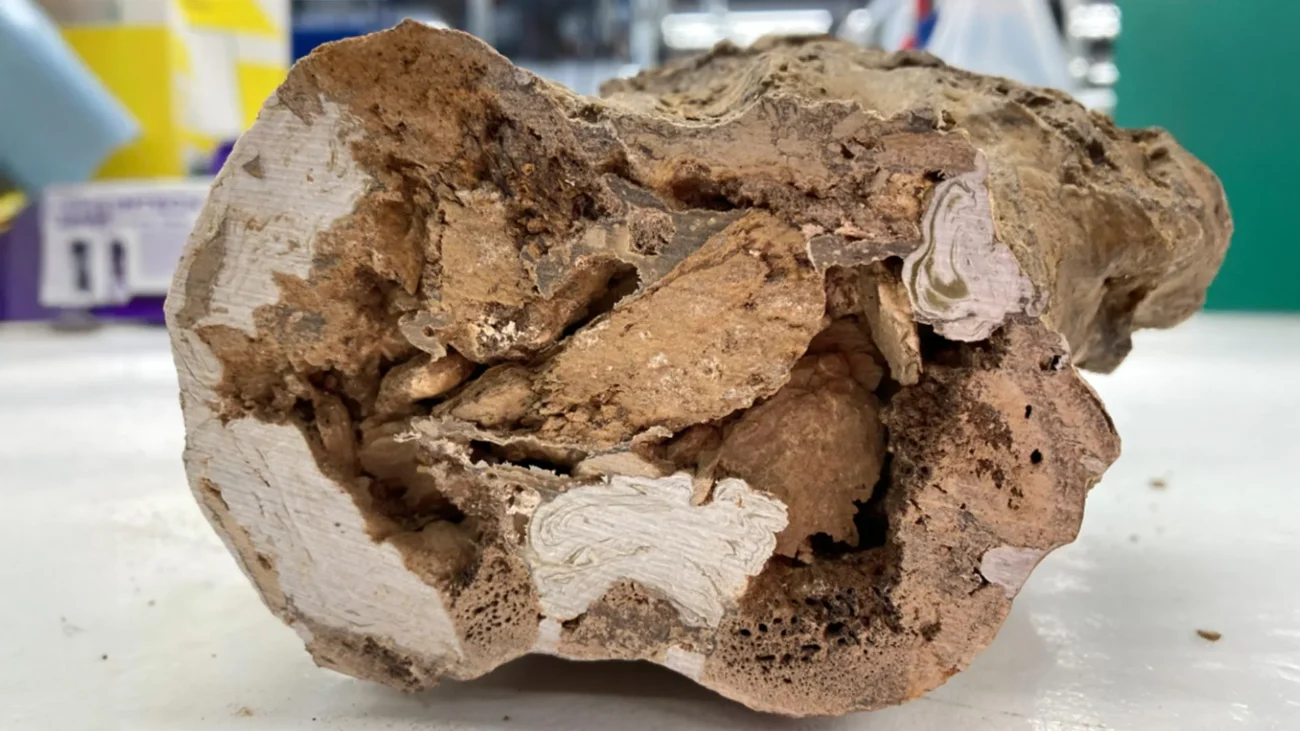
For decades, the prevailing scientific consensus held that dinosaur fossils were essentially mineralized geological formations, their original biological material long since surrendered to the relentless march of time and geological processes. However, a groundbreaking study, meticulously focused on a remarkably preserved Edmontosaurus fossil, is poised to fundamentally alter this long-held assumption. Researchers have unearthed compelling evidence suggesting that traces of original organic molecules, most notably collagen, persist within dinosaur bones dating back an astonishing 66 million years. This discovery provides potent support for a controversial hypothesis that has fractured the paleontological community for over three decades.
The Landmark Edmontosaurus Discovery
The focal point of this transformative research is a 22-kilogram sacrum, a crucial bone from the hip region of an Edmontosaurus, excavated from South Dakota’s renowned Hell Creek Formation. This Late Cretaceous behemoth, a large duck-billed herbivore, shared its environment with iconic predators such as Tyrannosaurus rex. The meticulous analysis, led by a team from the University of Liverpool, employed a sophisticated array of advanced laboratory techniques, including high-resolution protein sequencing and multiple forms of mass spectrometry. These cutting-edge methods allowed scientists to detect definitive remnants of collagen, the principal structural protein integral to bone tissue, embedded within the fossilized matrix. The identification of collagen, a relatively resilient biomolecule, in such an ancient context presents a formidable challenge to theories positing its complete degradation over geological timescales.
Further bolstering the findings, researchers from the University of California, Los Angeles (UCLA) identified hydroxyproline, a specific amino acid unequivocally associated with collagen within bone. This crucial corroboration served as a powerful confirmation that the degraded collagen fragments detected were indeed endogenous, meaning they originated from the dinosaur itself, rather than being modern contaminants.
Professor Steve Taylor, chair of the Mass Spectrometry Research Group at the University of Liverpool’s Department of Electrical Engineering & Electronics, articulated the profound significance of these findings. "This research shows beyond doubt that organic biomolecules, such as proteins like collagen, appear to be present in some fossils," he stated. "Our results have far-reaching implications. Firstly, it refutes the hypothesis that any organics found in fossils must result from contamination."
A Decades-Long Debate Rekindled
The notion of preserved soft tissues and proteins within dinosaur fossils has been a subject of intense scientific contention since the early 2000s. A significant faction of the scientific community has consistently argued that any reported organic material was likely the result of modern contamination from researchers or microbial residues, rather than authentic dinosaurian molecules.
One of the earliest and most influential contributions to this debate came in 2005, when paleontologist Mary Schweitzer and her colleagues reported the discovery of soft tissue structures within a Tyrannosaurus rex fossil. Subsequent studies, building upon this initial revelation, identified potential collagen and structures resembling blood vessels in additional dinosaur specimens, including hadrosaurs, a group to which Edmontosaurus belongs.
The current Edmontosaurus analysis distinguishes itself through its rigorous, multi-pronged approach. By employing multiple, independent testing methodologies on the same fossil specimen – a combination of advanced microscopy, detailed chemical analysis, and precise protein sequencing – the research team aimed to systematically eliminate the possibility of contamination. This integrated strategy significantly strengthens the assertion that the detected molecules are genuinely original to the dinosaur.
The pivotal findings of this research were formally published in the peer-reviewed journal Analytical Chemistry in 2025, under the impactful title, "Evidence for Endogenous Collagen in Edmontosaurus Fossil Bone."
Implications: A New Frontier in Paleontological Research
The implications of this discovery are nothing short of revolutionary for the field of paleontology. If proteins, particularly resilient ones like collagen, can indeed survive for tens of millions of years within fossilized remains, it opens up entirely new avenues for understanding extinct life.
Tiny molecular traces, previously overlooked or dismissed as contaminants, could now serve as invaluable indicators of evolutionary relationships between dinosaur species, potentially revealing connections that are difficult or impossible to discern from skeletal morphology alone. Furthermore, these molecular remnants may offer unprecedented insights into various aspects of dinosaur biology, including their growth patterns, aging processes, physiological functions, and even the prevalence of diseases that afflicted them.
Professor Taylor emphasized the need to re-examine existing fossil collections. "Our results suggest that scientists may now need to revisit fossil samples collected over the past century," he remarked. "Cross-polarized light microscopy images taken decades ago could contain overlooked evidence of preserved collagen in ancient bones." He further elaborated, "These images may reveal intact patches of bone collagen, potentially offering a ready-made trove of fossil candidates for further protein analysis. This could unlock new insights into dinosaurs, for example revealing connections between dinosaur species that remain unknown."
The Enigma of Molecular Persistence
The very survival of these delicate organic molecules over such immense geological timescales presents a profound scientific mystery. Proteins, by their very nature, are prone to degradation. Across millions of years, this breakdown is expected to be nearly complete. Yet, the existence of some fossils capable of preserving microscopic biological structures under specific, albeit still debated, conditions challenges this expectation.
A growing area of scientific inquiry focuses on the role of mineral interactions within the fossilization process. It is hypothesized that the intimate association of organic molecules with mineral matrices inside bone may create a protective shield, effectively inhibiting complete decay. Recent studies investigating fossil biomolecules suggest that specific burial environments, characterized by particular geological conditions and the unique micro-architectural properties of bone, can create stable environments that dramatically slow down chemical decomposition.
The Edmontosaurus, as a subject of this study, is already celebrated for its exceptional preservation qualities. Over the past century, numerous Edmontosaurus specimens have been unearthed that retain remarkably detailed skin impressions and other soft tissue features, leading to their popular moniker, "dinosaur mummies." More recent paleontological expeditions have continued to uncover Edmontosaurus specimens exhibiting a surprising degree of soft tissue preservation, including evidence of fleshy structures and intricate skin anatomy.
Collectively, these discoveries are fundamentally reshaping our perception of fossils. Rather than viewing them solely as stony replicas of ancient skeletal structures, scientists are increasingly recognizing some fossils as potential molecular time capsules, capable of safeguarding vestiges of prehistoric biology for millions of years. This paradigm shift promises to usher in a new era of paleontological investigation, one where the molecular past of extinct giants can be meticulously deciphered.
Historical Context and the Evolution of Fossil Interpretation
The journey to understanding fossilized organic matter has been a long and often contentious one, marked by significant technological advancements and evolving scientific paradigms. Early paleontological endeavors, primarily focused on the macroscopic and skeletal aspects of dinosaurs, relied heavily on techniques that would have destroyed delicate organic molecules. The advent of radiometric dating in the mid-20th century provided a more accurate framework for understanding the vast timescales involved in fossilization, reinforcing the notion that organic material would be completely replaced by minerals.
The initial whispers of preserved organic material began to surface in the late 20th century, often met with skepticism. These early claims, while intriguing, lacked the robust analytical tools and multi-disciplinary validation that characterize the current study. The 2005 announcement by Mary Schweitzer regarding soft tissues in a T. rex fossil, though groundbreaking, ignited a firestorm of debate. Critics argued vehemently for contamination, pointing to the perceived impossibility of such preservation.
The Edmontosaurus study, published in 2025, represents a critical inflection point. The rigorous application of multiple, independent analytical techniques – each with its own limitations and strengths – provides a formidable bulwark against accusations of contamination. The convergence of results from protein sequencing, mass spectrometry, and amino acid analysis, all pointing to the presence of endogenous collagen, offers a compelling case for the authenticity of the findings.
The "Dinosaur Mummy" Phenomenon and Molecular Insights
The exceptional preservation of certain Edmontosaurus specimens, often referred to as "dinosaur mummies," has long hinted at the potential for more than just mineralized bone to survive. These fossils, exhibiting preserved skin, scales, and even impressions of musculature, suggest that under specific environmental conditions, the decay of soft tissues could be significantly arrested. The current research builds upon this observation by delving into the molecular remnants within the bone itself.
The hypothesis that mineral interactions play a crucial role in shielding organic molecules from degradation is gaining traction. Certain mineral compositions and structures within the fossilized bone matrix might act as a protective barrier, encapsulating and preserving fragments of proteins like collagen. Understanding these specific mineralogical and environmental factors is now a key area of research, as it could unlock the secrets to identifying and extracting such molecular data from other fossil specimens.
Broader Implications for Science and Education
Beyond the immediate impact on paleontology, this discovery has profound implications for broader scientific understanding and public engagement with science.
- Evolutionary Biology: The ability to analyze endogenous protein sequences from ancient organisms could revolutionize our understanding of evolutionary relationships. Molecular data can provide finer-scale resolutions than morphological data, potentially resolving long-standing phylogenetic uncertainties among dinosaur groups and even linking them more definitively to avian lineages.
- Paleoecology and Paleoclimatology: Analyzing preserved organic molecules might offer clues about the diet, physiology, and even the health of dinosaurs, providing a more nuanced picture of ancient ecosystems and the environmental conditions that shaped them.
- Biomaterials Science: The study of how these ancient biomolecules have persisted could inspire new approaches in biomaterial preservation and engineering, potentially leading to advancements in fields like long-term storage of biological samples or the development of more durable biomaterials.
- Public Engagement and Education: The "dinosaur mummy" phenomenon has already captured the public imagination. The idea that fossils are not just inert rocks but potential repositories of ancient biological information can spark immense curiosity and enthusiasm for science, particularly among younger generations. It offers a more tangible and exciting connection to the prehistoric past.
Future Directions and Unanswered Questions
While the Edmontosaurus study represents a monumental leap forward, many questions remain. The precise mechanisms of collagen preservation over geological timescales are still not fully understood. Further research is needed to identify the specific environmental and mineralogical conditions that facilitate this extraordinary preservation.
Additionally, the extent to which this phenomenon is widespread across different dinosaur species and geological eras needs to be investigated. Future research will undoubtedly involve the re-examination of existing fossil collections with new analytical techniques and the careful selection of new specimens for targeted molecular analysis. The potential for discovering preserved proteins in other ancient vertebrates, and even invertebrates, also opens up exciting new avenues of inquiry.
The implications of this research extend to how we curate and study our existing fossil records. The potential for hidden molecular treasures within long-archived specimens suggests that our current understanding of paleontological history may be just scratching the surface. The Edmontosaurus fossil, once viewed as a complex mineralized structure, now stands as a testament to the enduring power of life’s building blocks, offering a direct molecular link to a world long vanished.

