


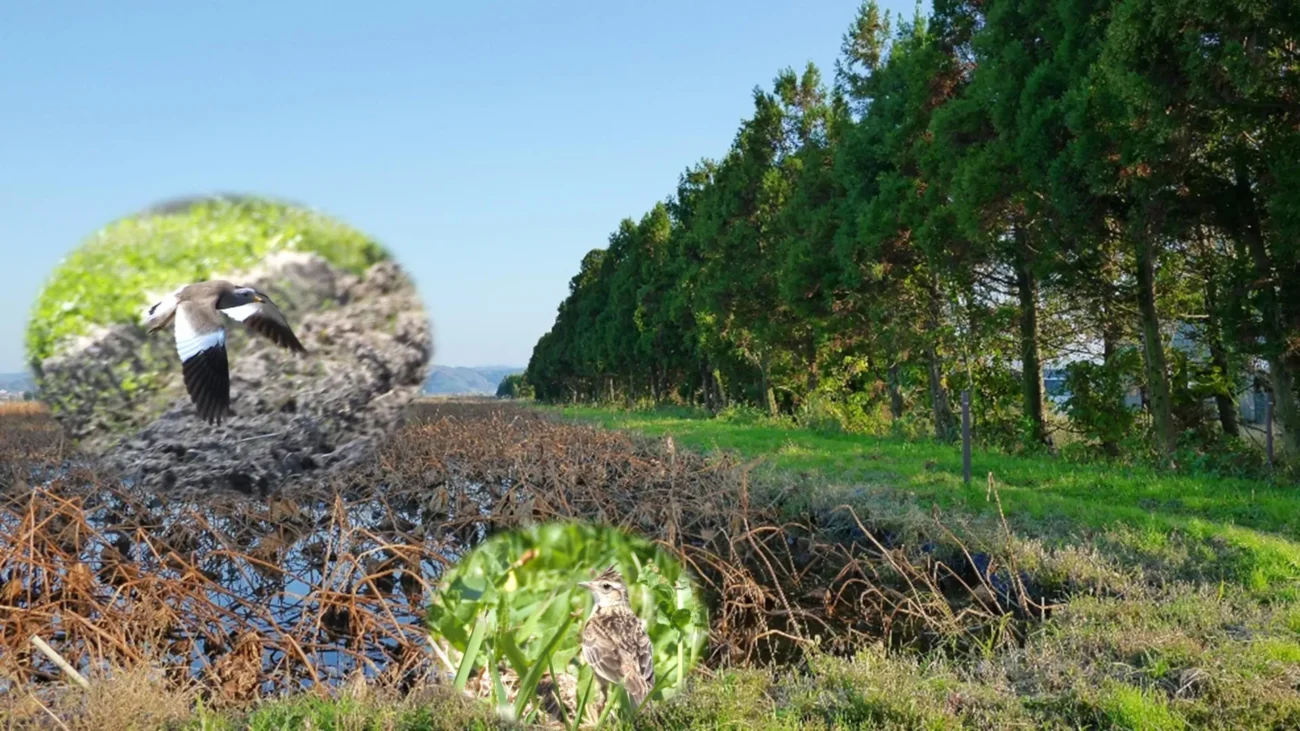
Trees planted along farmland to shield crops from strong winds are often viewed as a simple way to support biodiversity. But new research suggests the picture is more complicated, especially in agricultural wetlands where many bird species depend on open landscapes. A team of researchers studying farmland wetlands on the western coast of central Japan found that shelterbelts, rows of trees planted as windbreaks, do not benefit all birds equally. While they provide habitat for some species, they can also reduce the abundance and diversity of birds that rely on open grassland and wetland environments. The findings, published in the Journal of Environmental Management, challenge the prevailing assumption that all woody features automatically enhance farmland biodiversity.
The Conventional Wisdom and Its Limitations
For decades, agricultural conservation programs across the globe have actively encouraged farmers to integrate woody landscape features, such as trees and hedgerows, into their farmlands. This practice, commonly referred to as establishing shelterbelts or windbreaks, is widely promoted as a cornerstone of biodiversity enhancement in agricultural settings. The rationale is straightforward: these linear features offer crucial habitat, foraging grounds, and nesting sites for a variety of wildlife, thereby increasing the overall ecological richness of the farmed environment. This approach has been particularly popular in Europe and North America, where extensive research has demonstrated positive impacts on certain bird species and insect populations within cropland and grassland systems.
However, the new study from Japan introduces a critical nuance, highlighting that the benefits of shelterbelts are not universally applicable, particularly in unique ecosystems like agricultural wetlands. These wet farming landscapes, such as the ubiquitous rice paddies prevalent across Asia, serve a dual purpose: they are essential for food production and, critically, function as vital surrogate wetlands for a multitude of bird species. These avian populations include migratory birds that rely on these areas as critical stopover points along major flyways. As natural wetland habitats continue to face pressure and decline worldwide, the ecological importance of these agricultural wetlands intensifies.
"The central question of our study is, ‘Do shelterbelts and other woody linear features benefit all farmland birds equally in agricultural wetland landscapes, or do they create trade-offs by disadvantaging species that depend on open habitats?’" explained Masumi Hisano, the corresponding author and assistant professor at Hiroshima University’s Graduate School of Advanced Science and Engineering. This inquiry is particularly pertinent given the dual role of agricultural wetlands. If conservation efforts focused on increasing biodiversity through tree planting inadvertently diminish the quality of habitat for species that thrive in open environments, these well-intentioned initiatives could lead to unintended negative consequences for bird communities.
A Case Study in Japan’s Agricultural Wetlands
To address this complex ecological question, the research team turned their attention to the farmland surrounding Lake Kahokugata in central Japan. This region presents an ideal setting for such a study due to its mosaic of agricultural landscapes, which includes extensive rice paddies, lotus fields, cultivated cropland, and pastureland. The geographical location is also subject to significant climatic challenges, regularly experiencing strong winter winds and storms. Consequently, shelterbelts are a prevalent feature, strategically planted by farmers to mitigate wind damage to their crops and protect their agricultural endeavors.
Lake Kahokugata itself is recognized as a vital stopover site along the East Asian-Australasian Flyway, a critical migratory route for millions of birds. The area provides essential resources for avian species throughout the year. Wintering species find refuge and sustenance during the colder months, while breeding species utilize the wetlands and surrounding farmlands for nesting and raising their young during the summer. The ecological significance of this location is underscored by the fact that nearly 300 different bird species have been recorded in the region, indicating a high level of biodiversity and ecological importance.
The study was conducted over two distinct periods to capture seasonal variations in bird populations. Bird surveys were initially carried out in February and March of 2021, focusing on the wintering and migratory bird communities. A subsequent survey was conducted in June 2023, targeting the breeding bird populations. The researchers employed a standard point count method, a widely accepted scientific technique for assessing bird abundance and diversity within specific areas. This involved establishing fixed observation points and recording all bird species detected within a defined radius over a set period. By comparing bird populations in areas adjacent to shelterbelts with those in open, unobstructed areas, the team aimed to quantify the impact of these woody structures.
Unveiling the Ecological Trade-Offs
The results of the comprehensive bird surveys at Lake Kahokugata painted a clear and compelling picture of an ecological trade-off. The presence of shelterbelts did indeed benefit certain bird species, specifically those that are associated with shrubland habitats and the edges of vegetated areas. These species, which often seek refuge and foraging opportunities within dense foliage, demonstrated increased abundance in areas close to the tree lines.
However, this localized benefit came at a significant cost to other avian populations. The research revealed a substantial reduction in both the abundance of grassland birds and the diversity of wetland species that are intrinsically dependent on large, open expanses. These are the species that rely on unobstructed fields and water bodies for foraging, nesting, and predator avoidance.
"We found that the abundance of grassland birds was more than 70 percent lower at sites next to shelterbelts compared with open sites located about one kilometer away," stated Hisano, emphasizing the magnitude of this negative impact. This stark statistic underscores the profound influence that even relatively narrow strips of trees can exert on the composition and dynamics of bird communities within an agricultural landscape.
The researchers explained that shelterbelts effectively function as "ecological walls." While these "walls" create new habitat opportunities for some species, they simultaneously reduce the available usable space for birds that are adapted to and require open environments for their survival. Furthermore, the dense structure of shelterbelts can alter predator-prey dynamics, potentially increasing the exposure of open-habitat birds to predators that may utilize the shelterbelts as hunting grounds or hiding places. This indirect effect can further contribute to the decline of vulnerable species.
"Our study provides clear, quantitative evidence that small-scale landscape features can have large ecological consequences, directly relevant to land-use planning and environmental management," Hisano concluded, highlighting the practical implications of their findings for policymakers and land managers.
Strategic Placement: The Key to Balanced Conservation
The study’s findings strongly advocate for a more nuanced approach to farmland management, moving beyond the simplistic notion that planting trees is always beneficial for biodiversity. Instead, the researchers emphasize the critical importance of where and how trees are incorporated into agricultural landscapes. The strategic placement and design of shelterbelts, rather than their mere presence, are paramount in determining their ecological impact.
"Biodiversity-friendly farmland management must balance structural complexity with the ecological needs of open-habitat species, especially in landscapes where wetlands have already been heavily modified by humans," Hisano advised. This call for balance is particularly relevant given the current trajectory of agricultural conservation. Many existing programs enthusiastically promote tree planting as a universal solution for enhancing biodiversity, often without a thorough consideration of how these changes might fundamentally alter entire bird communities.
This oversight can lead to situations where well-intentioned conservation efforts inadvertently harm the very biodiversity they aim to protect. For instance, a farmer might plant a dense hedgerow to control erosion and provide habitat, unaware that this could fragment open grassland crucial for ground-nesting birds or displace species that rely on unobstructed views for foraging. The study suggests that a "one-size-fits-all" approach to tree planting in agricultural areas can be counterproductive.
Charting a Course for Future Research and Effective Policy
Looking ahead, the research team identifies several key areas for future investigation to refine our understanding of shelterbelts and their role in agricultural ecosystems. They propose exploring how specific characteristics of shelterbelts—including their width, height, spacing between trees, overall configuration, and the composition of tree species used—influence wildlife populations across different geographical regions and seasons. A wider range of environmental conditions and agricultural practices could yield varied results, necessitating broader studies.
Furthermore, the researchers aim to delve deeper into the indirect effects of shelterbelts. These can include alterations in predator activity, shifts in insect populations, and changes in habitat connectivity, all of which can have cascading impacts on bird populations that are not immediately apparent. For example, a shelterbelt might provide nesting sites for raptors, which could then exert increased predation pressure on smaller birds in adjacent open areas.
"Ultimately, our goal is to help design evidence-based agri-environmental policies that work in wet-farmed landscapes worldwide," Hisano articulated, outlining the long-term vision for their research. The aim is not to advocate for a single, universal solution, such as the indiscriminate planting of trees across all agricultural lands. Instead, the focus is on supporting landscape-level planning that thoughtfully integrates both open habitats and woody features. This integrated approach seeks to create landscapes that can sustainably support diverse bird communities and the essential ecosystem functions they provide.
The researchers envision a future where agricultural wetlands can continue to be productive for human needs while simultaneously serving as vital habitats for wildlife. This is particularly crucial in an era of rapid environmental change, where the resilience and adaptability of both agricultural systems and natural ecosystems are being tested. By embracing a more nuanced and data-driven approach to land management, the hope is to foster agricultural landscapes that are not only economically viable but also ecologically robust, ensuring the survival of avian biodiversity for generations to come.
The collaborative nature of this research is evident in the diverse affiliations of the study’s authors. The research team included Masumi Hisano from Hiroshima University, The University of Tokyo, and Kyoto University; Shota Deguchi from Fukui City Museum of Natural History; Wenhuan Xu from the University of British Columbia and Simon Fraser University; Xike Xiao from Hiroshima University; Keinosuke Sannoh from Nihonkai Eco Engineering Technologies; Xinli Chen from Zhenjiang A&F University; and Ken Motomura from Nakano City Hall. This multidisciplinary effort, supported by the Kahokugata Lake Institute and the Japan Society for the Promotion of Science KAKENHI, underscores the complexity and importance of addressing biodiversity challenges in agricultural landscapes.

