


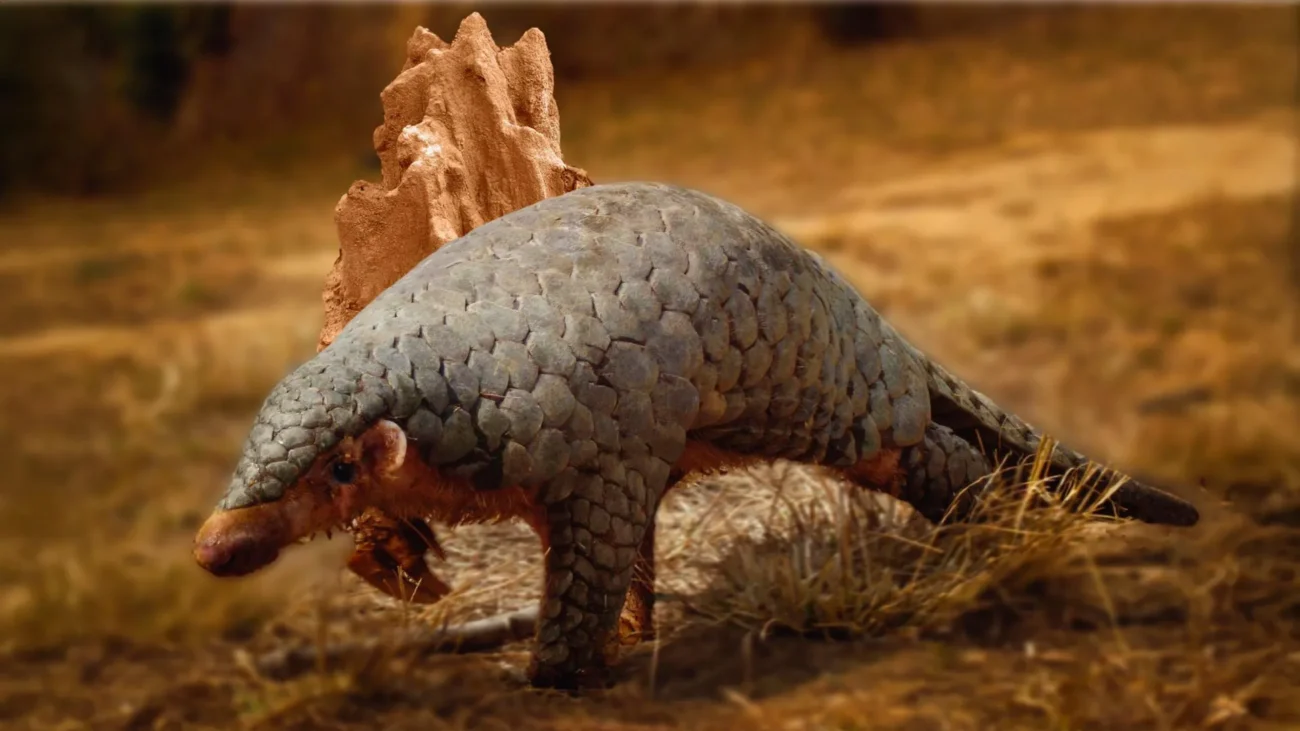
Few creatures on Earth evoke a sense of living prehistoric history quite like the pangolin. Covered from head to toe in thick, overlapping keratin scales that mimic the appearance of a pinecone, these solitary, insectivorous mammals possess an otherworldly aesthetic defined by long, powerful tails and formidable curved claws built for tearing open subterranean termite mounds. Distributed exclusively across the tropical and subtropical regions of Africa and Asia, pangolins occupy a unique ecological niche as nature’s primary pest controllers, consuming millions of ants and termites annually. Yet, this ancient evolutionary armor, which shields them from natural predators like lions and tigers in the wild, has proven entirely useless against humanity. Today, pangolins bear the tragic distinction of being the most heavily trafficked mammals in the world, caught in the crosshairs of an unrelenting illegal wildlife trade that pushes multiple species dangerously close to total extinction.
Amid this bleak conservation landscape, an international coalition of scientists has announced a major breakthrough that could fundamentally alter the trajectory of pangolin protection. Researchers have officially confirmed that a distinct, previously unrecognized Asian pangolin species—scientifically designated as Manis aurita—maintains native populations across the rugged terrain of Nepal and Northern India. Published in the peer-reviewed journal Communications Biology, the comprehensive study untangles decades of taxonomic confusion, shedding definitive light on evolutionary relationships, geographical distributions, and physical diagnostics. Beyond its academic significance, this taxonomic clarity provides law enforcement agencies and conservationists with an indispensable forensic tool, enabling authorities to trace the geographic origins of confiscated wildlife products and mount targeted interventions against poaching syndicates.
Untangling the Complex Pangolin Family Tree
The path toward recognizing Manis aurita as a valid, distinct species has been marked by decades of scientific debate, shifting classifications, and rapid modern advancements in molecular genetics. For generations, naturalists grouped the vast majority of Asian pangolins into broad, generalized categories, often overlooking subtle morphological variations across vast geographic expanses. However, modern scientific scrutiny has accelerated rapidly in recent years, driven by a global push to address hidden biodiversity before vulnerable populations vanish forever.
The taxonomic revisions surrounding the Himalayan lineage began taking definitive shape in 2025. During that year, a separate research collective conducted a rigorous genetic and physical reassessment of animals previously classified uniformly as Chinese pangolins (Manis pentadactyla). Their findings revealed that these populations were not monolithic; instead, they represented two distinct evolutionary lineages. While true Chinese pangolins predominantly inhabit regions within China, a second, separate group was identified living exclusively along the remote Himalayan foothills, spanning territories across Nepal, India, Bhutan, and Myanmar. Initially, researchers designated this mountain-dwelling form as Manis indoburmanica, commonly referred to the Indo-Burmese pangolin.
Despite this classification, the rigid rules of international zoological nomenclature dictate that scientific naming must adhere strictly to the principle of priority. Under this standard, if the exact same biological species has been formally described and named at different points in history, the earliest valid scientific name takes permanent precedence over newer designations.
DNA from 1836 Provides the Decisive Answer
While the 2025 classification of M. indoburmanica circulated through the scientific community, a parallel, decade-long investigation into global pangolin evolution was already underway. Led by an expansive international team—including researchers from the Field Museum, Guangzhou University, the Guangdong Academy of Forestry, and various conservation institutions—scientists were systematically combining high-resolution DNA sequencing with detailed morphological analyses to construct a complete, definitive pangolin phylogeny.
During their extensive archival reviews, the team encountered historical records documenting Manis aurita, a pangolin species originally described and cataloged by early naturalists in 1836. Over the subsequent decades, as shifting taxonomic frameworks lumped species together, M. aurita had been systematically demoted, ultimately relegated to a mere subspecies of the Chinese pangolin. This left the modern researchers facing a complex biological riddle: What exact evolutionary relationship existed between the newly proposed indoburmanica and the historical aurita? Were they genetically identical, or did they represent entirely separate entities?
The critical breakthrough required bridging a gap of nearly two centuries. The definitive piece of the puzzle fell into place at the Natural History Museum in London. Utilizing cutting-edge paleogenomic techniques, researchers at the museum successfully extracted and sequenced intact DNA directly from the historical type specimen of the Nepalese subspecies (aurita). Because this museum voucher dated back to 1836, it provided a pristine genetic snapshot of the animal as it existed nearly 190 years ago.
When the modern genetic samples gathered from wild Himalayan pangolins were compared against the ancient DNA extracted from the London museum specimen, the results were unequivocal. The modern Himalayan populations matched aurita perfectly, proving conclusively that the animals temporarily designated as M. indoburmanica in 2025 were, in fact, members of the exact same species originally named M. aurita nearly two centuries prior. Consequently, Manis aurita was reinstated as the correct, legally prioritized scientific name.
Morphological Distferences and Geographic Isolation
With the nomenclature resolved, researchers outlined the distinct physical and ecological characteristics that separate the Himalayan pangolin (Manis aurita) from its relative, the Chinese pangolin. While the differences can appear subtle to an untrained observer, they are pronounced enough to maintain clear evolutionary boundaries.
According to Dr. Anderson Feijó, Negaunee Assistant Curator of Mammals at the Field Museum and co-corresponding author of the study, the Himalayan pangolin exhibits distinct anatomical traits. Compared directly to the Chinese pangolin, M. aurita boasts a noticeably larger overall body mass, a significantly longer tail, and distinctively smaller external ears. Ironically, the specific epithet aurita—revived from the 1836 description—directly references the animal’s ear morphology, honoring the historical observations made by early naturalists.
Furthermore, biogeographical mapping confirms that the two species do not share overlapping native territories. The Himalayan pangolin is strictly confined to its mountain-adjoined habitats along the southern slopes of the Himalayas, separated entirely from the lowland and eastern ranges occupied by the Chinese pangolin. For critically endangered taxa subjected to severe anthropogenic pressures, precise geographic delimitation is not merely an academic exercise; it serves as a foundational prerequisite for effective, localized conservation planning.
A Revolutionary Forensic Tool Against Global Wildlife Trafficking
The illegal international trade in pangolins operates on a massive, industrial scale, driven primarily by demand in traditional medicine markets. Pangolin scales, which are composed entirely of keratin—the same protein found in human fingernails and rhinoceros horns—are falsely believed in certain traditional practices to possess medicinal properties, acting as aphrodisiacs or cures for various ailments. Despite a total commercial ban under international law, hundreds of thousands of pangolins continue to be poached from the wild, slaughtered, and smuggled across borders annually.
Combating this illicit supply chain presents immense logistical hurdles for law enforcement agencies and border control officials. Because pangolins are heavily poached for their scales, authorities rarely encounter live, intact animals during routine seizures. Instead, custom officials typically confiscate massive sacks, crates, or shipping containers packed tight with loose, dried scales. Historically, identifying the exact species of pangolin from a pile of disarticulated keratin scales was virtually impossible through visual inspection alone, severely hampering efforts to prosecute smugglers or map trafficking networks.
The confirmation of Manis aurita and the mapping of its precise genetic profile dramatically shift the paradigm of wildlife forensics. Conservation scientists can now apply advanced molecular diagnostic techniques to confiscated scales, rapidly identifying the specific genetic markers of the samples. By pinpointing whether seized scales originated from M. aurita, the Chinese pangolin, or other vulnerable African and Asian species, authorities can trace contraband directly back to its geographic source.
This intelligence-led approach allows law enforcement agencies and international conservation organizations to work backward from illicit trade hubs to the specific forest strongholds where poaching pressure has reached critical levels. By identifying vulnerable population hotspots, governments can deploy anti-poaching patrols and investigative resources where they are most urgently needed.
Implications for Species Reintroduction and Habitat Restoration
Accurate taxonomy and species delimitation carry profound implications beyond forensic investigations; they are equally critical for captive breeding and wild reintroduction initiatives. Across Asia, conservation groups frequently rescue injured or confiscated pangolins from illegal holding facilities, aiming to rehabilitate and eventually release them back into protected natural habitats.
Historically, the absence of clear taxonomic boundaries created severe ecological risks during these reintroduction efforts. Conservationists lacked the genetic tools to guarantee that rehabilitated animals were being returned to their native ecosystems, raising the alarming prospect of accidental translocations—such as releasing Chinese pangolins into native Himalayan habitats where they do not naturally belong. Such practices risk outcompeting local fauna, diluting distinct gene pools, or introducing pathogens to isolated populations.
"Before, you might have introduced Chinese pangolins into Nepal, because you didn’t know the difference," explains Dr. Feijó. "By defining the differences between the species and the limits of where each species is found, we can make better conservation decisions."
The Invaluable Role of Natural History Museums
The successful resurrection and validation of Manis aurita underscores an often-underappreciated facet of modern biological research: the irreplaceable value of natural history museum collections. In an era where funding frequently flows toward flashy, high-tech field expeditions, the quiet, methodical curation of historical specimens housed in museum archives remains the bedrock upon which modern conservation biology is built.
Because wild pangolins are exceptionally rare, secretive, and largely nocturnal, encountering them in their native forest habitats is remarkably difficult for field researchers. Gathering fresh biological samples across an entire continental range is often logistically impossible. Museum repositories solve this limitation by preserving physical specimens collected decades or even centuries ago, effectively creating a biological time capsule that captures historical genetic diversity that may no longer exist in heavily fragmented modern landscapes.
"Using museum collections allows us to have access to more individuals across the species’ range," emphasizes Dr. Feijó. "If you only rely on fresh material, since the animals are so rare to find in the wild, this greatly limits the information that you can gather. We used collections to have a more complete sampling of the species. It’s a big advantage to have this resource available as a repository of material that we can look back and keep learning from."
Echoing this sentiment, Narayan Koju, a researcher at Nepal Engineering College at Pokhara University and the study’s first author, highlights the collaborative global effort required to reach this milestone. The research project represents the culmination of more than five years of rigorous investigation, bridging local fieldwork in Nepal with advanced genetic laboratories across multiple continents.
"This finding marks the culmination of more than five years of research that began in Nepal, where we first documented evidence suggesting that Himalayan pangolins represented a distinct evolutionary lineage," states Koju. "The confirmation of Manis aurita as a valid species demonstrates the importance of long-term research, international collaboration, and museum collections. Most importantly, it provides a strong scientific basis for conservation planning, wildlife forensics, and efforts to protect one of the world’s most trafficked mammals from extinction."
As illegal wildlife trade continues to push numerous specialized species toward the precipice of oblivion, the formal recognition of Manis aurita offers a vital beacon of hope. By arming scientists, governments, and border agents with precise genetic frameworks and historical baselines, humanity gains a fighting chance to secure a future for the world’s most vulnerable scaled mammals before they are lost to history forever.

