


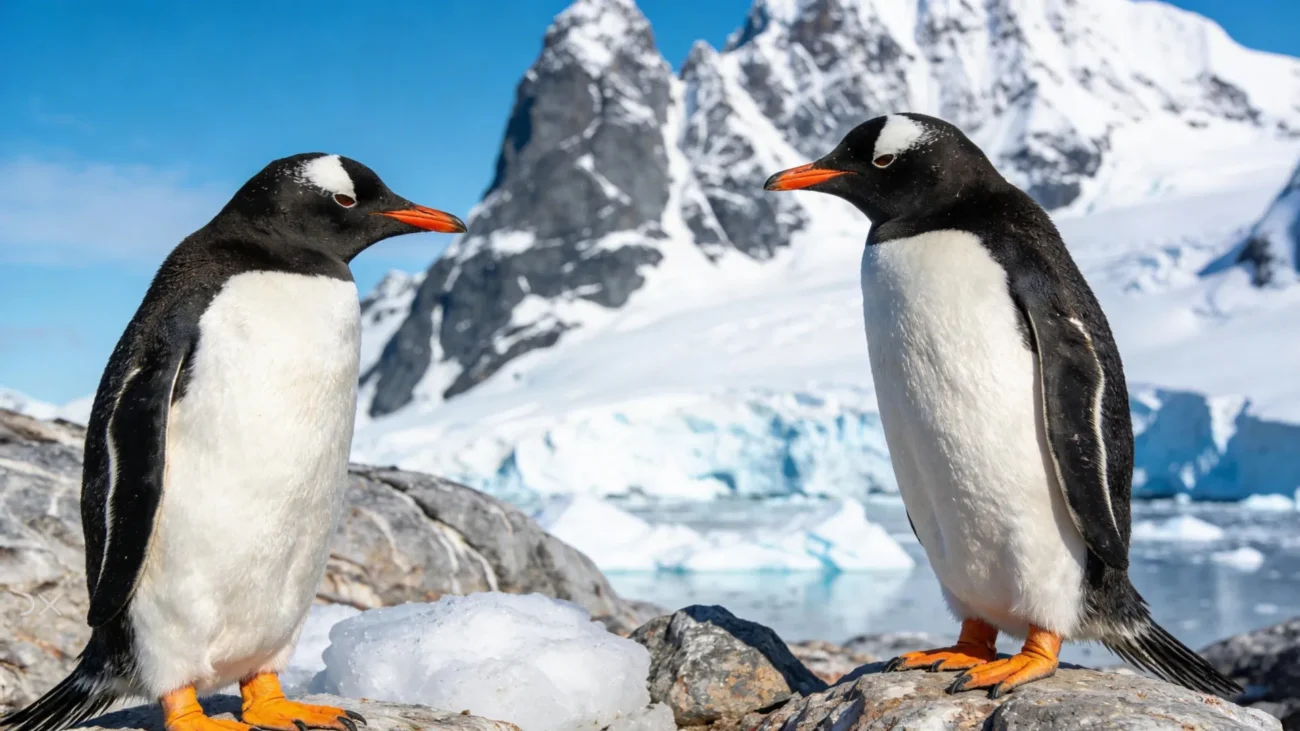
The remote and windswept Kerguelen Islands, frequently referred to in French as the Desolation Islands, lie isolated nearly 2,000 miles away from any permanently inhabited landmass in the Southern Indian Ocean. For generations, this geographic extreme served as an effective veil, hiding an entire biological lineage from formal scientific recognition. In a landmark study published in the journal Communications Biology, an international consortium of researchers led by scientists in Chile and the University of California, Berkeley, has formally identified a distinct new gentoo penguin species inhabiting these remote shores. This discovery marks the first time in more than a century that a new penguin species has been officially named and cataloged, fundamentally reshaping our understanding of avian biodiversity in the sub-Antarctic.
The research resolves a century-old debate regarding the taxonomy of gentoo penguins. By deploying cutting-edge whole-genome sequencing across nearly the entirety of the species’ geographic range, the research team determined that what scientists historically classified as a single, widely distributed gentoo penguin species is actually a complex of four distinct species. Alongside the newly recognized southeastern gentoo penguin, which has been designated Pygoscelis kerguelensis, the team elevated three previously recognized subspecies to full species status. This comprehensive taxonomic revision carries profound implications for international conservation efforts, particularly as shifting climatic patterns threaten fragile island ecosystems across the Southern Hemisphere.
A Century of Taxonomic Controversy and Modern Genomic Breakthroughs
The classification of gentoo penguins has long challenged ornithologists. Since the genus Pygoscelis was first studied in detail, researchers have proposed as many as six different subspecies based largely on superficial morphological traits and regional distribution patterns. However, a lack of comprehensive, pan-range genetic sampling prevented the scientific community from reaching a universal consensus.
To definitively settle these long-running disagreements, Dr. Juliana Vianna, a professor of ecosystems and environment at Andrés Bello National University in Santiago, Chile, joined forces with co-senior authors Dr. Rauri Bowie, a professor of integrative biology and curator in UC Berkeley’s Museum of Vertebrate Zoology, and Dr. Elie Poulin, a professor at the University of Chile. Together, they mobilized a global network of penguin specialists to execute a sweeping genomic investigation.
The research team analyzed whole-genome sequences extracted from 64 individual penguins gathered across 10 distinct breeding colonies. This unprecedented sampling effort covered virtually the entire geographic range of the gentoo penguin family. In addition to sequencing thousands of genetic differences known as single nucleotide polymorphisms (SNPs)—led primarily by University of Chile graduate student and first author Daly Noll—the team conducted rigorous comparative analyses of physical and behavioral characteristics. These included detailed evaluations of plumage coloration, vocalizations, breeding phenology, dietary habits, and foraging behavior.
The resulting data unveiled a classic example of a cryptic species: an organism that looks remarkably similar to its close relatives, retaining the familiar white underside and black back characteristic of the gentoo family, yet possessing stark, unmistakable genetic boundaries.
Evolutionary History and the Mechanics of Speciation
To understand how these four distinct species emerged, Dr. Bowie and Dr. Vianna drew upon nearly a decade of collaborative research into penguin evolution. Previous milestones in their research program included a 2019 study establishing that modern penguins originated near the coasts of Australia and New Zealand approximately 22 million years ago.
As evolutionary lineages diverged, Emperor and King penguins split from the main trunk, with Emperor penguins becoming specialized for the hyper-cold conditions of the Antarctic continent, while King penguins adapted to the sub-Antarctic islands. Approximately 12 million years ago, a major oceanographic turning point occurred: the formation and invigoration of the Antarctic Circumpolar Current. This massive oceanic conveyor belt facilitated the dispersal of other penguin lineages through the sub-Antarctic, allowing them to colonize isolated archipelagoes and eventually extend their ranges as far north as the coasts of Africa and South America.
Gentoo penguins possessed a critical evolutionary advantage that fueled this global dispersal: dietary flexibility. Unlike many of their specialized relatives, gentoos are opportunistic generalists. Rather than relying heavily on a single prey species, they consume virtually any marine organism they can capture underwater, including fish, squid, cuttlefish, and krill.
Ironically, this same dietary flexibility acted as a catalyst for speciation. Because gentoos could easily secure diverse prey near their breeding grounds, they faced less evolutionary pressure to undertake massive migrations in search of food. They consistently returned to the same natal nesting sites year after year. Over hundreds of thousands of years—with researchers estimating the four species diverged between 300,000 and 500,000 years ago—isolated island populations adapted intimately to their local micro-environments.
Geographic isolation, reinforced by natural selection across their genomes, was further solidified by oceanographic barriers such as the Antarctic Polar Front. This major hydrographic boundary in the Southern Ocean marks a sharp shift in water temperature and salinity, effectively restricting the movement of marine species.
Genomic Mapping of the Four Gentoo Lineages
The genomic data enabled researchers to map the precise geographic distributions and specialized physiological adaptations of the four newly defined gentoo species:
- The Southeastern Gentoo (Pygoscelis kerguelensis): The newly discovered cryptic species native to the Kerguelen Islands and likely nearby Heard Island, situated near the Antarctic Polar Front. Its population size is relatively small, raising immediate conservation concerns.
- The Southern Gentoo (Pygoscelis ellsworthi): The most numerous and widely distributed lineage, inhabiting the Antarctic Peninsula, coastal Antarctica, and South Georgia Island. Genomic analysis reveals that this species is uniquely adapted to extreme polar conditions, carrying an enrichment of genes linked to heat production, lipid and fat storage, and light perception—the latter helping the birds navigate extreme seasonal shifts in daylight and intense glare from glacial ice.
- The Eastern Gentoo (Pygoscelis taeniata): Inhabiting sub-Antarctic waters north of the Polar Front on the Crozet, Marion, and Macquarie Islands, this lineage possesses genetic adaptations geared toward efficient carbohydrate metabolism and enhanced diving performance. Their genome shows enrichments in genes regulating oxygen transport, blood vessel formation, mitochondrial activity, and lung development, enabling prolonged foraging dives in less biologically productive waters.
- The Northern Gentoo (Pygoscelis papua): Restricted primarily to the Falkland/Malvinas Islands and Martillo Islands in South America, this lineage exhibits genomic enrichments associated with digestive efficiency, heart contraction, and muscle excitation, supporting sustained physical activity during extended underwater foraging.
Conservation Implications and Vulnerability to Climate Change
While the taxonomic revision resolves a century of scientific debate, it also sounds an urgent alarm for conservation biologists. Climate change is rapidly transforming marine and terrestrial ecosystems across the Antarctic and sub-Antarctic zones.
The research team integrated their genomic findings with predictive climate models to project the availability of suitable gentoo habitats through the year 2050. Under moderate greenhouse gas emission scenarios, the outlook varies sharply between the continental species and its island-bound relatives.
The southern gentoo (Pygoscelis ellsworthi) in Antarctica may experience relatively little negative impact and could potentially expand its southern range as glacial ice retreats. In stark contrast, the island-dwelling sub-Antarctic species face a precarious future. Predictive models indicate that these populations could lose suitable habitat across their current island ranges by mid-century, with few or no neighboring islands available for migration.
"In Antarctica, of course, other species, not the gentoo, are threatened by climate change," explained Dr. Vianna. "But the gentoo is of most concern in the sub-Antarctic region," a complex zone of widely separated islands governed by multiple sovereign nations, including Chile, South Africa, France, the Netherlands, Australia, and New Zealand.
"It’s very important that conservation institutions in all the different countries involved recognize and take appropriate action to save these three gentoo penguin species," Dr. Vianna urged.
Beyond warming sea temperatures, these island populations face compound anthropogenic pressures. Habitat degradation, predation by introduced species such as rats and dogs, competition with commercial fisheries, and accidental mortality in fishing nets threaten numerous sub-Antarctic colonies. Because these endemic island species have restricted population sizes and nowhere to retreat, their vulnerability mirrors that of other isolated taxa, such as the Galápagos penguin.
The Broader Value of Genomic Surveillance in Wildlife Management
The dataset assembled for this research extends far beyond avian taxonomy, offering a powerful tool for modern wildlife management and conservation biology. Dr. Bowie emphasized that whole-genome sequencing has revolutionized the scientific community’s capacity to monitor biodiversity and assess species resilience.
Currently, Dr. Vianna and her international colleagues are utilizing these extensive genomic frameworks to screen penguin populations for genetic variations associated with survivability against avian influenza. As global outbreaks of the virus continue to devastate wild bird and marine mammal populations, identifying specific genetic markers linked to pathogen resistance will allow conservationists to pinpoint vulnerable colonies and prioritize intervention strategies.
By bridging historical taxonomic gaps with 21st-century genomic technology, the international research team has provided a definitive roadmap for protecting the hidden diversity of the Southern Ocean—ensuring that newly recognized species like the Kerguelen gentoo are safeguarded before environmental shifts render them lost to history.

