


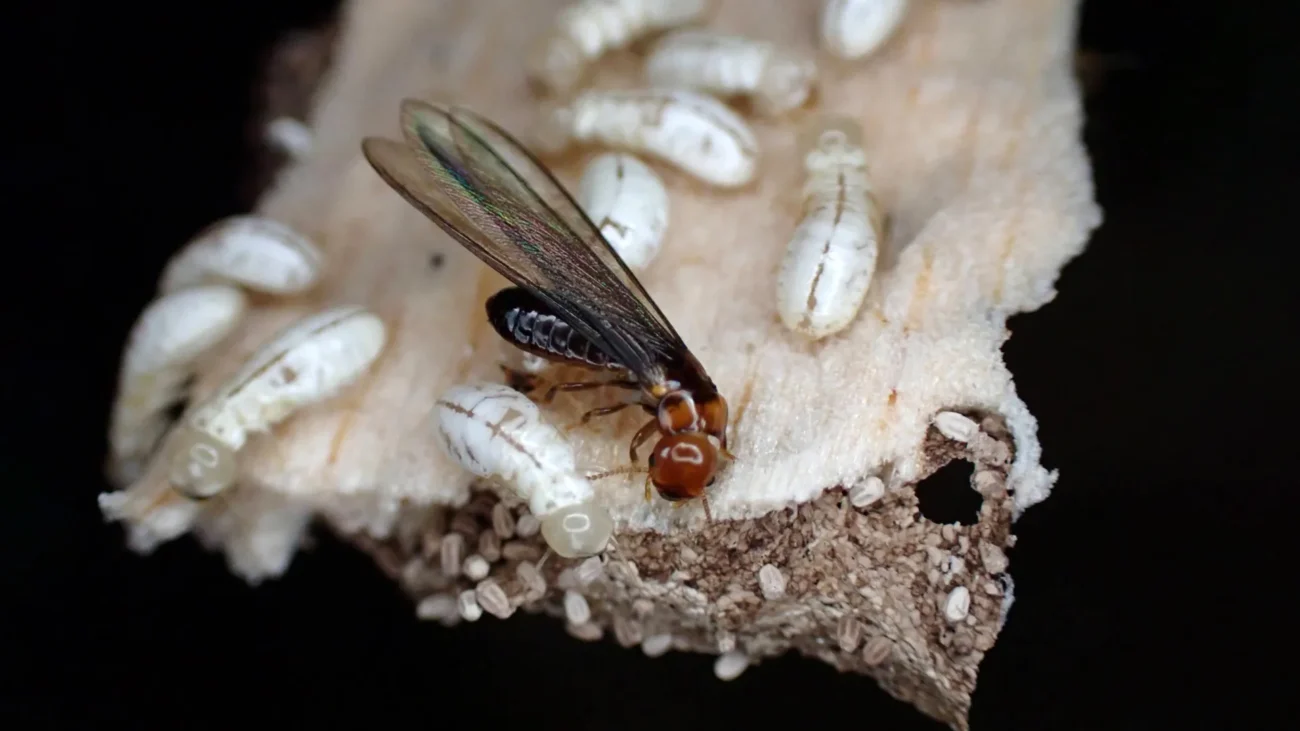
The covert and destructive nature of drywood termites has long posed a significant challenge for homeowners and pest control professionals alike. Unlike subterranean counterparts that maintain active connections to the ground, western drywood termites spend the vast majority of their lifecycles entirely hidden within structural beams, framing, and furniture. They hollow out intricate galleries as colonies grow, rarely exposing themselves to the outside world. This secretive existence allows infestations to advance for years before manifesting any visible signs of damage, making traditional detection and localized eradication methods notoriously difficult.
However, a series of recent scientific breakthroughs from the University of California, Riverside (UCR) Department of Entomology is offering a fresh perspective on pest management. By weaponizing the insects’ own biological vulnerabilities—specifically their requirement to molt, their complex social interactions, and the microbial signatures left behind in their waste—researchers are developing precision alternatives to whole-structure fumigation. These innovations aim to reduce the environmental and financial burdens traditionally associated with termite extermination while targeting active infestations at their microscopic roots.
Turning Natural Biology Into a Weapon
The cornerstone of this new line of research centers on a biological inevitability: insects must molt to grow. Because mammals possess internal skeletons, human interventions against pests often rely on neurotoxins. Insects, conversely, rely on a rigid external skeleton called an exoskeleton, which derives its structural strength and protective armor from chitin. Chitin is a durable natural polysaccharide found not only in insect exoskeletons and fungal cell walls but also in fish scales and the beaks of cephalopods.
For a growing western drywood termite, this armor cannot stretch indefinitely. Throughout its lifecycle, an individual must molt approximately seven times, shedding its old exoskeleton to replace it with a larger one.
In a study published in the Journal of Economic Entomology, UCR researchers demonstrated that bistrifluron—an insect growth regulator classified as a chitin synthesis inhibitor—disrupts this exact process. Rather than acting as a fast-acting poison that kills on contact, bistrifluron interferes with the insect’s ability to synthesize sufficient chitin for its upcoming molt.
Nicholas Poulos, a doctoral student in UCR’s Department of Entomology and corresponding author of the paper, emphasized the chemical’s safety profile relative to traditional alternatives. "This chemical is more environmentally friendly than ones traditionally used for drywood termite infestations," Poulos noted. "It’s specific to insects and can’t harm humans."
Controlled laboratory evaluations underscored the compound’s high efficacy. When termites were given a choice between treated and untreated wood, the chemical yielded a 95.7 percent mortality rate. When continuously exposed to treated wood, mortality climbed to approximately 99 percent. Furthermore, the slow-acting nature of the compound is viewed by researchers not as a drawback, but as a tactical advantage. A rapid poison might eliminate exposed foragers before they can return to the colony; a delayed mechanism affords contaminated individuals ample time to travel deeper into the nest and interact with nestmates.
Social Structures and the Spread of Lethal Doses
To evaluate how effectively a treatment can propagate through a concealed colony, the UCR research team conducted social behavior trials. Termites are intensely social insects that routinely exchange food, fluids, and nutrients through specialized behaviors.
In experiments utilizing colored food tracers to track movement, researchers exposed a fraction of a test group to bistrifluron before introducing them to untreated nestmates. The results revealed that within 24 to 48 hours, material from the exposed termites had successfully reached unexposed members. Most strikingly, in test groups where only 5 percent of the population initially encountered the chemical, total colony mortality eventually reached 100 percent by day 90. Groups beginning with a 50 percent exposure rate demonstrated a nearly identical survival collapse.
Subsequent visual and imaging observations published by the UCR team in 2026 provided an even closer look at the mechanisms driving this transmission. Researchers documented western drywood termites performing proctodeal trophallaxis—a feeding behavior wherein one termite receives nourishment directly from another’s hindgut. This exchange is vital for colony survival because it transfers essential nutrients and gut microbes necessary for wood digestion.
While this cooperative behavior normally safeguards the colony, pest control researchers have realized it can be co-opted. If a localized treatment can contaminate even a small percentage of a colony, the insects’ own social exchanges will inadvertently distribute the lethal agent to hidden members who never directly encounter the treated wood.
A Potential Alternative to Whole-Structure Fumigation
For decades, structural fumigation has remained the standard method for addressing widespread drywood termite infestations. While effective across an entire building, fumigation carries notable drawbacks: residents must temporarily vacate the premises, food items require meticulous sealing or removal, and the gas leaves behind no residual protection against future infestations. Furthermore, fumigation can be financially costly and disruptive.
Dong-Hwan Choe, a UCR entomology professor and senior author of the studies, believes low-impact, targeted strategies will become increasingly attractive. "We believe this method of spot treatment can kill a larger colony and spread more easily than current termite control methods," Choe stated. "You don’t have to apply too much to get a very good result. The chitin synthesis inhibitors show promise as localized treatment for drywood termites."
Because bistrifluron can potentially remain active within treated wood over time, it may offer a secondary benefit: residual defense against subsequent incoming infestations. However, the researchers caution that laboratory trials utilizing small groups in controlled settings do not immediately translate to turnkey household application. A significant practical hurdle remains in the delivery method itself. In laboratory trials, researchers dissolved bistrifluron in acetone—a flammable solvent with a pungent odor that renders it unsuitable for residential interiors. Consequently, ongoing work is focused on developing practical, consumer- and technician-friendly formulations.
Luring Termites Toward Poison
Beyond chitin inhibitors, the UCR laboratory has explored complementary methods to maximize the efficiency of localized treatments. In previous investigations published in 2024, researchers evaluated pinene, a naturally occurring fragrant chemical released by many trees.
To a western drywood termite navigating the interior of a piece of wood, the scent of pinene acts as an environmental attraction signal. Laboratory trials tested whether this natural lure could draw termites away from their secluded clusters and directly toward localized insecticide deposits, such as aqueous fipronil. The addition of pinene proved remarkably effective, elevating mortality rates from roughly 70 percent with the insecticide alone to over 95 percent when combined with the attractant.
The practical trajectory of this discovery advanced further when a University of California patent application was filed in April 2025 and subsequently published in October 2025. The filing details the integration of alpha-pinene or beta-pinene into localized insecticide injections for western drywood termites. If successfully commercialized, this approach could allow pest control technicians to space treatment holes farther apart, reducing labor costs and minimizing the overall volume of chemical agents required.
Determining Active Infestations via Microbial Diagnostics
A perennial frustration in termite management is the ambiguity of physical evidence. Drywood termites continuously eject tiny, hard fecal pellets from their wooden galleries, creating small piles that alert property owners to a potential problem. However, old pellets can persist inside wall voids or crawlspaces long after a colony has naturally died out or been eradicated. Finding droppings alone does not prove an active infestation exists.
To solve this diagnostic dilemma, Poulos and his colleagues turned to the microbiome of the fecal pellets themselves. By examining fresh western drywood termite pellets alongside samples aged for three, six, and twelve months, the research team discovered that bacterial DNA undergoes a sharp, quantifiable decline over time. In pellets produced by termites feeding on natural hardwood, estimated bacterial DNA levels dropped as much as 190-fold between fresh samples and those aged for a year. A similar precipitous decline was observed in pellets derived from Douglas fir diets.
Moreover, specific bacterial families identified consistently in fresh pellets completely vanished as the biological material aged. The researchers hope these distinct microbial signatures can be harnessed to develop a rapid diagnostic tool, allowing pest professionals to distinguish between historical damage and active infestations before recommending treatment protocols.
Global Distribution and Future Implications
The urgency driving these diverse research initiatives stems from the expanding geographic footprint of western drywood termites. Native to the southwestern United States and northwestern Mexico, the species has long been recognized as a primary structural pest in California. However, international trade and the transport of lumber, furniture, and wooden packaging have facilitated the accidental introduction of populations far beyond their native range. Established populations have since been documented in Hawaii, Florida, New York, parts of Canada, China, Japan, South Korea, and Australia.
As global climate conditions shift and international commerce continues to move timber products across borders, researchers anticipate that these resilient insects will continue attempting to colonize new environments.
"As we move lumber around the world, the termites are constantly transported to new locations. If they find the climate there acceptable, the problem will spread," Choe warned. "In areas where these termites are common, it’s just a matter of time before homes are infested, so this study is a good initial step toward alternative strategies for controlling them."
By pivoting away from brute-force chemical applications and toward strategies that exploit insect molting biology, social trophallaxis, olfactory attraction, and microbial decay tracking, entomologists are reshaping the future of pest control. For an insect that has historically relied on absolute concealment to survive, these multi-faceted scientific advancements threaten to strip away its greatest defense.

