


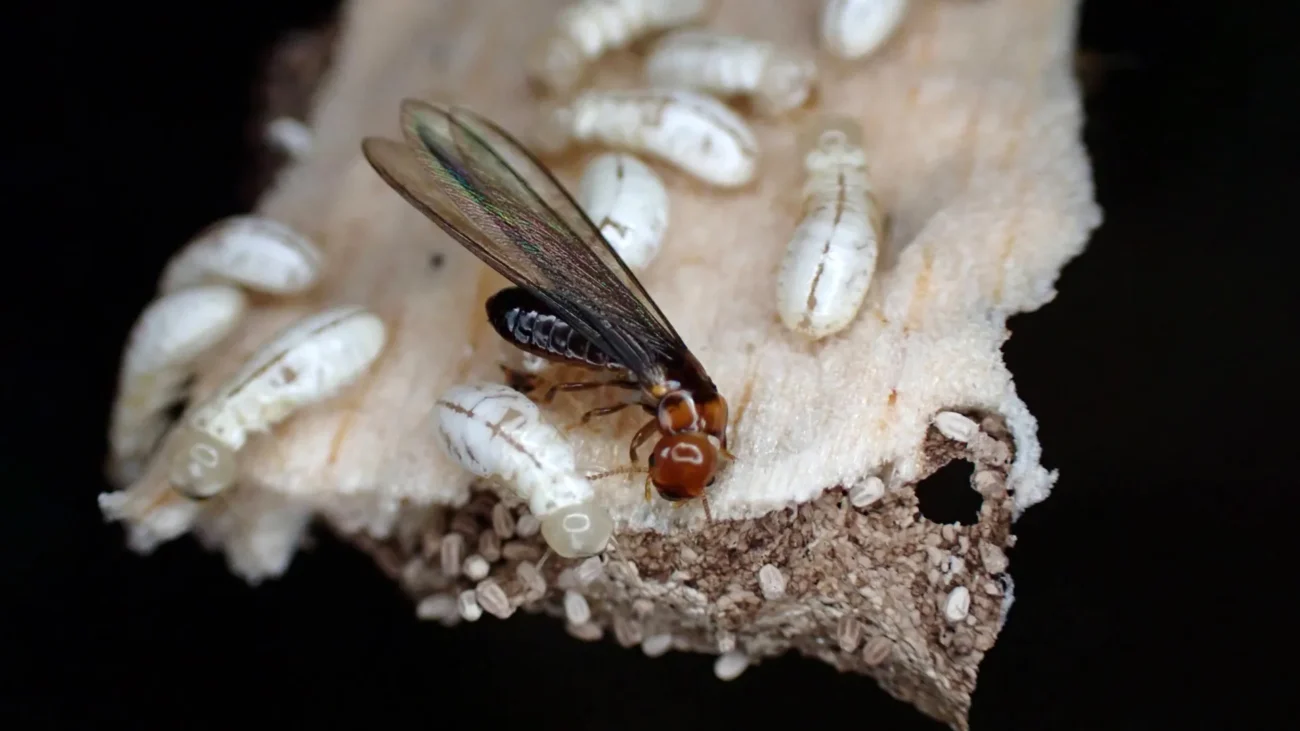
For decades, the western drywood termite (Incisitermes minor) has remained one of the most elusive and destructive structural pests in the United States, particularly within the housing markets of California, the Southwest, and globally through accidental transport in lumber. Unlike their subterranean counterparts, which require constant contact with the soil to survive and build visible mud tubes, drywood termites spend virtually their entire lifecycles entirely enclosed within the material they consume. They carve out intricate galleries deep inside beams, framing, joists, and antique furniture, leaving homeowners completely unaware of an infestation until significant structural damage has already occurred. Traditional eradication methods, such as whole-structure fumigation, require residents to vacate their homes for days, demand extensive food preparation, involve high financial costs, and notoriously fail to provide residual protection against future infestations.
However, recent scientific breakthroughs out of the University of California, Riverside (UCR) Department of Entomology are fundamentally challenging conventional approaches to pest management. By weaponizing the biological vulnerabilities, social behaviors, and microbial footprints of western drywood termites, entomologists are developing a suite of targeted, eco-friendly alternatives. Spearheaded by doctoral student Nicholas Poulos and Professor Dong-Hwan Choe, a series of studies published between 2024 and 2026 reveal how insect growth regulators, natural plant attractants, and diagnostic microbial tracking can work in tandem to transform termite eradication from a blunt, house-wide disruption into a precise, localized science.
Turning the Inevitable Molting Process into a Lethal Trap
The cornerstone of the UCR research team’s recent discoveries centers on a chemical compound called bistrifluron, an insect growth regulator belonging to a class known as chitin synthesis inhibitors. To understand why bistrifluron is so effective against drywood termites, scientists had to look closely at the fundamental biology of insect anatomy.
Unlike mammals, which possess internal skeletons that grow organically alongside them, insects rely on a rigid external covering known as an exoskeleton. This protective armor provides structural integrity and critical attachment points for muscle movement, with one of its primary organic building blocks being chitin—a remarkably tough, durable natural polymer also found in fungal cell walls, fish scales, and the beaks of cephalopods. Because a growing insect cannot simply stretch its rigid outer shell, it must periodically undergo ecdysis, or molting. Throughout its lifecycle, a western drywood termite will typically molt roughly seven times, shedding its old, restrictive exoskeleton and replacing it with a newly synthesized, larger one.
Bistrifluron exploits this biological necessity by directly interfering with the insect’s ability to synthesize sufficient chitin for its upcoming molt. In controlled laboratory experiments published in 2025 within the Journal of Economic Entomology, researchers evaluated the efficacy of bistrifluron alongside other chitin synthesis inhibitors like chlorfluazuron and noviflumuron. The results were striking: when termites were given a continuous exposure to bistrifluron-treated wood, the compound produced an astonishing 99 percent mortality rate. Even when given a choice between treated and untreated wood, the termites suffered a 95.7 percent mortality rate at a concentration of 0.1 percent over a 60-day testing window.
"This chemical is more environmentally friendly than ones traditionally used for drywood termite infestations," explained Nicholas Poulos, the corresponding author of the study. "It’s specific to insects and can’t harm humans."
Because bistrifluron targets chitin—a substance completely absent in humans and other mammals—it poses zero direct physiological threat to human residents or household pets. Furthermore, unlike conventional fast-acting neurotoxins that kill insects instantly upon contact, bistrifluron operates on a delayed timeline. The treated termites continue to feed and behave normally until they reach their required molting stage. Upon attempting to shed their old exoskeleton, they find themselves defenseless without a replacement, resulting in fatal physiological collapse.
Social Behavior and Trophallaxis as a Vector for Eradication
The delayed action of bistrifluron is not a design flaw, but rather its greatest tactical advantage. Because drywood termites live in tightly knit, highly cooperative colonies hidden deep within wood grain, a fast-acting poison would merely kill a handful of foraging insects before they could return to the nest, leaving the core colony unharmed.
To test how the chemical moves through a colony, UCR researchers conducted behavioral tracking using colored food dyes and targeted exposures. They exposed a small fraction of a termite colony to bistrifluron and then reintroduced them to unexposed nestmates. The results shattered expectations regarding how localized treatments can scale up.
Within 24 to 48 hours, ingested material from the exposed termites had successfully traveled to untreated members of the colony via social exchanges. Most remarkably, in experimental groups where only 5 percent of the population was initially exposed to bistrifluron, the entire colony reached 100 percent mortality by day 90. Groups with a 50 percent initial exposure rate demonstrated nearly identical terminal trajectories.
This cascading mortality is directly facilitated by the unique social behaviors of wood-boring insects. In 2026, the UCR research team released high-resolution imagery and video documentation highlighting a specialized feeding behavior known as proctodeal trophallaxis. During this process, one termite receives nutrient-rich material directly from a nestmate’s hindgut. While this social sharing of essential gut microbes and nutrients is the evolutionary mechanism that allows termites to efficiently digest cellulose, it inadvertently transforms into a fatal liability when an insect growth regulator is introduced. A tiny fraction of contaminated foragers effectively acts as a biological Trojan horse, carrying the lethal dose deep into the heart of the colony.
"We believe this method of spot treatment can kill a larger colony and spread more easily than current termite control methods," Professor Dong-Hwan Choe noted. "You don’t have to apply too much to get a very good result. The chitin synthesis inhibitors show promise as localized treatment for drywood termites."
Luring Termites Toward Poison Using Natural Forest Scents
While bistrifluron solves the problem of how to systematically eliminate concealed colonies, pest control professionals still face the challenge of ensuring foragers actually encounter the treatment. To bridge this gap, the UCR laboratory expanded its research into natural chemical attractants, specifically focusing on pinene—a fragrant organic compound naturally emitted by many species of trees.
In prior investigations published in mid-2024, researchers discovered that the scent of pinene acts as an environmental beacon for western drywood termites, drawing them away from untreated areas and steering them directly toward localized insecticide deposits. When testing an aqueous fipronil treatment combined with pinene, the mortality rate jumped dramatically from roughly 70 percent with the insecticide alone to over 95 percent when pinene was added to the mix.
The practical application of this discovery advanced significantly when the University of California filed a patent application in April 2025 (published in October 2025) detailing the addition of alpha-pinene or beta-pinene to localized insecticide injections. According to the patent filing, enticing termites toward treated zones could allow pest control technicians to space their injection holes significantly farther apart. This innovation promises to reduce labor time, minimize drilling damage to structural wood, and lower the overall volume of chemical agents required for effective mitigation.
Solving the Diagnostic Challenge: Are Those Termite Droppings Active?
Even with advanced chemicals and chemical luring agents, treating an infestation requires knowing precisely where the active colony resides. For homeowners, the most common sign of a drywood termite infestation is the appearance of frass—tiny, hard, hexagonal fecal pellets ejected from kick-out holes in infested wood.
However, frass presents a notoriously misleading diagnostic challenge. Because drywood termites are meticulous housekeepers that continually push out old waste, ancient piles of frass can remain trapped inside wall voids or resting on windowsills long after the colony has naturally died out or migrated. Consequently, discovering frass has historically failed to prove whether an infestation is currently active, often leading to unnecessary panic or redundant treatments.
To resolve this dilemma, the UCR research team investigated the microbial communities inhabiting termite droppings, publishing a breakthrough diagnostic discovery shortly after their bistrifluron trials. Poulos and his colleagues analyzed fresh western drywood termite frass alongside samples aged for three months, six months, and one year.
The analysis revealed a profound biological clock: bacterial DNA within the pellets degrades at an exponential rate over time. In frass produced by termites feeding on natural hardwood and Douglas fir—a standard framing lumber—estimated bacterial amounts plummeted by up to 190-fold between fresh samples and those aged for a single year. Furthermore, specific bacterial families identified as abundant in fresh Douglas fir-derived pellets vanished entirely as the samples aged.
These distinct microbial signatures lay the foundation for a rapid diagnostic tool. By analyzing the bacterial DNA present in frass, pest management professionals could soon determine with high scientific precision whether a home contains an active, thriving colony or merely lingering remnants of past activity, ensuring treatments are deployed only where genuinely necessary.
Broader Implications for Global Pest Management
The comprehensive body of research emerging from UCR arrives at a critical juncture for structural pest control. Native to the southwestern United States and northwestern Mexico, Incisitermes minor has steadily expanded its geopolitical footprint due to human trade. The global movement of timber, wooden pallets, and antique furniture has successfully established invasive populations in Hawaii, New York, Florida, Canada, China, Japan, Korea, and Australia. As shifting global climate patterns create more hospitable regional microclimates, the threat of expanding drywood termite ranges remains a persistent concern for urban entomologists and structural engineers alike.
Despite these promising laboratory milestones, researchers emphasize that immediate commercial availability requires overcoming several practical obstacles. For instance, in their controlled laboratory experiments, scientists dissolved bistrifluron in acetone—a volatile, highly flammable solvent with a potent chemical odor entirely unsuitable for residential application. Poulos and Choe’s team are currently engineering safer, highly stable aqueous and gel formulations that can be readily integrated into professional pest control toolkits without posing safety hazards to homeowners.
Furthermore, while whole-structure fumigation will likely remain a necessary emergency measure for massive, multi-front infestations, the ongoing evolution of targeted, low-impact strategies points toward a more sustainable future. By leveraging insect molting biology, cross-colony social feeding habits, aromatic tree scents, and microbial aging clocks, modern science is systematically stripping away the drywood termite’s greatest evolutionary defense: its ability to hide in plain sight.

