


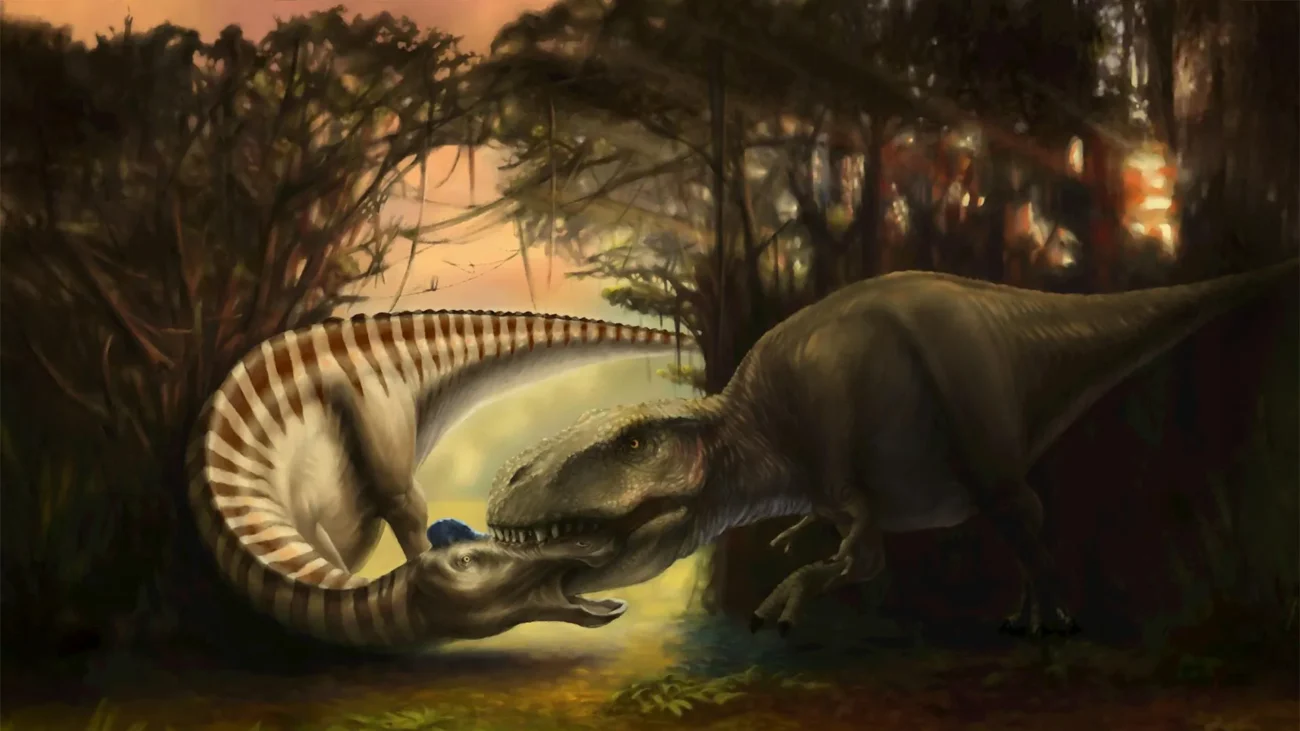
The discovery of a uniquely preserved fossil housed within the paleontology collections of the Museum of the Rockies at Montana State University has provided researchers with an unprecedented window into the violent apex predator dynamics of the Late Cretaceous epoch. At the center of this scientific breakthrough is a fossilized Edmontosaurus skull bearing a broken, fully embedded Tyrannosaurus tooth. Unearthed in the badlands of eastern Montana, the specimen serves as a prehistoric anchor for a comprehensive new study conducted by researchers from Montana State University and the University of Alberta. Published in the peer-reviewed scientific journal PeerJ, the investigation brings modern medical imaging and rigorous comparative anatomy to bear on an ancient paleoecological mystery, offering fresh empirical data to fuel the ongoing academic debate surrounding the hunting strategies and feeding habits of one of history’s most formidable carnivores.
Chronology of a Discovery and the Hell Creek Ecosystem
The chain of events leading to this modern revelation began approximately 66 million years ago during the waning days of the Mesozoic Era. In the lush, subtropical floodplains and coastal lowlands of what is now eastern Montana, the ecological landscape was dominated by megafaunal behemoths. Tyrannosaurus rex reigned unchallenged as the apex predator of the region, sharing its diverse habitat with heavily armored herbivores such as Triceratops and massive herds of duck-billed hadrosaurids, including Edmontosaurus. Within this dynamic ecosystem, high-stakes predator-prey interactions occurred constantly, leaving scars across the skeletal record of the formation.
Fast-forwarding millions of years to the summer of 2005, a joint paleontological field crew made a routine yet remarkable discovery within the Hell Creek Formation, a geologic unit renowned for its exceptionally rich fossil beds spanning the Cretaceous-Paleogene boundary. On land managed by the United States Department of the Interior’s Bureau of Land Management, researchers located a nearly complete Edmontosaurus skull. Recognizing its structural integrity and potential scientific value, the fossil was carefully excavated, prepared, and integrated into the permanent research collections at the Museum of the Rockies in Bozeman, Montana.
For nearly two decades, the fossil remained a quiet centerpiece in the museum’s extensive holdings until a collaborative research initiative was launched. Spearheaded by Taia Wyenberg-Henzler, a doctoral student at the University of Alberta, and Dr. John Scannella, Curator of Paleontology at the Museum of the Rockies, the specimen became the primary focus of an intensive investigative effort. Their goal was to move beyond generalized assumptions of tyrannosaurid behavior and examine the exact physical mechanics of how the fossilized tooth came to rest inside the skull of the herbivore.
Anatomy of a Cretaceous Encounter: Supporting Data and Methodology
While fossilized bones bearing the distinctive, serrated score marks of carnivorous teeth are frequently documented in the fossil record, the presence of an entirely embedded, broken tooth crown inside another dinosaur’s facial anatomy is exceptionally uncommon. This rarity forms the crux of the recent PeerJ publication.
"Although bite marks on bones are relatively common, finding an embedded tooth is extremely rare," stated Taia Wyenberg-Henzler during the release of the study. "The great thing about an embedded tooth, particularly in a skull, is it gives you the identity of not only who was bitten but also who did the biting. This allowed us to paint a picture of what happened to this Edmontosaurus, kind of like Cretaceous crime scene investigators."
To rigorously verify the identity of the biter, the research team implemented a strict comparative methodology. They analyzed the morphology, dimensions, and serration density of the embedded tooth fragment and compared it against the dentition of every known carnivorous dinosaur species documented within the Hell Creek Formation. The anatomical match was definitive, pointing exclusively to Tyrannosaurus.
To peer beneath the surface without damaging the delicate, millions-of-years-old matrix, the research team transported the fossil to Advanced Medical Imaging at Bozeman Health Deaconess Hospital. High-resolution computed tomography (CT) scans were performed on the Edmontosaurus skull, yielding three-dimensional digital cross-sections of the bone and the lodged tooth. These scans revealed the precise trajectory of the bite, the depth of penetration, and the structural impact the force had on the skull’s nasal region.
Contextualizing the Evidence: Predator Behavior and Pathology
The implications of the CT scan data and the physical positioning of the tooth offer vital clues regarding the nature of the encounter. According to the research team, the orientation of the tooth embedded directly into the nasal bones of the Edmontosaurus indicates a direct, face-to-face confrontation. In modern mammalian predator-prey dynamics, direct attacks to the head and facial regions of large prey typically occur when a predator is actively subduing resistant prey, rather than merely scavenging from an already decaying carcass.
Furthermore, microscopic analysis of the bone surrounding the impaled tooth revealed a notable absence of healing or bone remodeling. In vertebrate paleontology, the presence of reactive bone growth—such as woven bone or callus formation—serves as a primary indicator that an animal survived an injury, allowing researchers to gauge healing over weeks or months. The complete lack of such healing in the Hell Creek Edmontosaurus specimen suggests two primary possibilities: either the herbivore was already deceased at the moment of the encounter, or the force and placement of the bite were immediately fatal, leaving no biological window for cellular repair.
"A fossil like this is extra exciting because it captures a behavior: a tyrannosaur biting into this duckbill’s face," noted Dr. John Scannella. "The skull shows no signs of healing around the tyrannosaur tooth, so it may have already been dead when it was bitten, or it may be dead because it was bitten."
Wyenberg-Henzler emphasized the sheer kinetic energy required to sheer off a tyrannosaurid tooth within dense cranial bone. The structural robustness of Tyrannosaurus teeth is legendary; they were thick, D-shaped in cross-section, and designed to withstand massive bone-crushing loads rather than simply slicing flesh. For a tooth to fracture and remain embedded in the face of an adversary requires an immense application of mechanical force. This evidence builds a compelling case for active predation, painting what the researchers describe as a vivid and violent picture of the Edmontosaurus’s final moments.
Broader Impact and Implications for Paleontological Science
The debate surrounding the behavioral ecology of Tyrannosaurus rex has persisted among paleontologists for over a century. Since the formal description of the genus by Henry Fairfield Osborn in 1905, scientists have debated whether the animal functioned primarily as an active, apex predator capable of taking down massive, healthy prey, or if it operated largely as an opportunistic scavenger reliant on scavenging carcasses left behind by environmental attrition or other predators.
While numerous studies over recent decades have uncovered fossil evidence supporting active predation—including healed tyrannosaur bite marks on Triceratops and Edmontosaurus bones, as well as tyrannosaur teeth found inside the healed vertebrae of prey species—specimens featuring fully embedded teeth remain the gold standard for direct behavioral association. This new research from the Museum of the Rockies and the University of Alberta contributes a critical data point to the broader scientific consensus. By combining forensic osteology with advanced medical imaging, the study demonstrates how modern technological applications can extract novel information from historical museum collections.
The specimen itself, now safely preserved and publicly accessible within the Hall of Horns and Teeth at the Museum of the Rockies, stands as a testament to the dynamic and often brutal realities of the Late Cretaceous world. As paleontologists continue to refine their methodologies and apply emerging analytical techniques to existing museum archives, discoveries of this caliber ensure that our understanding of Earth’s ancient ecosystems will continue to evolve, replacing generalized speculation with precise, data-driven insight.

