


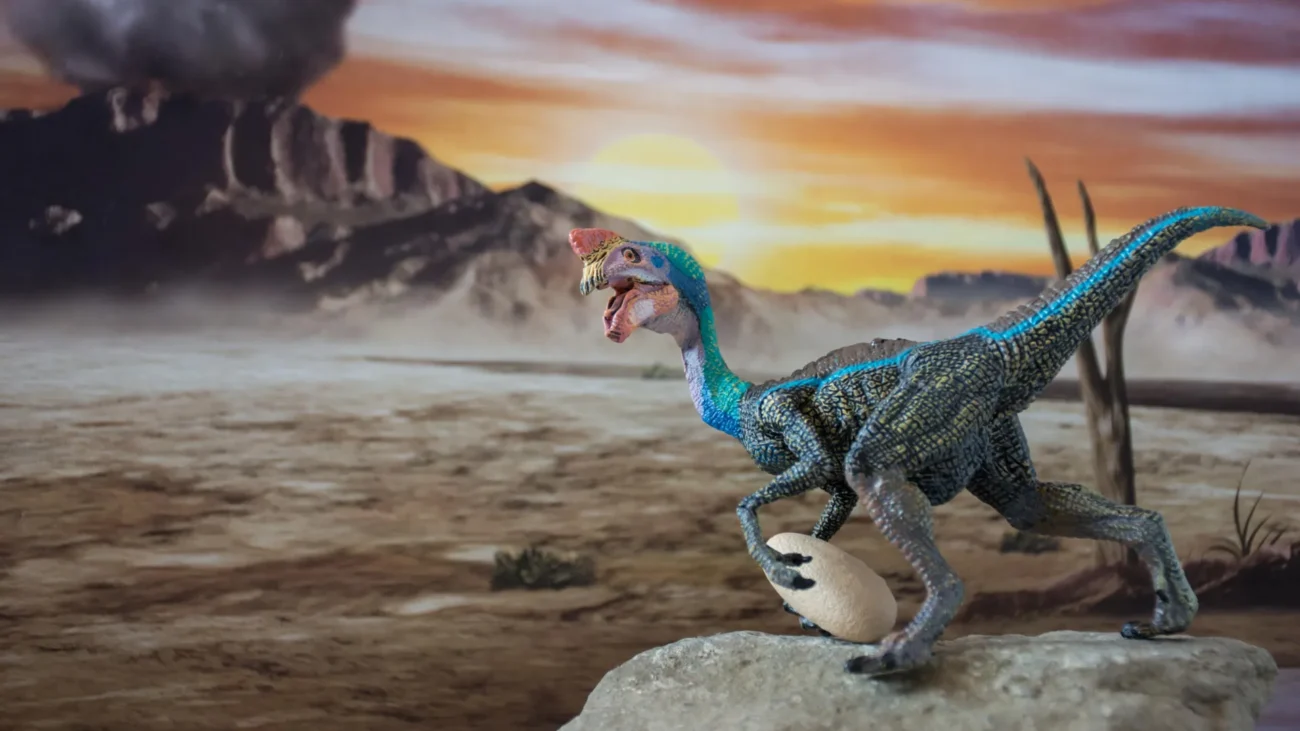
The enduring enigma of how oviraptors, those captivating feathered dinosaurs that roamed the Earth during the Late Cretaceous period, brought their young into the world has been a persistent question in paleontology. These agile, bird-like creatures, unable to take to the skies, presented a fascinating dichotomy: did they incubate their eggs with the same direct body heat as modern birds, or did they, like their reptilian cousins such as crocodiles and turtles, rely more heavily on the ambient warmth of their environment? A groundbreaking study, published in the esteemed journal Frontiers in Ecology and Evolution, has shed new light on this ancient reproductive puzzle, employing a sophisticated blend of physical experimentation and advanced computer simulations to meticulously recreate and analyze the incubation process of these remarkable dinosaurs.
The research, spearheaded by a dedicated team of scientists in Taiwan, sought to quantify the thermal dynamics of oviraptor nests and assess the efficiency of their hatching strategies. To achieve this, the researchers embarked on an ambitious endeavor: constructing a life-sized model of an oviraptor, meticulously designed to represent species like Heyuannia huangi, which inhabited what is now China between 70 and 66 million years ago. This model was then carefully positioned within a meticulously recreated nest, complete with artificial eggs engineered to mimic the properties of oviraptor ova.
Recreating an Ancient Dinosaur Nest: A Multifaceted Approach
The reconstruction process for the oviraptor model and its nest was a testament to scientific ingenuity and attention to detail. The chosen oviraptor species, Heyuannia huangi, was selected for its well-documented fossil record, which provided crucial anatomical and behavioral clues. This particular oviraptor was a relatively modest-sized creature, measuring approximately 1.5 meters in length and weighing around 20 kilograms. Its nests, as revealed by fossil evidence, were characterized by semi-open structures arranged in distinct rings of eggs.
The construction of the oviraptor model involved a robust internal framework of wood, overlaid with polystyrene foam to represent the animal’s musculature and soft tissues. Layers of cotton, cloth, and bubble paper were strategically applied to further enhance the realism of the model’s physical form. The artificial eggs themselves were a significant undertaking. Cast from resin, they were designed to approximate the size, shape, and likely thermal conductivity of actual oviraptor eggs, which are known to differ significantly from those of any extant species. The arrangement of these resin eggs within the nest replicated the precise double-ring configuration observed in fossilized oviraptor nesting sites, a critical detail for understanding heat distribution.
"Part of the difficulty lies in reconstructing oviraptor incubation realistically," explained Chun-Yu Su, the study’s first author, who was a high school student at Washington High School in Taichung when the research was conducted. "For example, their eggs are unlike those of any living species, so we invented the resin eggs to approximate real oviraptor eggs as best as we could." This innovative approach highlights the challenges and creative solutions inherent in paleobiological research, where direct observation is impossible.
The Crucial Role of Adult Position and Environmental Heat
The study’s findings, meticulously gathered through a series of controlled experiments and sophisticated computational analyses, strongly suggest that the posture and positioning of the brooding adult oviraptor relative to its clutch played a pivotal role in the development of the eggs. This was a departure from the prevailing hypothesis that oviraptors might have solely relied on passive environmental incubation.
"We show the difference in oviraptor hatching patterns was induced by the relative position of the incubating adult to the eggs," stated Dr. Tzu-Ruei Yang, the senior author and an associate curator of vertebrate paleontology at Taiwan’s National Museum of Natural Science. This suggests a more active, though perhaps less direct, form of parental care than initially envisioned.
The researchers tested various environmental conditions, including different ambient temperatures, and observed the impact of the model adult’s presence on egg temperatures. Under cooler conditions, a notable temperature gradient emerged. Eggs situated in the outer rings of the nest, when attended by the adult model, exhibited temperature variations of up to 6 degrees Celsius compared to those closer to the presumed body of the incubating dinosaur. Such temperature disparities within a single clutch could have led to asynchronous hatching, where some embryos develop and hatch at different rates than others. This phenomenon is observed in some modern bird species and can provide an evolutionary advantage by allowing for staggered hatching, potentially aligning with resource availability or predator evasion.
However, the influence of environmental heat, particularly solar radiation, became increasingly apparent under warmer conditions. In these scenarios, the temperature differential between the outer and inner eggs significantly diminished, dropping to a mere 0.6 degrees Celsius. This observation led the researchers to conclude that oviraptors inhabiting warmer climates likely benefited from direct sunlight, which acted as a supplementary heat source, contributing to more uniform egg temperatures.
"It’s unlikely that large dinosaurs sat atop their clutches," Dr. Yang elaborated. "Supposedly, they used the heat of the sun or soil to hatch their eggs, like turtles. Since oviraptor clutches are open to the air, heat from the sun likely mattered much more than heat from the soil." This hypothesis aligns with the semi-open nature of oviraptor nests and the open-air environments they inhabited during the Late Cretaceous.
Oviraptor Incubation: A Less Efficient, Yet Effective Strategy
A significant revelation from the study is the comparative inefficiency of oviraptor incubation when juxtaposed with that of modern birds. The researchers determined that oviraptor incubation strategies were markedly less efficient than the thermoregulatory contact incubation (TCI) employed by most contemporary avian species.
Modern birds typically achieve TCI by directly transferring their body heat to the eggs through physical contact. This method relies on three critical conditions: the parent must touch every egg, serve as the primary source of heat, and maintain all eggs within a relatively narrow and optimal temperature range conducive to embryonic development.
The unique architecture of oviraptor nests, characterized by their semi-open design and the arrangement of eggs in rings, presented a structural impediment to direct, full-clutch contact. The study suggests that oviraptors, by necessity, could not have consistently met the rigorous requirements of TCI.
"Oviraptors may not have been able to conduct TCI as modern birds do," Su commented. Instead, the research posits a model of "co-incubation," where the adult dinosaur and ambient environmental heat sources, primarily the sun, worked in tandem to warm the eggs. This co-incubation strategy, while less efficient in terms of direct heat transfer, may have represented an adaptive evolutionary step. It could reflect a transition from earlier dinosaur nesting behaviors involving buried eggs to the more exposed, semi-open nests observed in oviraptors.
Dr. Yang cautioned against framing this comparison as a competition, emphasizing that "modern birds aren’t ‘better’ at hatching eggs. Instead, birds living today and oviraptors have a very different way of incubation or, more specifically, brooding. Nothing is better or worse. It just depends on the environment." This perspective underscores the principle of evolutionary adaptation, where different strategies evolve to suit specific ecological niches and environmental pressures.
Broader Implications: Understanding Dinosaur Parenting and Evolution
The findings from this Taiwanese research team offer invaluable insights into the complex world of dinosaur parental care and provide a compelling case study for the application of interdisciplinary scientific methods in paleontology. The study’s innovative approach, which merges physical reconstruction with thermal modeling, opens new avenues for investigating aspects of dinosaur reproduction that have traditionally been challenging to decipher from fossil evidence alone.
The Late Cretaceous period, spanning from approximately 100 to 66 million years ago, was a dynamic era marked by significant evolutionary shifts. Oviraptors, meaning "egg thief" – a misnomer stemming from an early fossil discovery – are now understood to be devoted parents. Their name’s ironic twist serves as a reminder of how scientific understanding evolves with new discoveries. The initial discovery of an oviraptor fossil near a nest led to the erroneous assumption of egg predation. However, subsequent findings, including adults found preserved in brooding positions atop their nests, have conclusively demonstrated their nurturing roles.
These dinosaurs are particularly significant to scientists because they provide a crucial link in understanding the evolutionary transition from non-avian dinosaurs to modern birds. Their possession of feathers, their sophisticated nesting behaviors, and their demonstrated parental care all point to the deep evolutionary roots of traits we now associate exclusively with birds. The study’s contribution to this understanding lies in illuminating the specific mechanics of their reproductive strategies, bridging the gap between fossil anatomy and inferred physiology.
The implications of this research extend beyond oviraptors themselves. It provides a robust framework that can be applied to other extinct species, allowing for a more nuanced understanding of their reproductive biology. By developing accurate models and employing advanced simulation techniques, paleontologists can begin to reconstruct the thermal environments and incubation strategies of a wider range of extinct animals, offering a richer tapestry of prehistoric life.
Dr. Yang also highlighted the inspirational aspect of the study, particularly for students in Taiwan. "It also truly is an encouragement for all students, especially in Taiwan," he concluded. "There are no dinosaur fossils in Taiwan, but that does not mean that we cannot do dinosaur studies." This statement underscores the universal nature of scientific inquiry and the power of innovative research methodologies to overcome geographical limitations.
While the researchers acknowledge that their conclusions are based on a reconstructed nest and that Earth’s climate has undergone significant changes since the Late Cretaceous, which could have influenced hatching patterns, their work represents a significant leap forward. The study not only refines our understanding of oviraptor reproduction but also demonstrates the profound potential of integrating physical and digital modeling to unlock the secrets of the ancient world, offering a compelling glimpse into the lives and legacies of creatures that once dominated our planet. The ongoing study of oviraptors continues to reveal fascinating details about their lives, contributing to our broader understanding of the evolution of birds and the complex ecological dynamics of the Mesozoic Era.

