


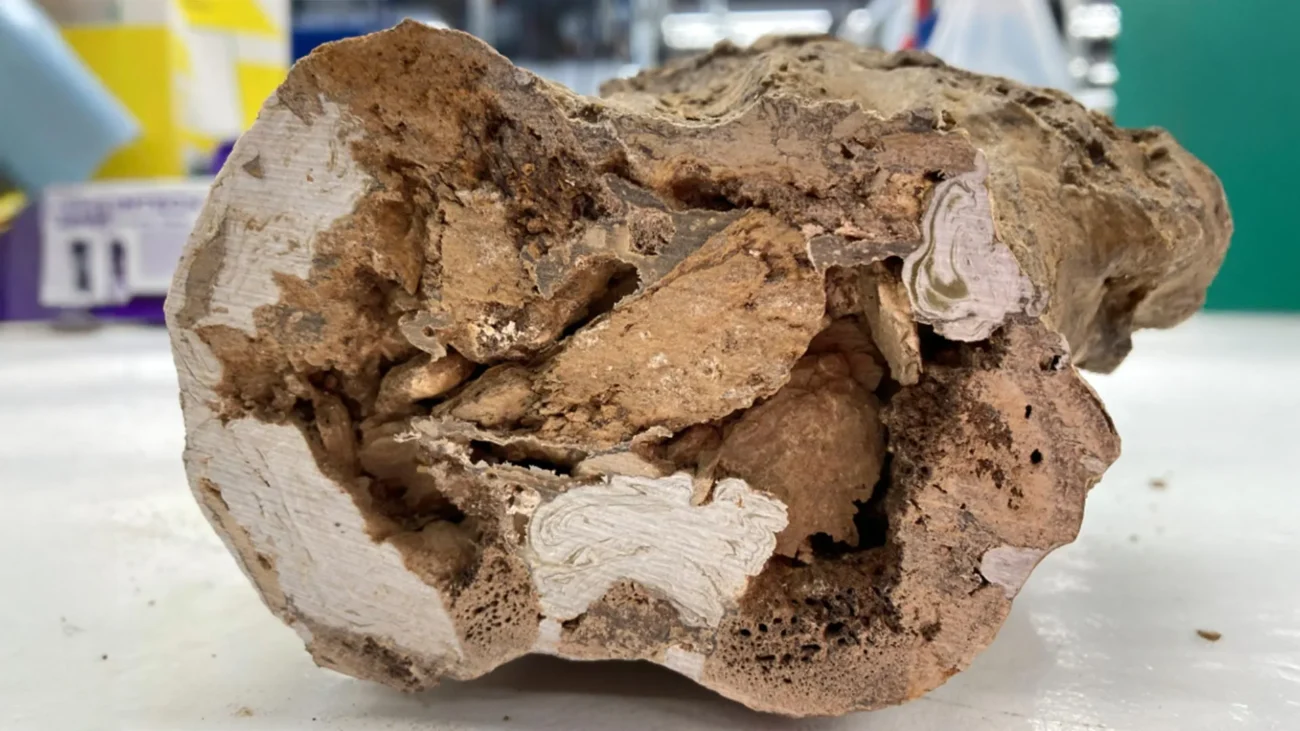
For decades, the prevailing scientific consensus painted dinosaur fossils as little more than petrified relics, mineralized casts where any semblance of original biological material had long succumbed to the relentless march of time and geological processes. However, a groundbreaking study, meticulously centered on an exceptionally preserved Edmontosaurus fossil, is now dramatically challenging this deeply entrenched assumption, potentially rewriting our understanding of paleontological preservation. This extraordinary research, spearheaded by a team from the University of Liverpool, presents compelling evidence suggesting that traces of original organic molecules, most notably collagen, persist within dinosaur bones dating back an astonishing 66 million years. This discovery lends significant weight to a controversial hypothesis that has polarized the paleontological community for over three decades, reigniting a debate that could unlock unprecedented avenues for studying extinct life.
The Landmark Discovery: Preserved Collagen in an Ancient Bone
The cornerstone of this paradigm-shifting investigation is a remarkably intact Edmontosaurus sacrum, a critical component of the dinosaur’s hip structure, weighing approximately 22 kilograms. Unearthed from the renowned Hell Creek Formation in South Dakota, this fossil represents a specimen of Edmontosaurus annectens, a large, herbivorous duck-billed dinosaur that coexisted with apex predators like Tyrannosaurus rex during the twilight of the Cretaceous Period. The remarkable preservation of this specimen provided an unparalleled opportunity to probe its internal composition.
Employing a sophisticated arsenal of advanced laboratory techniques, including state-of-the-art protein sequencing and multiple forms of mass spectrometry, the research team was able to detect undeniable remnants of collagen embedded deep within the fossilized bone matrix. Collagen, the most abundant protein in vertebrate bone and a fundamental building block of connective tissues, is notoriously challenging to preserve over geological timescales. Its identification in this context is particularly significant, as it is far more difficult to dismiss as modern contamination compared to other organic molecules.
Further bolstering the findings, researchers from the University of California, Los Angeles (UCLA) independently identified hydroxyproline, a non-essential amino acid that is a critical and characteristic component of collagen in bone tissue. This independent confirmation served as vital corroboration, strengthening the assertion that degraded collagen fragments were indeed intrinsically present within the fossil, rather than being a superficial contaminant.
Professor Steve Taylor, chair of the Mass Spectrometry Research Group at the University of Liverpool’s Department of Electrical Engineering & Electronics, articulated the profound implications of these findings. "This research shows beyond doubt that organic biomolecules, such as proteins like collagen, appear to be present in some fossils," he stated. "Our results have far-reaching implications. Firstly, it refutes the hypothesis that any organics found in fossils must result from contamination." This direct refutation strikes at the heart of decades of skepticism.
A Decades-Long Scientific Schism: The Debate Over Soft Tissue Preservation
The notion that dinosaur fossils might contain preserved organic material, particularly soft tissues and proteins, has been a lightning rod for intense scientific debate since the early 2000s. The initial claims, often met with considerable skepticism, were frequently attributed to modern contamination by bacteria or other biological agents, or the residual organic matter from the surrounding sedimentary environment. The prevailing view held that the extreme heat and pressure associated with fossilization, coupled with the vast stretches of geological time, would inevitably lead to the complete degradation of all original organic compounds, leaving only mineralized structures.
One of the most pivotal moments in this protracted scientific dispute occurred in 2005, when paleontologist Mary Schweitzer and her colleagues published their groundbreaking findings detailing the discovery of soft tissue structures within a Tyrannosaurus rex fossil. This discovery, which included what appeared to be blood vessels and flexible bone matrix, sent shockwaves through the paleontological world. Subsequent research built upon this foundation, with studies reporting the identification of possible collagen fragments and blood vessel-like structures in additional dinosaur specimens, including hadrosaurs, a group to which Edmontosaurus belongs.
However, the Edmontosaurus analysis detailed in Analytical Chemistry distinguishes itself through its rigorous, multi-pronged approach. The research team meticulously employed a suite of independent testing methodologies on the very same fossil specimen. By integrating high-resolution microscopy, detailed chemical analysis, and precise protein sequencing, the scientists aimed to systematically eliminate the possibility of contamination and build an irrefutable case for the endogenous origin of the detected molecules. This convergent approach, where multiple independent lines of evidence all point to the same conclusion, significantly strengthens the scientific validity of their claims.
The findings were formally published in the esteemed journal Analytical Chemistry in 2025, under the title "Evidence for Endogenous Collagen in Edmontosaurus Fossil Bone." This publication marks a critical milestone in the ongoing scientific discourse.
Unlocking the Secrets of the Past: The Far-Reaching Implications of Molecular Survival
The implications of this discovery are nothing short of revolutionary for the field of paleontology. If proteins, such as collagen, can indeed survive in fossilized remains for tens of millions of years, it opens up an entirely new and incredibly powerful dimension for studying extinct animals. This could fundamentally alter how paleontologists reconstruct the lives, evolutionary histories, and biological intricacies of creatures that have been extinct for millennia.
Molecular traces, even in minute quantities, could provide crucial insights into the evolutionary relationships between different dinosaur species. Phylogenomic studies, which infer evolutionary relationships by comparing genetic material, have been a cornerstone of modern biology. The ability to analyze ancient proteins could, in essence, provide a form of "paleo-genomic" data, allowing scientists to establish connections and divergences between dinosaur lineages that are currently obscured or difficult to discern from skeletal morphology alone.
Furthermore, these preserved biomolecules could offer unparalleled windows into dinosaurian physiology, growth patterns, aging processes, and even the prevalence of diseases. Understanding how these ancient animals developed, how their bodies functioned, and what ailments they might have suffered from would provide a much richer and more nuanced picture of their existence.
Professor Taylor highlighted another crucial aspect of this research: the need to re-examine existing fossil collections. He suggested that archival images, particularly those captured using cross-polarized light microscopy decades ago, might contain overlooked evidence of preserved collagen within ancient bones. "These images may reveal intact patches of bone collagen, potentially offering a ready-made trove of fossil candidates for further protein analysis," Taylor explained. "This could unlock new insights into dinosaurs, for example revealing connections between dinosaur species that remain unknown." This prospect suggests that the answers to some long-standing paleontological mysteries might already be within our reach, simply waiting to be re-evaluated with new analytical perspectives.
The Enigma of Molecular Longevity: How Did They Survive?
Beyond the immediate implications for paleontological research, the discovery of preserved collagen raises a profound and fascinating scientific question: how have these delicate organic molecules managed to endure for such immense periods? Proteins, by their very nature, are complex molecular structures that are prone to degradation over time through various chemical and biological processes, especially across the vast timescales of geological history.
Yet, the fossil record demonstrates that under specific, and as yet not fully understood, conditions, some fossils possess an extraordinary capacity to preserve microscopic biological structures. Scientists are increasingly investigating the role of mineral interactions within the bone matrix. It is theorized that these minerals may act as a protective shield, encapsulating and shielding fragments of collagen from complete decay. Recent research into fossil biomolecules suggests that particular burial environments, characterized by specific geochemical conditions, coupled with the intricate microstructure of fossilized bone, could create remarkably stable environments that significantly slow down chemical breakdown.
The Edmontosaurus fossils themselves have long been recognized for their exceptional state of preservation. Historically, some specimens recovered over the past century have exhibited astonishingly detailed skin impressions and other soft tissue features, earning them the evocative moniker "dinosaur mummies." More recent paleontological expeditions have continued to uncover Edmontosaurus specimens that showcase surprisingly intricate soft tissue preservation, including evidence of fleshy structures and well-preserved skin anatomy.
Collectively, these ongoing discoveries are actively reshaping the scientific perception of fossils. Rather than viewing them solely as inert, stone replicas of ancient skeletal structures, researchers are increasingly beginning to regard certain fossils as sophisticated molecular time capsules, capable of retaining tangible traces of prehistoric biology for millions of years. This evolving perspective promises to revolutionize paleontological research, ushering in an era where the study of ancient life is as much about molecular archaeology as it is about skeletal reconstruction. The enduring mystery of molecular survival in fossils is no longer just a theoretical puzzle; it is a tangible reality that is beginning to yield its secrets, offering an unprecedented glimpse into the deep past.

