


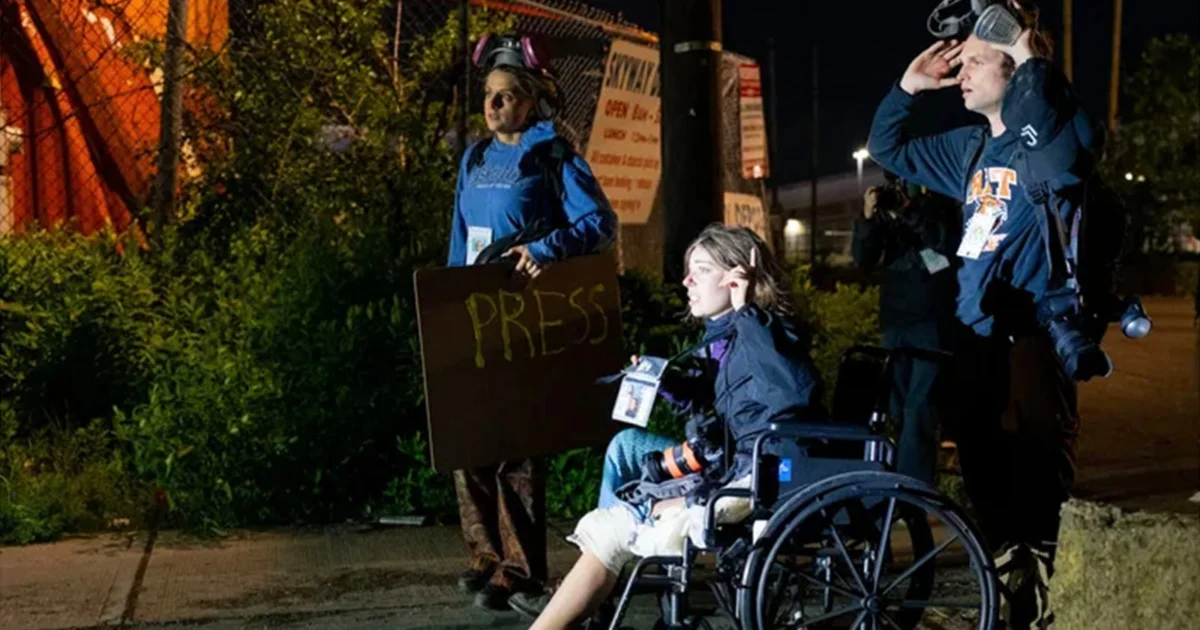
The intersection of press freedom, police accountability, and public transparency has moved to the forefront of a legal battle in New Jersey as a non-profit news organization seeks the release of body-worn camera footage involving an Essex County police sergeant accused of stealing a photojournalist’s equipment. The lawsuit, filed by the New Jersey Center for Non-Profit Journalism on behalf of its news outlet, The Jersey Vindicator, challenges the Essex County Prosecutor’s Office for its refusal to disclose recordings that reportedly document a high-ranking officer interacting with a camera bag that later turned up at his private residence. The case stems from a chaotic night of protests outside a Newark detention facility, an event that has already sparked federal litigation and widespread condemnation from civil rights advocates.
On the night of May 30, the atmosphere outside Delaney Hall—a private detention facility in Newark used by U.S. Immigration and Customs Enforcement (ICE)—was one of intense volatility. Demonstrators had gathered to protest the treatment and detention of immigrants, leading to a heavy law enforcement presence from various agencies, including the Essex County Police Department. Among those documenting the scene was Angelina Katsanis, a freelance photojournalist on assignment for the Associated Press. As clashes between police and protesters escalated, the environment became physically dangerous for those on the front lines. During the melee, Katsanis was struck by a wooden beam, an injury significant enough to require immediate medical intervention.
In the urgency of seeking medical attention, Katsanis was forced to leave her professional camera bag behind. When she returned to the scene later that evening, assisted by a wheelchair due to her injuries, the bag—which contained expensive professional gear and personal items—had vanished. However, the recovery of the equipment did not rely on traditional detective work alone. Katsanis had equipped her bag with an Apple AirTag, a tracking device that allowed her to monitor its location in real-time. While she was receiving treatment at a local hospital, the digital trail led directly to a residential address in Sparta, New Jersey. Investigative records later confirmed that this address belonged to Sergeant Darryl Brown of the Essex County Police Department.
The Criminal Charges and Internal Investigation
The discovery of the bag’s location prompted an internal investigation by the Essex County Prosecutor’s Office. According to officials, a review of Sergeant Brown’s own body-worn camera footage from the night of the protest showed him "interacting" with the photographer’s bag. Following a search of Brown’s home in Sparta, authorities recovered several items belonging to Katsanis. Notably, some of these items were clearly marked with the photographer’s name and contact information, undermining any potential defense of accidental acquisition or lack of ownership knowledge.
Sergeant Brown, a veteran officer, was subsequently suspended without pay. He now faces a charge of third-degree theft, a serious offense under New Jersey law. If convicted, the charge carries a potential prison sentence of three to five years and a fine that could reach $15,000. While the criminal case against Brown is proceeding, the administrative and legal fallout has shifted toward the transparency of the evidence itself. The Essex County Prosecutor’s Office has maintained a strict grip on the bodycam footage, citing the ongoing nature of the criminal investigation as a justification for withholding the video from the public.
The Legal Challenge for Transparency
The refusal to release the footage sparked a swift legal response from The Jersey Vindicator. Steve Janoski, a veteran reporter with the outlet, filed a formal request for the footage and related investigative documents on June 5, utilizing the state’s Open Public Records Act (OPRA). The request sought not only the bodycam video from the night of the incident but also all recordings and reports generated leading up to Brown’s arrest. On June 10, the Prosecutor’s Office denied the request in its entirety, arguing that the records were exempt from disclosure because they pertained to an active criminal investigation.
The lawsuit filed by The Jersey Vindicator argues that this denial is a violation of state law. Represented by CJ Griffin, a prominent attorney specializing in government transparency and public records access, the news outlet contends that the footage should be public. The core of their argument rests on the timing and nature of the recording. Griffin argues that the footage was captured while Brown was performing his duties as a public servant, prior to him becoming the subject of a criminal investigation. Under this interpretation, the footage is a routine record of police activity rather than a specialized "investigatory record" created for the purpose of a prosecution.
"There is no justification for keeping the video from the public," Griffin stated regarding the filing. "The public has a right to see how its officers behave in the field, especially when an officer is accused of exploiting a chaotic situation to commit a crime against a member of the press. We deserve to see what occurred."
A Chronology of Events
The timeline of the incident and the subsequent legal maneuvers highlights a rapid escalation from a local protest to a significant legal confrontation:
- May 30: Protests occur at Delaney Hall in Newark. Photojournalist Angelina Katsanis is injured and her camera bag goes missing.
- May 31: Using AirTag technology, the bag is tracked to a home in Sparta, NJ, belonging to Sgt. Darryl Brown.
- Early June: The Essex County Prosecutor’s Office reviews bodycam footage, searches Brown’s home, and recovers the stolen gear.
- June 5: Sgt. Brown is charged with third-degree theft and suspended. On the same day, reporter Steve Janoski files an OPRA request for the footage.
- June 10: The Essex County Prosecutor’s Office officially denies the records request, citing the "ongoing investigation" exemption.
- Late June: The Jersey Vindicator files a lawsuit in New Jersey Superior Court to compel the release of the footage.
Contextual Background: The Hostile Environment at Delaney Hall
The incident involving Sergeant Brown and Angelina Katsanis does not exist in a vacuum. It is part of a broader, more troubling pattern of alleged hostility toward journalists covering immigration-related protests in Newark. Delaney Hall, managed by the Education and Health Centers of America, has been a flashpoint for activists for years. The facility houses detainees for ICE, and protests there are frequently met with a robust response from both federal and local law enforcement.
In the weeks following the May 30 incident, the American Civil Liberties Union (ACLU) filed a separate federal lawsuit against ICE. That litigation accuses the federal agency of failing to turn over records regarding its practices of threatening and surveilling photographers who film federal agents. The ACLU’s action was prompted by numerous reports from photojournalists who claimed they were specifically targeted, harassed, or physically obstructed by ICE agents while attempting to document the protests at Delaney Hall.
The Katsanis case adds a new layer to these allegations. While the ACLU focuses on federal agents, the charges against Sergeant Brown suggest that local law enforcement may also be contributing to a climate of interference with the press. The fact that a journalist was injured and then allegedly robbed by a law enforcement officer while attempting to recover her gear has sent shockwaves through the regional media community.
Analysis of Implications for Public Records Law
The outcome of the lawsuit filed by The Jersey Vindicator could have significant implications for how bodycam footage is handled in New Jersey. Historically, law enforcement agencies have used the "ongoing investigation" exemption as a broad shield to prevent the release of potentially embarrassing or incriminating video. However, New Jersey’s courts have increasingly signaled a preference for transparency, especially in cases involving police misconduct.
Legal experts suggest that if the court rules in favor of the news outlet, it could establish a clearer precedent that bodycam footage recorded during public events is a public record from the moment of its creation, regardless of whether it later becomes evidence in a criminal trial. This would prevent agencies from "retroactively" exempting footage simply because an officer depicted in the video is later charged with a crime.
Furthermore, the case highlights the role of technology in modern accountability. The use of an AirTag was the catalyst for the entire investigation; without it, the theft might have remained unsolved, and the bodycam footage might never have been scrutinized by internal affairs. This intersection of consumer technology and legal transparency is becoming a recurring theme in 21st-century civil rights litigation.
Official Responses and Current Status
To date, the Essex County Police Department and the Prosecutor’s Office have declined to comment on the specifics of the pending litigation, citing policy regarding ongoing court cases. Sergeant Darryl Brown remains suspended pending the resolution of the criminal charges against him. Representatives for the Associated Press, while not a party to the lawsuit for the footage, have expressed support for the safety and protection of journalists in the field.
The New Jersey Center for Non-Profit Journalism maintains that its pursuit of the footage is not merely about one incident of theft, but about the fundamental right of the public to oversee those who are sworn to protect them. As the legal proceedings move forward in the New Jersey Superior Court, the case serves as a critical test of whether the state’s transparency laws are robust enough to withstand the procedural hurdles often erected by law enforcement agencies.
The broader impact of this case will likely be felt by every photojournalist and reporter working in high-friction environments. If the footage is released, it will provide a rare, unfiltered look at the interactions between police and the press during times of civil unrest. If it remains suppressed, it may reinforce fears among the media that law enforcement can operate with a degree of opacity, even when their own members are accused of criminal acts. For now, the eyes of the legal and journalistic communities remain fixed on Essex County, awaiting a decision that will define the boundaries of public access to police records in the digital age.

