


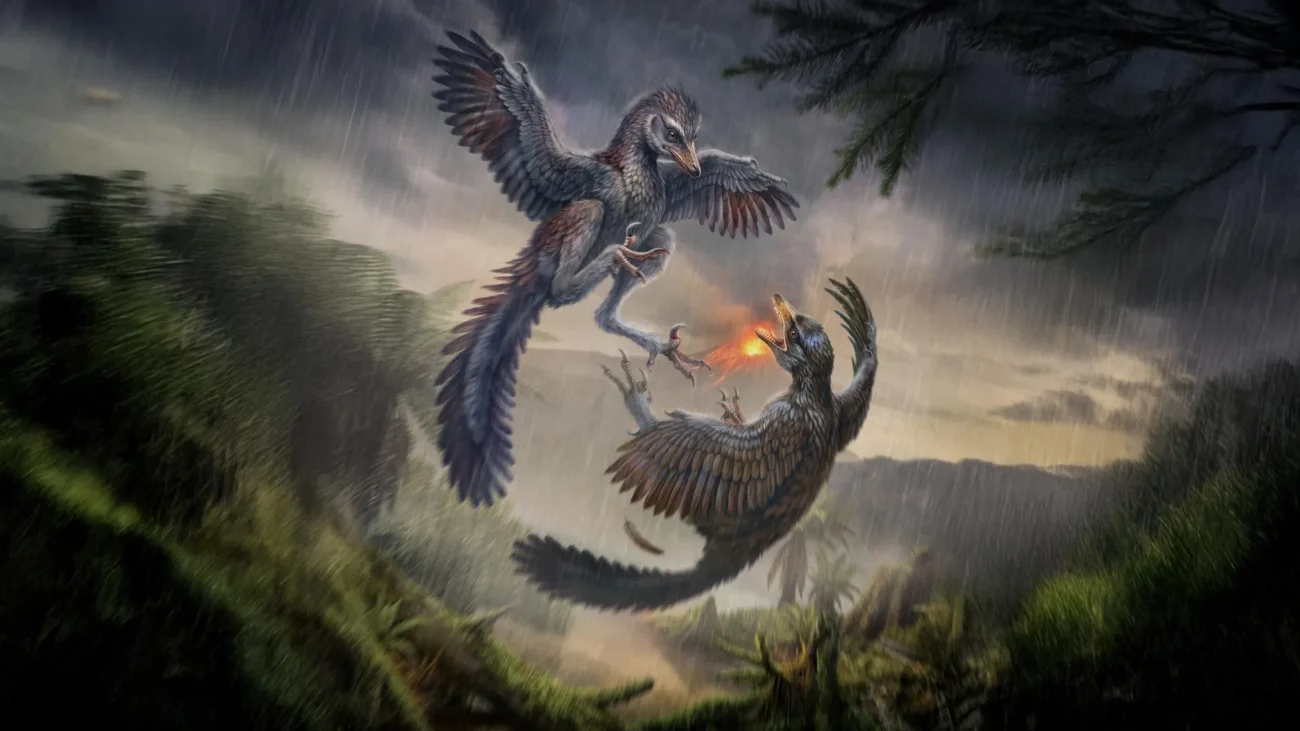
The discovery of a remarkably preserved, crow-sized fossil in southeastern China has dramatically altered our understanding of avian history, revealing that some of the earliest known ancestors of modern birds abandoned the skies to live exclusively on the ground. Unveiled in a landmark study published in the prestigious journal Nature, the newly identified species—christened Yuezhuornis yangyuanensis—dates back approximately 150 million years to the Late Jurassic period. Rather than adhering to the traditional linear narrative of avian evolution, which assumes a steady, continuous progression toward increasingly sophisticated flight capabilities, this ancient creature demonstrates that the dawn of bird evolution was characterized by radical experimentation, behavioral diversification, and, in some cases, the complete secondary loss of flight.
Unearthed in the newly recognized Zhenghe Fauna of Fujian Province, Yuezhuornis sits at a critical intersection of paleontological discovery. The collaborative research effort, led by scientists from the Institute of Vertebrate Paleontology and Paleoanthropology (IVPP) of the Chinese Academy of Sciences (CAS) alongside colleagues at the Fujian Institute of Geological Sciences, provides robust anatomical evidence that ancient avian lineages were rapidly adapting to a diverse array of terrestrial niches long before the Cretaceous period.
A Mosaic of Bird and Dinosaur Anatomy
At first glance, the skeletal architecture of Yuezhuornis presents a confounding evolutionary puzzle. The specimen bridges the morphological gap between early birds and small, predatory theropod dinosaurs in a manner previously unseen in such detail. While the creature possessed pelvic and hindlimb structures characteristic of primitive avialans, it simultaneously retained archaic predatory features typical of deinonychosaurs—a specialized group of meat-eating dinosaurs that includes agile hunters closely related to birds, such as dromaeosaurids and troodontids.
Most striking among these predatory adaptations are the jaws of Yuezhuornis, which are lined with closely spaced, sharply serrated teeth. Such dentition is exceptionally rare among early birds, most of which rapidly transitioned toward toothless beaks or vastly simplified, nonserrated teeth as they evolved. Furthermore, the creature’s second toe bore an enlarged, curved, sickle-shaped claw capable of an unusual range of backward movement. In deinonychosaurs, this specialized pedal structure was famously utilized as a predatory weapon.
"When we examined Yuezhuornis, we were struck by its extraordinary mix of features," noted Dr. Min Wang, corresponding author of the study and a leading researcher at the IVPP. "It possesses bird-like pelvic and hindlimb structures yet retains the specialized predatory foot and teeth of a small meat-eating dinosaur. It shows us that early bird evolution was far more complicated than we previously realized."
This mosaic of traits highlights the complex mosaic evolution that defined the transition from non-avian dinosaurs to true birds. Rather than shedding their dinosaurian characteristics in a neat, uniform sequence, early avialans retained various ancestral predatory traits while simultaneously developing novel adaptations suited to specialized ecological roles.
Evolutionary Placement and Phylogenetic Analysis
To determine the exact taxonomic position of Yuezhuornis within the vertebrate family tree, the research team conducted rigorous phylogenetic analyses. Utilizing two distinct computational approaches—maximum parsimony and Bayesian tip-dating—the scientists compared dozens of anatomical characteristics across a broad matrix of prehistoric taxa.
Maximum parsimony operates on the principle that the most likely evolutionary tree is the one requiring the fewest evolutionary changes, mapping traits logically across generations. Bayesian tip-dating, a more sophisticated statistical method, integrates assumptions about rates of morphological change and explicitly incorporates fossil age data to construct a probabilistic timeline of divergence.
Remarkably, both analytical frameworks yielded identical, highly robust conclusions. Yuezhuornis was placed firmly within Avialae, the broader evolutionary clade comprising modern birds and their closest extinct relatives. Specifically, the phylogenetic tree positions the new species just crownward of the iconic Archaeopteryx and identifies it as a sister taxon to Zhengheornis, another significant fossil bird from the same general geographic and temporal horizon.
"The results consistently placed Yuezhuornis firmly within Avialae, just crownward of Archaeopteryx and as a sister taxon to Zhengheornis," explained Dr. Zhonghe Zhou, a co-author of the study and prominent paleontologist at the Chinese Academy of Sciences.
This precise phylogenetic positioning is of paramount scientific importance. Archaeopteryx, discovered in Germany in the 19th century and also dating to roughly 150 million years ago, has long served as the baseline reference for the earliest stages of avian evolution. By demonstrating that Yuezhuornis belongs to an established early branch of Avialae rather than representing an aberrant feathered dinosaur, the discovery confirms that flightlessness in this lineage was a secondary evolutionary reversal rather than a primitive trait inherited from non-flying ancestors.
The Anatomy of Flightlessness
To reconstruct the lifestyle and locomotor capabilities of Yuezhuornis, the research team performed detailed quantitative analyses of its skeletal proportions. By measuring the relative lengths of limb bones—such as the femur, tibiotarsus, and tarsometatarsus—and comparing these metrics against a vast database of extant birds and extinct theropods using discriminant function analysis, the scientists evaluated whether the animal was adapted for aerial locomotion or terrestrial running.
The statistical outputs were definitive. The limb proportions of Yuezhuornis bear a striking resemblance to those of modern ground-dwelling birds, such as modern cursorial runners, as well as to specialized terrestrial non-avian theropods. The forelimbs and pectoral girdle lacked the structural adaptations necessary to support powered flight, indicating that the organism spent its entire life on the substrate, relying on running or foraging on foot rather than navigating the canopy or the open air.
This finding challenges the long-held teleological view of evolution, which tacitly assumes that biological systems naturally progress toward greater complexity, efficiency, or specialization—in this case, the perfection of powered flight. Instead, the evolutionary trajectory of Yuezhuornis illustrates that natural selection acts strictly on immediate local fitness. If an ecological niche on the ground offered abundant resources, safety from aerial predators, or less metabolic competition, the loss of flight capabilities could become an advantageous, highly successful evolutionary strategy.
Contextualizing the Zhenghe Fauna
The discovery of Yuezhuornis also highlights the rapidly growing significance of the Zhenghe Fauna in Fujian Province. Situated in southeastern China, this newly explored fossil assemblage provides a rare and pristine window into Late Jurassic ecosystems—a critical geological interval that has historically suffered from a sparse fossil record compared to the subsequent Cretaceous period.
During the Late Jurassic, the geography and climate of what is now Fujian Province featured complex lacustrine and terrestrial environments capable of supporting high biodiversity. The exceptional preservation of vertebrate fossils in this region, often locked in fine-grained sedimentary layers, allows paleoecologists to reconstruct ancient food webs and ecosystem dynamics with unprecedented precision.
As paleontologists continue to excavate and analyze material from the Zhenghe Fauna, researchers anticipate uncovering additional transitional forms that will illuminate the early chapters of avian history. The region is rapidly emerging as a world-class laboratory for studying the deep-time evolution of feathers, endothermy, and terrestrial locomotion among small-bodied dinosaurs.
Broader Implications for Paleontology
The implications of the Yuezhuornis discovery extend far beyond avian taxonomy, forcing a broader philosophical re-evaluation of how evolutionary biologists interpret the fossil record. For decades, the discovery of a non-flying bird-like creature from the Jurassic would have been shoehorned into a linear model, often dismissed as a transitional dead-end or an evolutionary anomaly.
By demonstrating that flightlessness occurred early, independently, and within established avialan lineages, Yuezhuornis underscores the dynamic, bush-like nature of macroevolution. Evolution does not march in a straight line toward a predetermined goal; rather, it radiates outward in all directions, constantly testing the boundaries of anatomical possibility in response to shifting environmental pressures.
Furthermore, the presence of predatory dinosaur teeth and a sickle claw in a confirmed early bird reinforces the porous boundary between dinosaurs and birds. Birds are, taxonomically and phylogenetically, theropod dinosaurs; Yuezhuornis serves as a tangible, physical reminder of that deep ancestry, preserving the lethal armament of a carnivorous predator alongside the specialized hindlimbs of an early avialan.
Ultimately, the crow-sized resident of Late Jurassic China has rewritten the introductory chapters of the avian story. As researchers parse through the finer details of the Zhenghe Fauna, Yuezhuornis yangyuanensis will stand as a monument to evolutionary complexity—a creature that looked to the skies of the Jurassic, chose the ground instead, and in doing so, unlocked a deeper truth about the winding paths of life on Earth.

