


Aspergillosis represents one of the most significant and challenging fungal diseases encountered in avian medicine, requiring a nuanced understanding of environmental factors, clinical presentation, and diagnostic limitations. Caused by the ubiquitous Aspergillus mold, this condition primarily impacts the respiratory system of birds, manifesting as infections in the lungs and air sacs. Because the disease is often insidious in its progression, it frequently poses a diagnostic hurdle for avian veterinarians and a source of significant anxiety for bird owners.
The Pathophysiology of Aspergillus Exposure
The Aspergillus fungus is present throughout the natural world, thriving in decaying organic matter, soil, and agricultural environments. In a domestic setting, birds encounter microscopic spores through inhalation. However, exposure to the fungus does not equate to the development of disease. The clinical manifestation of aspergillosis is largely determined by a binary interaction: the concentration of fungal spores in the immediate environment and the immunocompetence of the bird.
Birds that are chronically stressed, malnourished, or suffering from underlying immunosuppression are at a significantly higher risk of infection. A critical, well-documented risk factor is vitamin A deficiency, which impairs the integrity of the respiratory epithelium—the bird’s first line of defense against inhaled pathogens. While certain species, including African greys, Amazons, cockatiels, and macaws, are statistically overrepresented in clinical case studies, it is an axiom of avian medicine that any bird, regardless of species, is susceptible to the disease.
Clinical Presentation and Diagnostic Challenges
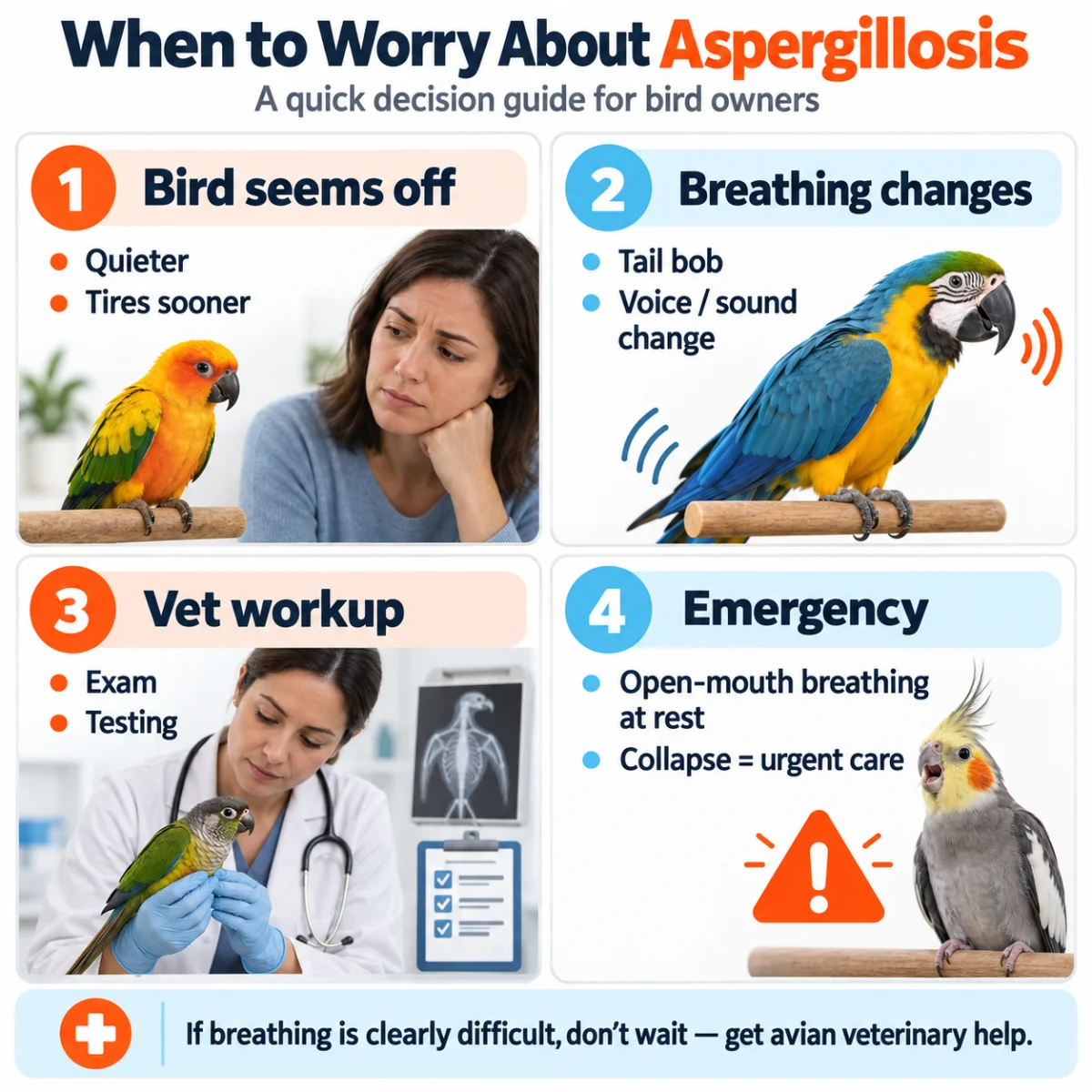
The clinical trajectory of aspergillosis often begins with subtle, non-specific behavioral shifts. Owners frequently report that their bird simply "seems off"—a description that encompasses reduced appetite, increased sleep, and decreased enthusiasm for social interaction or physical play. As the disease advances, exercise intolerance becomes more apparent; a bird that previously navigated a room with ease may find short flights exhausting.
Diagnostic complexity arises because many of the symptoms—wheezing, clicking sounds, persistent tail bobbing, and vocal changes—are shared by a host of other conditions, including bacterial pneumonia, heart disease, and airway obstructions. Consequently, there is no "gold standard" diagnostic test for aspergillosis. Instead, veterinarians must utilize a multi-modal approach, synthesizing physical examination findings with hematology, diagnostic imaging such as X-rays or CT scans, and, when indicated, endoscopy or biopsy.
Recent systematic reviews have highlighted that diagnostic accuracy varies significantly across existing methodologies. For instance, antibody testing may yield false negatives if the bird’s immune response is muted, while PCR tests or fungal cultures may miss the specific site of an infection. This "puzzle-piece" approach requires owners to be patient and informed, understanding that repeat testing is often necessary to track the progression or regression of internal fungal plaques.
Establishing a Chronology of Care
When an owner suspects their bird is suffering from aspergillosis, the timeline of intervention is critical. The following framework serves as a guide for decision-making:
- Early Phase (Subtle Changes): If a bird shows a gradual decrease in weight or stamina, the owner should initiate a detailed log of weight and behavior. These data points are invaluable for the veterinarian during an initial consultation.
- Intermediate Phase (Symptomatic): The presence of audible respiratory distress, such as clicking or wheezing, warrants an immediate veterinary exam. At this stage, the focus shifts to identifying the underlying cause through diagnostic imaging and blood analysis.
- Emergency Phase (Acute Respiratory Distress): If a bird displays open-mouth breathing at rest, gasping, or an inability to perch, the situation is a life-threatening emergency. Immediate intervention is required to stabilize the patient, often involving oxygen therapy and intensive supportive care.
Treatment Modalities and Recovery Projections
Treatment for aspergillosis is rarely a short-term commitment. Because the fungus often forms granulomas—masses of inflammatory tissue that encapsulate the infection—antifungal medications must be administered over a period of weeks or even months to achieve deep-tissue penetration.
The recovery process is marked by incremental improvements rather than a sudden resolution. Owners should look for normalized eating habits, improved stamina, and a reduction in respiratory effort. However, even when a bird appears to have recovered, the cessation of treatment should only occur under strict veterinary guidance. Discontinuing medication prematurely can lead to recurrence, as residual spores or damaged respiratory tissue may provide a foothold for the infection to return.
Environmental Management and Risk Mitigation
While the complete eradication of Aspergillus spores from a home environment is physically impossible, owners can significantly reduce the risk of infection by controlling moisture. Mold thrives in damp, poorly ventilated areas. Sources of potential fungal growth include:
- Cage Hygiene: Damp cage substrates and debris-filled food cups are primary sites for mold proliferation. A consistent, daily cleaning routine is more effective than periodic, deep-cleaning "marathons."
- Humidifiers and Plants: While appropriate humidity is important for avian health, poorly maintained humidifiers can aerosolize mold spores. Similarly, houseplant potting soil that remains chronically soggy can act as a reservoir for Aspergillus.
- Food Storage: Contrary to some common misconceptions, feeding a well-stored peanut is not an automatic death sentence. The danger lies in contaminated, moldy, or improperly stored grains and nuts. Procurement from reputable sources and dry storage are the primary preventive measures.
The Role of Advanced Air Filtration
In recent years, the use of HEPA (High-Efficiency Particulate Air) filtration has become a recommended supplement for bird owners. While an air purifier cannot compensate for a leaking pipe or a moldy wall, it provides an additional layer of protection by capturing airborne particulates. It is important to note that air filtration should be treated as a secondary defense; source control—fixing moisture problems and maintaining cleanliness—remains the primary directive for avian wellness.

Ethical Considerations and Second Opinions
The complexity of aspergillosis occasionally leads to situations where owners feel uncertain about a diagnosis or a treatment plan. It is a standard of professional practice for owners to seek a second opinion from another avian-certified veterinarian. When doing so, it is vital to provide the new clinician with the complete history and diagnostic records from the first provider. This prevents the unnecessary repetition of tests and ensures that the clinical assessment is based on a comprehensive view of the bird’s health history.
The Human-Animal Interface
A common point of concern for bird owners is the potential for zoonotic transmission—the risk of the disease spreading to humans. Current consensus from organizations such as the Centers for Disease Control and Prevention (CDC) confirms that aspergillosis is not transmitted between birds and humans. Both parties are generally exposed to the same environmental spores. However, immunocompromised individuals living in a home with a bird suffering from aspergillosis should consult their own physicians regarding the environmental presence of mold.
Conclusion and Future Outlook
The management of aspergillosis is an exercise in diligence and partnership between the bird owner and the avian veterinarian. Because the disease can be masked by the bird’s natural tendency to hide illness, early detection is often the most significant factor in a positive prognosis.
By monitoring for subtle changes in behavior, maintaining a clean and dry living environment, and adhering to long-term treatment protocols when necessary, owners can improve the quality of life for their birds. As diagnostic technology continues to evolve, the ability to identify and treat this fungal pathogen will undoubtedly improve. Until then, the most effective tool remains the observant owner who acts promptly when their bird deviates from its normal baseline. The goal of every bird owner should not be the creation of a sterile, clinical environment, but rather a healthy, well-maintained space that supports the bird’s immune system and minimizes the opportunity for fungal colonization. Through consistent care and informed veterinary collaboration, many birds are able to successfully navigate an aspergillosis diagnosis and return to a full, active life.

