


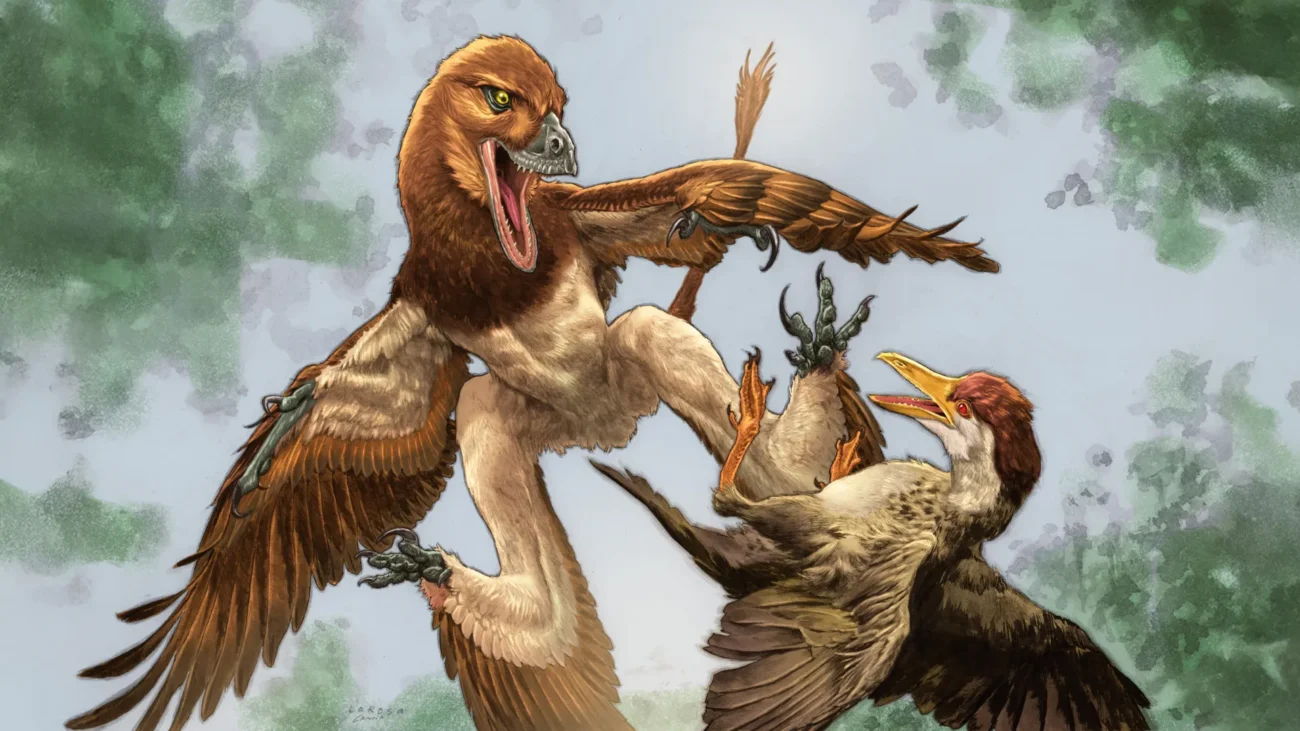
In the rugged expanse of northwestern China’s Gansu province, the Changma Basin has long stood as a treasure trove for paleontologists studying the early evolution of birds. For decades, researchers working in this fossil-rich sedimentary basin have recovered hundreds of prehistoric avian remains, offering a remarkably clear window into the Cretaceous period. Yet, despite the sheer abundance of bird fossils, a lingering enigma has baffled the scientific community: numerous excavations revealed clusters of shattered, compressed bird bones arranged in pellet-like masses strikingly similar to the regurgitated pellets produced by modern owls. For years, scientists strongly suspected that a larger, opportunistic carnivore was actively hunting these ancient birds, but the absence of direct skeletal evidence left the identity of the apex predator a frustrating mystery.
That long-standing scientific gap has finally begun to close. In a study recently published in the Annals of Carnegie Museum, an international team of paleontologists has unveiled a previously unknown dinosaur species unearthed from the very same fossil beds. Named Jian changmaensis, this newly described creature was a feathered, predatory relative of the famous Velociraptor. Sporting long, elaborate feathers on both its forelimbs and hind limbs, and displaying distinctive anatomical adaptations in its arm and shoulder bones, the dinosaur is now considered by researchers to be the prime suspect behind the mysterious, compressed bird bone accumulations discovered across the site.
The discovery not only offers a compelling solution to a paleoecological whodunit but also sheds vital light on the complex predator-prey dynamics of Cretaceous ecosystems, enriching our broader understanding of how early birds coexisted with their fiercely competitive, non-avian dinosaur cousins.
Chronology of Discovery: From Mysterious Pellets to a New Species
The unraveling of the Changma Basin mystery spans years of meticulous fieldwork and laboratory analysis. The site itself first drew international attention due to its exceptional concentration of fossilized birds, primarily belonging to enantiornithes, an extinct group of diverse, toothed flying birds that dominated the Cretaceous skies. As researchers collected and cataloged more than a hundred avian specimens over successive field seasons, they repeatedly encountered anomalous clusters of broken bones. These compressed fossilized masses bore all the structural hallmarks of raptor pellets—indigested bone fragments compacted by a predatory digestive tract and regurgitated.
Despite the frequency of these pellet-like formations, the identity of the regurgitating predator remained entirely speculative. The overwhelming majority of vertebrate fossils recovered from the Changma site were avian; non-avian dinosaur remains were glaringly absent. Without physical fossils of a terrestrial carnivore preserved alongside the birds, researchers could only hypothesize about the top of the local food web.
The turning point arrived when paleontologists unearthing material from the horizon discovered a single, highly significant non-avian dinosaur specimen. Subsequent preparation, anatomical comparison, and phylogenetic analysis confirmed that the bones belonged to an entirely new species of dromaeosaurid. The findings were officially documented in the Annals of Carnegie Museum by a collaborative team of researchers representing institutions such as the Field Museum in Chicago, the Carnegie Museum of Natural History, the Gansu Geological Museum, the University of Nebraska State Museum, the Institute of Vertebrate Paleontology and Paleoanthropology of the Chinese Academy of Sciences, and Gansu Agricultural University.
Anatomy and Morphology: A Feathered Glider of Unusual Proportions
The newly identified Jian changmaensis belongs to a specialized subgroup of dromaeosaurs known as microraptors. Typically, microraptors are characterized by their diminutive stature; many previously discovered species from equivalent geological formations in China were remarkably small, often scaling down to the size of a modern crow. However, Jian breaks the mold by representing one of the largest microraptor specimens ever documented in the paleontological record.
Although excavation yielded only a partial skeleton—highlighted notably by a well-preserved upper arm bone measuring approximately four inches in length—researchers were able to reconstruct the animal’s approximate dimensions with a high degree of confidence. Comparative skeletal scaling indicates that the entire dinosaur possessed an estimated wingspan of roughly four feet, placing it on par with a modern barn owl.
True to its dromaeosaur heritage, Jian was fully feathered. Based on the anatomical configuration of closely related microraptors, scientists believe the animal featured long, asymmetrical feathers covering not only its arms but also its legs, creating a distinctive four-winged silhouette. Biomechanical analyses of similar four-winged dromaeosaurs suggest that these creatures were not adapted for powered, flapping flight in the manner of modern birds. Instead, their morphology was ideally suited for arboreal life and aerial locomotion through gliding, allowing them to traverse forest canopies and ambush prey much like a modern flying squirrel.
The nomenclature of the newly minted species pays homage to both its physical nature and its geographical provenance. In traditional Chinese mythology, Jian is conceptualized as a legendary winged creature that requires a pair working in unison to fly, a fitting moniker for a four-winged gliding predator. The specific epithet, changmaensis, honors the Changma Basin in Gansu province, cementing the region’s pivotal status in vertebrate paleontology.
Expert Insights and Official Reactions
The discovery has generated substantial excitement within the global paleontological community, offering unprecedented clarity regarding an otherwise opaque ancient ecosystem.
Jingmai O’Connor, associate curator of fossil reptiles at the Field Museum in Chicago and senior author of the descriptive study, emphasized the uniqueness of the find within the context of the Changma fossil bed. "Scientists have found these weird, broken-up clusters of bird bones at this site, and we didn’t know what made them. This new microraptor dinosaur, Jian changmaensis, is our best guess," O’Connor remarked. Highlighting its ecological dominance at the locality, she added, "It’s the only dinosaur found at this site that wasn’t a bird, it was a carnivore, and it was much bigger than everything else that we’ve found there."
Matt Lamanna, the Mary R. Dawson Curator of Vertebrate Paleontology at the Carnegie Museum of Natural History, corresponding author of the study, and a senior dinosaur researcher, underscored how the discovery bridges a major gap in the local fossil record. "Jian changmaensis reveals that non-avian dinosaurs lived in what is now the Changma Basin, an area famous for its fossil birds," Lamanna stated. "Our team has recovered more than a hundred bird fossils at Changma, but only this single non-avian dinosaur specimen. Jian provides critical new insight into the biological history of the Changma region and the ecological context of the ancestors of today’s birds."
Broader Ecological Implications and Evolutionary Context
To fully appreciate the significance of Jian changmaensis, researchers emphasize the necessity of looking at the broader evolutionary tapestry of the Mesozoic Era. Modern birds—the avian dinosaurs—stand as the sole surviving lineage of a once-vast dinosaurian radiation, having managed to endure the catastrophic mass extinction event triggered by an asteroid impact at the close of the Cretaceous period 66 million years ago.
Long before that cataclysmic event, however, early birds shared terrestrial and aerial niches with a bewildering array of non-avian dinosaur groups, ranging from titanic sauropods to agile, feathered theropods like the dromaeosaurs. Popularized in modern culture by cinematic franchises such as Jurassic Park—though frequently portrayed with cinematic embellishments rather than their actual, fully feathered and smaller biological realities—dromaeosaurs were sophisticated, highly adapted predators.
The revelation that a large microraptor like Jian was actively hunting and consuming birds in the Changma ecosystem provides a concrete example of the complex trophic interactions that shaped early avian evolution. Predation pressure from agile, feathered carnivores like Jian likely played a profound evolutionary role, driving adaptations in early flight mechanics, flocking behaviors, nesting strategies, and sensory capabilities among prehistoric birds.
Furthermore, analyzing creatures like Jian helps scientists dissect the specific physiological and ecological traits that ultimately insulated the surviving avian lineage against global environmental collapse while dooming their non-avian counterparts. As O’Connor noted, understanding the origins of modern biological success requires rigorous examination of ancestral lineages. "You cannot understand life on the planet today without looking at its origins," she observed. "Birds are arguably the most successful group of land-dwelling vertebrate animals on Earth today. Learning about early birds and their close non-bird dinosaur relatives gives us a better understanding of what made the group of birds that survived so special."
As ongoing fieldwork in northwestern China and other fossil-rich basins continues to yield new specimens, paleontologists remain optimistic that further discoveries will flesh out the intricate relationships of the Cretaceous world. For now, Jian changmaensis stands as a formidable addition to the fossil record—a four-winged predator that finally brings a long-standing ecological mystery into sharp, illuminating focus.

