


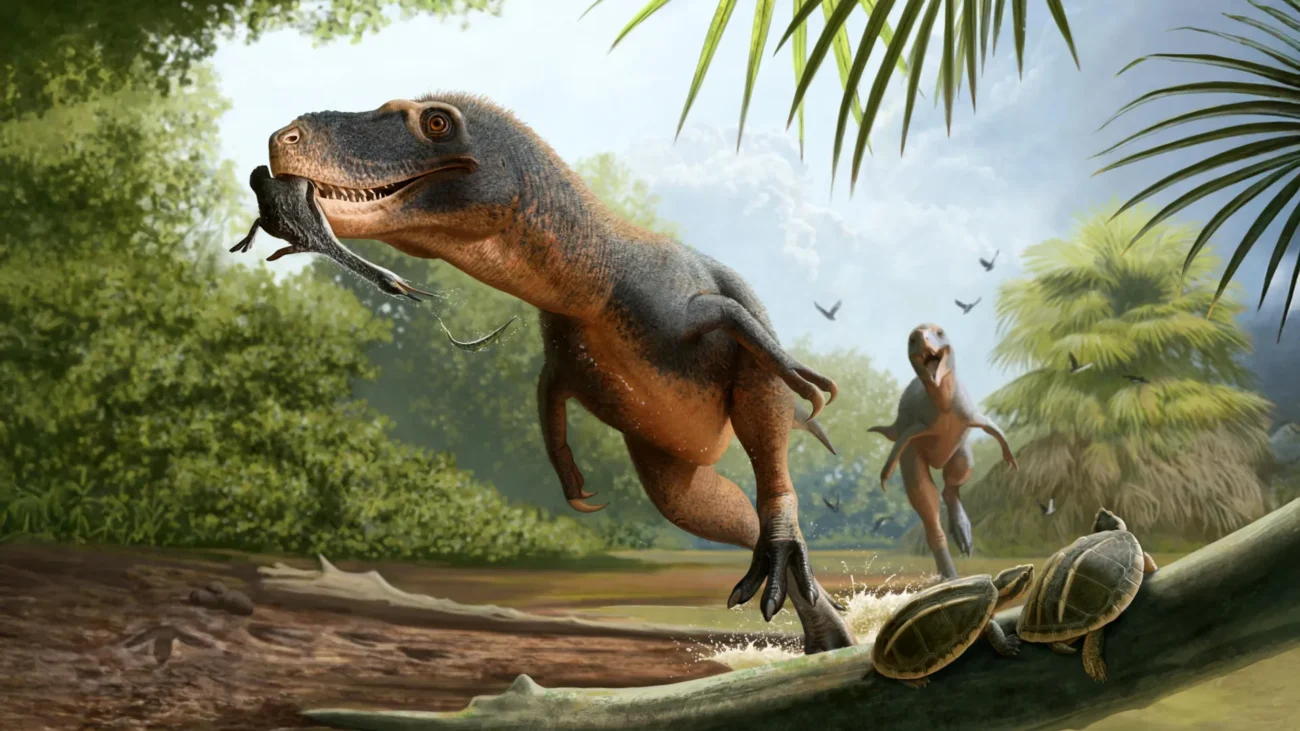
Approximately 66 million years ago, a massive apex predator—likely a Tyrannosaurus rex or a closely related Nanotyrannus—stalked the floodplains of what is now northeastern Montana. In the twilight hours of the Cretaceous Period, this formidable carnivore consumed an unsuspecting meal: a small, diving aquatic bird. While the predator long ago turned to dust, a remarkably resilient piece of evidence survived the aeons. Through an extraordinary stroke of geological fortune, the bird’s feathers, scales, and skeletal fragments were preserved inside a fossilized deposit of dinosaur dung, known scientifically as a coprolite.
Reported in the journal Current Biology, this discovery yields what paleontologists describe as the finest, most pristine feather specimens ever recovered from the Mesozoic Era. Beyond offering an unprecedented glimpse into a prehistoric predator-prey interaction, the microscopic examination of these feathers has unlocked a vital clue regarding one of the greatest evolutionary mysteries in Earth’s history: why modern birds managed to survive the cataclysmic asteroid impact that wiped out all other non-avian dinosaurs.
A Detective Story in the Badlands of Montana
The remarkable journey of this fossil began in 2016 during routine fieldwork in the Hell Creek Formation of Montana. David DeMar, Jr., a research scientist and Hell Creek Project collections manager at the University of Washington Burke Museum, was scouring a rocky outcrop for microfossils, specifically targeting fossilized fish teeth and scales.
Amidst the rugged terrain, an unassuming dark, reddish-brown nodule—roughly half the size of a golf ball—caught DeMar’s eye. Upon picking it up and examining its exterior with a hand lens, he spotted a tiny, delicate structure embedded in the matrix. It was a fossilized feather. Given that no feathers had ever been recovered from the Hell Creek Formation despite more than a century and a half of intensive geological prospecting, DeMar approached the find with cautious optimism.
Back in the laboratory, the interdisciplinary research team subjected the nodule to rigorous geochemical analysis and high-resolution computed tomography (CT) scanning. CT imaging allows scientists to non-destructively peer inside dense geological formations by digitally stitching together thousands of individual X-ray slices into a comprehensive three-dimensional rendering.
Nate Carroll, a co-author of the study and a paleontologist at the Carter County Museum in Ekalaka, Montana, noted the transformative nature of the scanning process. Although he had spent years analyzing delicate feathers preserved in Burmese amber, finding them locked within an ordinary-looking rock presented a novel challenge. Once the specimen was placed inside the micro-CT scanner at the University of Southern California’s medical campus, the hidden contents came into sharp focus. Hour by hour, data processing revealed an intricate matrix of well-preserved feathers, gar fish scales, and avian leg bones in stunning three-dimensional detail.
The Anatomy of an Ancient Meal
By analyzing the fossilized remains contained within the coprolite, the researchers successfully reconstructed the identity of the prey. The bones and associated plumage belonged to a hesperornithiform, an extinct lineage of specialized aquatic diving birds ecologically analogous to modern loons.
Hesperornithiforms were flightless or nearly flightless, utilizing powerful, specialized feet to propel themselves through ancient waterways in pursuit of fish. While they shared common ancestry with the lineage that ultimately gave rise to modern birds, hesperornithiforms belonged to a distinct evolutionary branch that populated the Cretaceous landscape alongside other diverse avian groups, such as the enantiornithines.
Crucially, the feathers found inside the coprolite belonged to this hesperornithiform. This provided scientists with their very first opportunity to study the plumage architecture of this specific bird group. The microscopic and structural analysis revealed an intermediate stage of feather evolution: the plumage displayed advanced, waterproof characteristics akin to modern diving birds, yet retained primitive, fuzzy, down-like body structures traditionally associated with non-avian dinosaurs and enantiornithines.
The Cretaceous-Paleogene Extinction Event: A Timeline of Catastrophe
To understand the broader implications of the Montana discovery, paleontologists must contextualize it within the timeline of the Cretaceous-Paleogene (K-Pg) boundary.
Roughly 150 million years ago, during the late Jurassic Period, the earliest known bird relative—Archaeopteryx—made its appearance in the fossil record. Over the ensuing 100 million years, avian species underwent a massive adaptive radiation. They coexisted, competed, and evolved alongside towering sauropods, horned ceratopsians, and ferocious theropods. Throughout this extended epoch, multiple distinct bird lineages branched out across global ecosystems.
This ecological balance was shattered abruptly 66 million years ago. A massive asteroid, estimated to be roughly 10 kilometers in diameter, struck the shallow waters of what is now the Yucatán Peninsula in Mexico, forming the Chicxulub crater. The impact released energy equivalent to billions of atomic bombs, triggering a cascade of global catastrophes: massive tsunamis, widespread wildfires, earthquakes, and the ejection of immense volumes of sulfur, dust, and debris into the upper atmosphere.
This atmospheric shroud blocked out solar radiation for years, plunging the planet into a protracted period of severe darkness and global cooling known as an "impact winter." Photosynthesis ground to a halt, collapsing marine and terrestrial food chains. Non-avian dinosaurs vanished entirely, taking with them the vast majority of Mesozoic bird lineages, including the enantiornithines and the hesperornithiforms.
Amidst this global devastation, a single specialized branch of the avian family tree managed to endure: the Neornithes. This group ultimately diversified to produce every modern bird species seen soaring through contemporary skies.
Challenging the Aquatic Survival Hypothesis
For decades, paleontologists have debated the precise mechanisms that allowed Neornithes to survive the K-Pg extinction while every other dinosaur lineage perished. One prominent hypothesis posited that ecological habitat played the decisive role. Because many Neornithes ancestors lived in aquatic or semi-aquatic environments, researchers theorized that freshwater and marine ecosystems might have buffered these species from the immediate thermal shock and food shortages on land.
However, the discovery of the hesperornithiform feathers complicates this straightforward environmental explanation. Hesperornithiforms were obligate aquatic organisms that spent their lives swimming and diving in the same freshwater and coastal habitats frequented by early Neornithes ancestors. Despite living in these supposedly protective aquatic niches, the hesperornithiform lineage still went extinct.
This contradiction suggests that geographic habitat alone cannot account for the selective survival of modern birds. Scientists must look closer at intrinsic biological traits—specifically, physiology and integumentary systems.
Plumage Efficiency and the Impact Winter
Led by Jingmai O’Connor, associate curator of fossil reptiles at the Field Museum in Chicago and lead author of the study, the research team proposes that the structure of avian feathers and the physiological mechanisms of molting may have been the underlying drivers of differential survival.
As revealed by the CT scans, the hesperornithiform retained primitive, fuzzy body feathers alongside its more modern, waterproof flight and contour plumage. While these primitive downy feathers provided adequate insulation under normal climatic conditions, they likely lacked the thermal efficiency of the advanced, tightly interlocking plumaceous feathers possessed by early Neornithes.
When the asteroid impact plunged the Earth into the freezing darkness of the impact winter, ambient temperatures plummeted globally. Birds possessing superior thermal insulation would have had a significantly higher metabolic advantage, conserving vital energy while foraging for scarce resources in a chilling landscape. Conversely, species burdened with less efficient, primitive insulation would have struggled to maintain core body temperatures, succumbing to the harsh environmental pressures.
Furthermore, O’Connor notes that the physiological process of how birds shed and replace their feathers—known as molting—could have played a critical role. Rapid or poorly timed molting cycles could have compromised an animal’s flight capabilities or thermal protection precisely when survival margins were razor-thin.
A New Methodological Frontier in Paleontology
Beyond its evolutionary implications, the study represents a technical milestone for vertebrate paleontology. Historically, researchers relied almost exclusively on exceptionally rare Lagerstätten—geological deposits characterized by exquisite preservation of soft tissues—such as the famous fossil beds of Liaoning in China or amber inclusions from Myanmar.
Coprolites, by contrast, are frequently overlooked in paleontological assessments, often dismissed as amorphous mineral lumps. This discovery demonstrates that fossilized feces can act as extraordinary biological time capsules. Digestive acids do not always destroy microscopic structures; in some anaerobic or chemically favorable environments, they seal and protect delicate items like feathers, hair, and scales from scavenging microorganisms and surface weathering.
Co-author Greg Wilson Mantilla, a professor at the University of Washington and curator of vertebrate paleontology at the Burke Museum, emphasized the rarity and value of such finds. Recovering articulated bird remains is already an extraordinary event; finding pristine feathers within the preserved dung of an apex predator offers a multi-layered view of an ancient trophic web. It illuminates not only the biology of the prey species but also the dietary habits and hunting range of the predator that consumed it.
Implications for Future Research
The successful extraction of high-fidelity biological data from a seemingly mundane rock found in Montana has prompted calls for a systematic reassessment of museum collections worldwide. Thousands of cataloged coprolites sit in institutional archives, largely unexamined by high-resolution internal imaging techniques.
By applying modern non-destructive CT scanning protocols to existing fossilized dung repositories, researchers worldwide may uncover hidden troves of feathers, embryonic bones, soft tissue fragments, and micro-botanical evidence that have remained invisible for decades.
As paleontology embraces these advanced imaging technologies, the chance discovery in the Hell Creek Formation serves as a reminder that major breakthroughs can emerge from the most unorthodox sources. Through a combination of serendipity, modern technology, and rigorous scientific inquiry, researchers have transformed a fossilized piece of dinosaur waste into a vital missing puzzle piece in the history of vertebrate evolution, clarifying how modern birds successfully weathered the darkest chapter in Earth’s history.

